Collaboration strategies in nontraditional community-based participatory research partnerships: lessons from an academic−community partnership with autistic self-advocates
- PMID: 21623016
- PMCID: PMC3319698
- DOI: 10.1353/cpr.2011.0022
Collaboration strategies in nontraditional community-based participatory research partnerships: lessons from an academic−community partnership with autistic self-advocates
Abstract
Background: Most community-based participatory research (CBPR) projects involve local communities defined by race, ethnicity, geography, or occupation. Autistic self-advocates, a geographically dispersed community defined by disability, experience issues in research similar to those expressed by more traditional minorities.
Objectives: We sought to build an academic-community partnership that uses CBPR to improve the lives of people on the autistic spectrum.
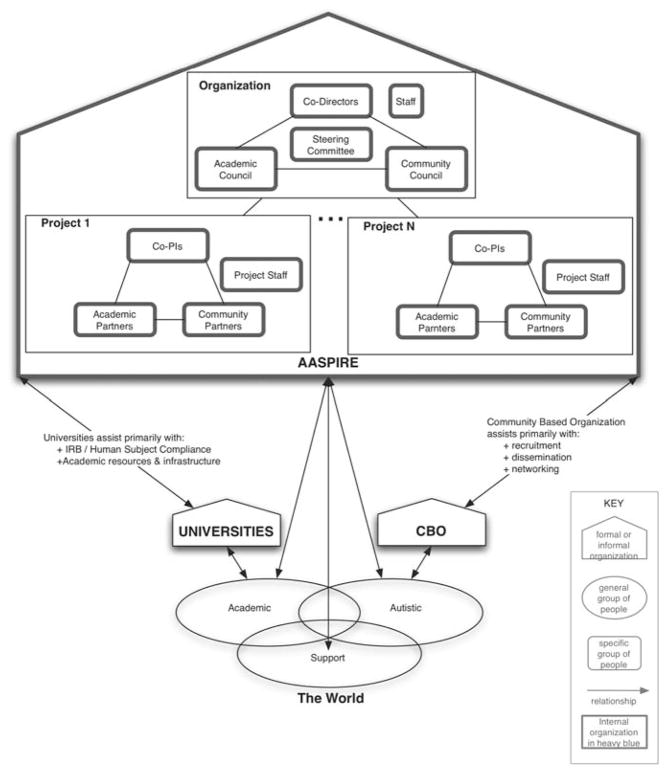
Methods: The Academic Autistic Spectrum Partnership in Research and Education (AASPIRE) includes representatives from academic, self-advocate, family, and professional communities. We are currently conducting several studies about the health care experiences and well-being of autistic adults.
Lessons learned: We have learned a number of strategies that integrate technology and process to successfully equalize power and accommodate diverse communication and collaboration needs.
Conclusions: CBPR can be conducted successfully with autistic self-advocates. Our strategies may be useful to other CBPR partnerships, especially ones that cannot meet in person or that include people with diverse communication needs.
Figures
References
-
- Pearson H. Autistic brains may daydream less. [cited 2010 Sep 6]. Available from: http://www.nature.com/news/2006/060508/full/news060508-3.html.
-
- Raymaker D. Review of “Daydreaming” paper. Asperger Syndrome Livejournal Community; 2006.
-
- Israel BA, Schulz AJ, Parker EA, Becker AB. Review of community-based research: assessing partnership approaches to improve public health. Annu Rev Public Health. 1998;19:173–202. - PubMed
Publication types
MeSH terms
Grants and funding
LinkOut - more resources
Full Text Sources