


Increased interleukin-4-positive lymphocytes in patients with Hashimoto's thyroiditis and concurrent non-endocrine autoimmune disorders
- PMID: 21623768
- PMCID: PMC3142639
- DOI: 10.1111/j.1365-2249.2011.04419.x
Increased interleukin-4-positive lymphocytes in patients with Hashimoto's thyroiditis and concurrent non-endocrine autoimmune disorders
Abstract
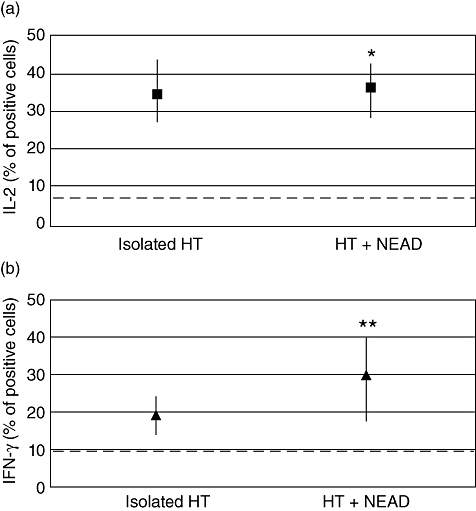
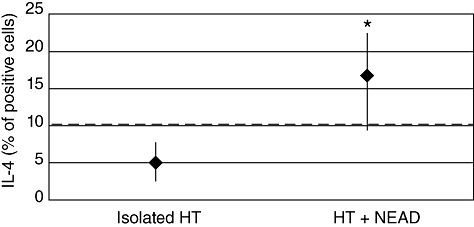
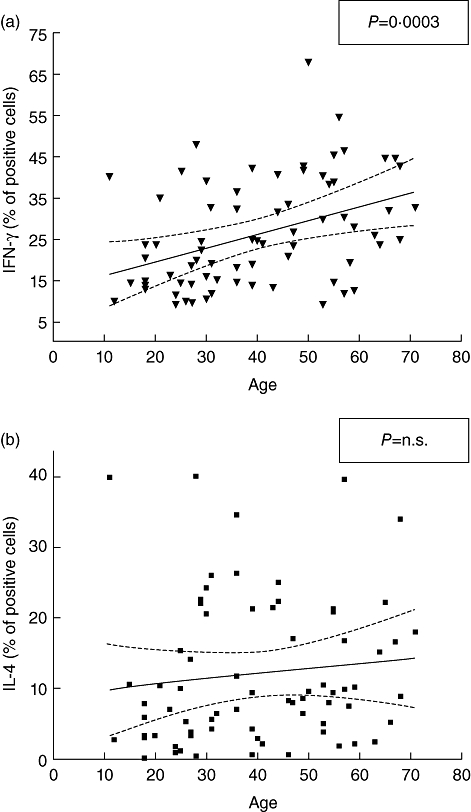
A prevalent T helper type 1 (Th1) subset of lymphocytes has been described in Hashimoto's thyroiditis (HT), but whether a similar polarization may characterize HT when associated with non-endocrine autoimmune disorders (NEAD) is not known. The aim of the present study was to analyse the intracellular Th1 and Th2 distinctive cytokines in patients with isolated HT or associated with non-endocrine autoimmune disorders. Intracellular cytokine expression was assessed in peripheral blood lymphocytes (PBL) of 68 out-patients (females = 55; males = 13; median age = 6 years) with HT : 33 had isolated HT and 35 had a concurrent NEAD. The percentage of interferon (IFN)-γ and interleukin (IL)-2 Th1- and IL-4 Th2-positive cells was measured by flow cytometric analysis. We found an increased percentage of IL-2-positive cells in all patients, without differences between patients with isolated HT or associated with NEAD. IFN-γ(+) cells were also increased in both groups, but the median percentage of those with isolated HT was lower than in patients with HT+NEAD (19·0 versus 29·9%; P = 0·0082). An increased number of IL-4-positive cells was observed in three of 33 (9·1%) patients with isolated HT and in 25 of 35 patients with NEAD [71%; P < 0·0001; relative risk (RR) = 3·18]. The median values of IL-4(+) cells (HT = 5·0% versus HT + NEAD = 16·8%) confirmed this large difference (P < 0·0001). A clear-cut increase of IL-4(+) lymphocytes characterizes patients with autoimmune thyroiditis who have associated non-endocrine autoimmune disorders. These findings may represent an initial tool to detect patients with autoimmune thyroiditis in which additional non-endocrine autoimmune disorders may be awaited.
© 2011 The Authors. Clinical and Experimental Immunology © 2011 British Society for Immunology.
Figures
References
-
- Eisenbarth GS, Gottlieb PA. Medical progress: autoimmune polyendocrine syndromes. N Engl J Med. 2004;350:2068–79. - PubMed
-
- Kahaly GJ. Polyglandular autoimmune syndromes. Eur J Endocrinol. 2009;161:11–20. - PubMed
-
- Weetman AP. Association of autoimmune thyroiditis with other autoimmune diseases. Hot Thyroidology.com. 2004 n.1.
-
- Betterle C, Dal Pra C, Mantero F, Zanchetta R. Autoimmune adrenal insufficiency and autoimmune polyendocrine syndromes: autoantibodies, autoantigens, and their applicability in diagnosis and disease prediction. Endocr Rev. 2002;23:327–64. - PubMed
Publication types
MeSH terms
Substances
LinkOut - more resources
Full Text Sources
Medical
