. 2011;6(5):e19949.
doi: 10.1371/journal.pone.0019949. Epub 2011 May 20.

Major-effect alleles at relatively few loci underlie distinct vernalization and flowering variation in Arabidopsis accessions

Affiliations

Major-effect alleles at relatively few loci underlie distinct vernalization and flowering variation in Arabidopsis accessions

Amy Strange et al. PLoS One. 2011.

Abstract

We have explored the genetic basis of variation in vernalization requirement and response in Arabidopsis accessions, selected on the basis of their phenotypic distinctiveness. Phenotyping of F2 populations in different environments, plus fine mapping, indicated possible causative genes. Our data support the identification of FRI and FLC as candidates for the major-effect QTL underlying variation in vernalization response, and identify a weak FLC allele, caused by a Mutator-like transposon, contributing to flowering time variation in two N. American accessions. They also reveal a number of additional QTL that contribute to flowering time variation after saturating vernalization. One of these was the result of expression variation at the FT locus. Overall, our data suggest that distinct phenotypic variation in the vernalization and flowering response of Arabidopsis accessions is accounted for by variation that has arisen independently at relatively few major-effect loci.


Conflict of interest statement

Competing Interests: The study was partly funded by DuPont. MN is an employee of Gregor Mendel Institute of Molecular Plant Biology GmbH. There are no patents, products in development or marketed products to declare. This does not alter the authors' adherence to all the PLoS ONE policies on sharing data and materials, as detailed online in the guidelines for authors.

Figures

Figure 1
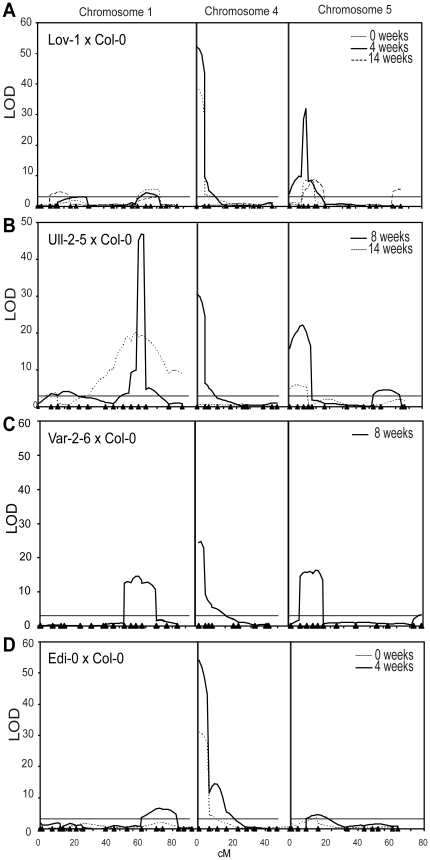
Figure 1. QTL analysis for variation in vernalization response.
Composite interval mapping was used to identify genes contributing to the variation in vernalization response after treatment of Arabidopsis populations with different lengths of cold. (A) Lov-1 × Col-0, (B) Ull-2-5 × Col-0, (C) Var-2-6 × Col-0 and (D) Edi-0 × Col-0. Each chromosome with significant QTL (chromosome 1, 4 and 5) is shown separately and the positions (in cM) of the markers used are indicated as triangles. LOD (Logarithm of odds) scores were calculated by QTL Cartographer with a 5 % significance threshold (shown as dashed lines) determined from a 1000 permutation test. For (B) Ull-2-5 x Col this resulted in a high threshold due to segregation distortion, which is widespread in this cross (Figure S2). Each chromosome was tested individually and chromosome 3 identified as the cause of the high threshold. The permutation analysis was then performed excluding chromosome 3.
Figure 2
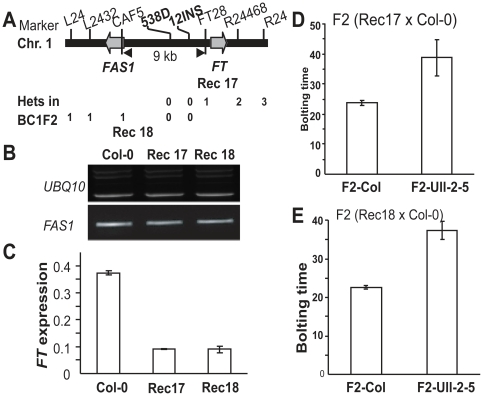
Figure 2. Fine-mapping and allelic analysis of the QTL on chromosome 1.
(A) Fine-mapping of the QTL – the later flowering time variation co-segregated with marker 538D and 12INS. (B) FAS1 expression in Col-0 and two recombinants plants Rec17 and Rec18. (C) FT expression in Col-0, Rec17 and Rec18. FT expression level was normalized to UBC. (D and E) Segregation analysis of the F2 population obtained from Rec17 (D) and Rec18 (E) crossed to Col-0 respectively. Error bars in (B) and (C) show S. D. from three experimental replicates, in (D) and (E) shows S. D. of at least 20 individuals.
Figure 3
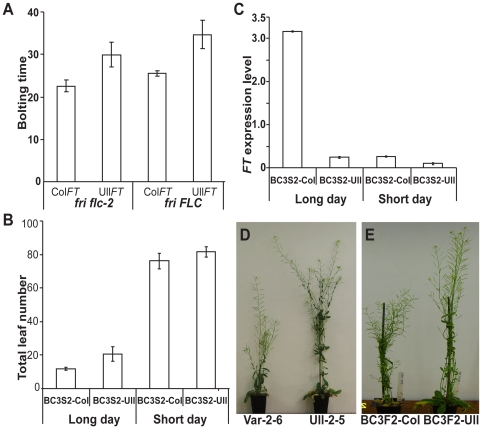
Figure 3. Functional analysis of the Ull-2-5 FT allele using backcrossed populations.
(A) Comparison of the contribution of Ull-2-5 and Col-0 FT alleles to flowering time with or without a functional FLC. (B) Comparison of flowering time between BC3S2-Ull and BC3S2-Col in long and short day growth conditions. (C) FT expression of Col-0 and Ull-2-5 alleles in response to different day lengths (D) Final size of plants vernalized for 10 weeks and then grown in a greenhouse. (E) Plant size of BC3S2-Col (left) and BC3S2-Ull (right) in long day growth condition. Error bars in (A) show S. D. of 20 individual plants, in (B) and (C) they show S. D. from three experimental replicates.
Figure 4
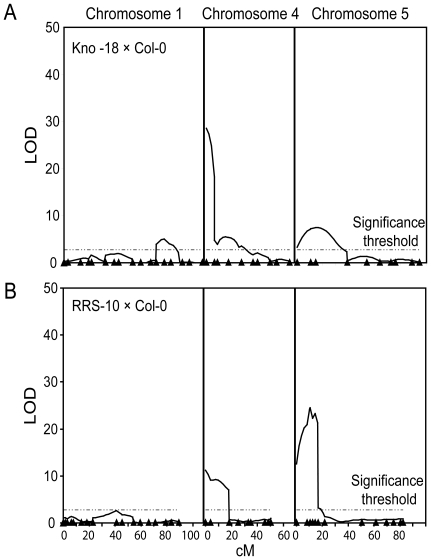
Figure 4. QTL analysis of vernalization requirement and response in two accessions from N. America.
QTL were found on chromosome 1, 4, and 5 (chromosomes 2 and 3 not shown). Dashed line shows 5 % significance threshold, as calculated from a 1000 permutation test. The positions (in cM) of the markers used are indicated as triangles. (A) KNO-18 × Col F2 population scored for flowering time without vernalization. (B) RRS-10 × Col F2 population scored for flowering time after 8 weeks of vernalization.
Figure 5
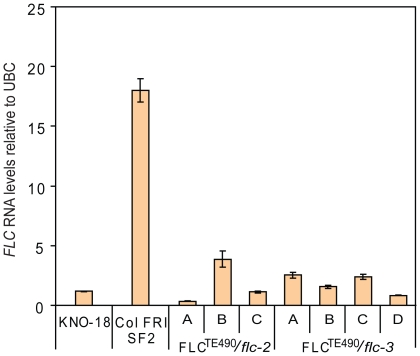
Figure 5. FLC expression level of Col FRI flc lines containing FLCTE490 compared to controls.
FLC RNA levels measured by qRT-PCR and normalised to UBC. Error bars show standard error from three experimental replicates.

References

    1. Chan YF, Marks ME, Jones FC, Villarreal G, Shapiro MD, et al. Adaptive evolution of pelvic reduction in sticklebacks by recurrent deletion of a Pitx1 enhancer. Science. 2010;327:302–305. - PMC - PubMed
    1. Simpson GG, Dean C. Arabidopsis, the Rosetta stone of flowering time? Science. 2002;296:285–289. - PubMed
    1. Johanson U, West J, Lister C, Michaels S, Amasino R, et al. Molecular analysis of FRIGIDA, a major determinant of natural variation in Arabidopsis flowering time. Science. 2000;290:344–347. - PubMed
    1. El-Assal S-E, Alonso-Blanco C, Peeters AJ, Raz V, Koornneef M. A QTL for flowering time in Arabidopsis reveals a novel allele of CRY2. Nat Genet. 2001;29:435–440. - PubMed
    1. Loudet O, Chaillou S, Camilleri C, Bouchez D, Daniel-Vedele F. Bay-0 x Shahdara recombinant inbred line population: a powerful tool for the genetic dissection of complex traits in Arabidopsis. Theor Appl Genet. 2002;104:1173–1184. - PubMed

Publication types