NSAID gastropathy and enteropathy: distinct pathogenesis likely necessitates distinct prevention strategies
- PMID: 21627632
- PMCID: PMC3252967
- DOI: 10.1111/j.1476-5381.2011.01509.x
NSAID gastropathy and enteropathy: distinct pathogenesis likely necessitates distinct prevention strategies
Abstract
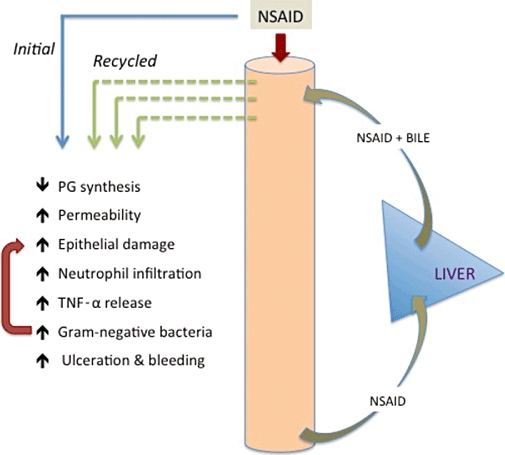
The mechanisms underlying the ability of nonsteroidal anti-inflammatory drugs (NSAIDs) to cause ulceration in the stomach and proximal duodenum are well understood, and this injury can largely be prevented through suppression of gastric acid secretion (mainly with proton pump inhibitors). In contrast, the pathogenesis of small intestinal injury induced by NSAIDs is less well understood, involving more complex mechanisms than those in the stomach and proximal duodenum. There is clear evidence for important contributions to NSAID enteropathy of enteric bacteria, bile and enterohepatic recirculation of the NSAID. There is no evidence that suppression of gastric acid secretion will reduce the incidence or severity of NSAID enteropathy. Indeed, clinical data suggest little, if any, benefit. Animal studies suggest a significant exacerbation of NSAID enteropathy when proton pump inhibitors are co-administered with the NSAID. This worsening of damage appears to be linked to changes in the number and types of bacteria in the small intestine during proton pump inhibitor therapy. The distinct mechanisms of NSAID-induced injury in the stomach/proximal duodenum versus the more distal small intestine likely dictate distinct strategies for prevention.
© 2011 The Author. British Journal of Pharmacology © 2011 The British Pharmacological Society.
Figures
References
-
- Andrews FJ, Malcontenti-Wilson C, O'Brien PE. Effect of nonsteroidal anti-inflammatory drugs on LFA-1 and ICAM-1 expression in gastric mucosa. Am J Physiol Gastrointest Liver Physiol. 1994;266:G657–G664. - PubMed
-
- Antoon JS, Perry MA. Role of neutrophils and mast cells in acute indomethacin-induced small bowel injury in the rat. J Gastroenterol. 1997;32:747–757. - PubMed
-
- Appleyard CB, McCafferty DM, Tigley AW, Swain MG, Wallace JL. Tumor necrosis factor mediation of NSAID-induced gastric damage: role of leukocyte adherence. Am J Physiol. 1996;270:G42–G48. - PubMed
-
- Asako H, Kubes P, Wallace J, Gaginella T, Wolf RE, Granger DN. Indomethacin-induced leukocyte adhesion in mesenteric venules: role of lipoxygenase products. Am J Physiol Gastrointest Liver Physiol. 1992a;262:G903–G908. - PubMed
-
- Asako H, Kubes P, Wallace J, Wolf RE, Granger DN. Modulation of leukocyte adhesion in rat mesenteric venules by aspirin and salicylate. Gastroenterology. 1992b;103:146–152. - PubMed
Publication types
MeSH terms
Substances
Grants and funding
LinkOut - more resources
Full Text Sources
Medical