. 2011 Jul 1;333(6038):97-101.
doi: 10.1126/science.1205292. Epub 2011 May 31.

Recombinant origin of the retrovirus XMRV

Affiliations

Recombinant origin of the retrovirus XMRV

Tobias Paprotka et al. Science. .

Abstract

The retrovirus XMRV (xenotropic murine leukemia virus-related virus) has been detected in human prostate tumors and in blood samples from patients with chronic fatigue syndrome, but these findings have not been replicated. We hypothesized that an understanding of when and how XMRV first arose might help explain the discrepant results. We studied human prostate cancer cell lines CWR22Rv1 and CWR-R1, which produce XMRV virtually identical to the viruses recently found in patient samples, as well as their progenitor human prostate tumor xenograft (CWR22) that had been passaged in mice. We detected XMRV infection in the two cell lines and in the later passage xenografts, but not in the early passages. In particular, we found that the host mice contained two proviruses, PreXMRV-1 and PreXMRV-2, which share 99.92% identity with XMRV over >3.2-kilobase stretches of their genomes. We conclude that XMRV was not present in the original CWR22 tumor but was generated by recombination of two proviruses during tumor passaging in mice. The probability that an identical recombinant was generated independently is negligible (~10(-12)); our results suggest that the association of XMRV with human disease is due to contamination of human samples with virus originating from this recombination event.


Figures
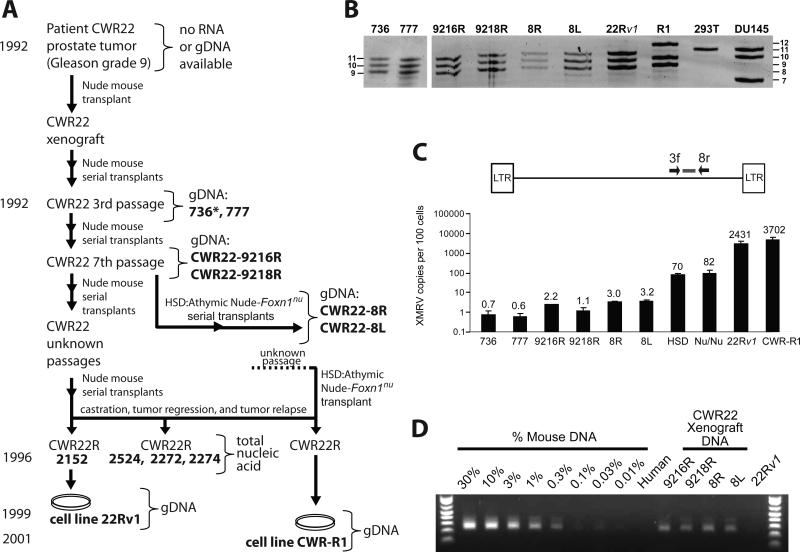
Fig. 1
Fig. 1
Characterization of CWR22 xenografts and XMRV-related sequences. (A) Genesis of 22Rv1 and CWR-R1 cell lines. Bold letters indicate samples from which genomic DNA (gDNA) or total nucleic acid was available for analysis. XMRV-positive samples are boxed. *, unknown early passage. (B) Short tandem repeat (STR) analysis. Representative D7S280 allele pattern of xenografts, 22Rv1 and CWR-R1 cell lines, along with analysis of six additional loci (Fig. S1). An allelic ladder is shown on left and right of gel. (C) Quantitative real-time PCR to detect XMRV env sequences. Calculated copies/100 cells are indicated above each bar. (D) IAP assay to quantitate the amount of mouse DNA present in the xenograft gDNAs.
Fig. 2
Fig. 2
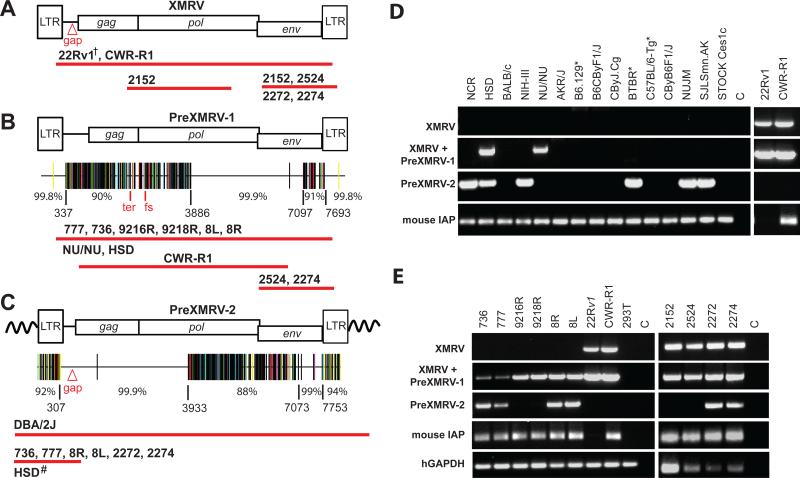
PCR and sequencing analysis of XMRV and XMRV-related sequences from xenografts, cell lines, and nude mouse strains. Using specific primer sets (Fig. S2), cloned PCR products from the xenografts, 22Rv1, CWR-R1, or mouse strains were sequenced. Approximate length and location of sequences determined from samples that were positive for XMRV (A), PreXMRV-1 (B) and PreXMRV-2 (C) are shown as red bars beneath each provirus. Details of primers and numbers of cloned products sequenced are shown in Figs. S2 and S3. Hypermut plots (see Fig. S3 for details), which indicate nucleotide mismatches relative to XMRV as color-coded vertical lines, are shown for PreXMRV-1 (B) and PreXMRV-2 (C), together with the percent identity to consensus XMRV for different regions of each provirus (nucleotide numbers refer to the 22Rv1 XMRV sequence [FN692043]). PreXMRV-1 has a 16-nt deletion (Δ16) in gag and a frameshift (fs) in pol making it replication defective while PreXMRV-2 gag, pol, and env reading frames are open. Mouse strains (D) and xenograft and PC cell lines (E) were analyzed by PCR for the presence of XMRV, PreXMRV-1 and PreXMRV-2. Mouse IAP and human GAPDH serve as positive controls for the presence of mouse and human DNA, respectively. For both (D) and (E) the primer set used to detect PreXMRV-1 can also detect XMRV. For ease of comparison, the 22Rv1 and CWR-R1 gel lanes from (E), which were run in parallel, are duplicated in (D). DNAs in (D) and (E) were all amplified with the same PCR primer master mix. †We previously determined the full-length sequence of XMRV from 22Rv1 cells (8). Δgap refers to the 24-bp deletion in the gag leader characteristic of XMRV. All mouse strains shown in (D) are nudes except for those indicated with *.
Fig. 3
Fig. 3
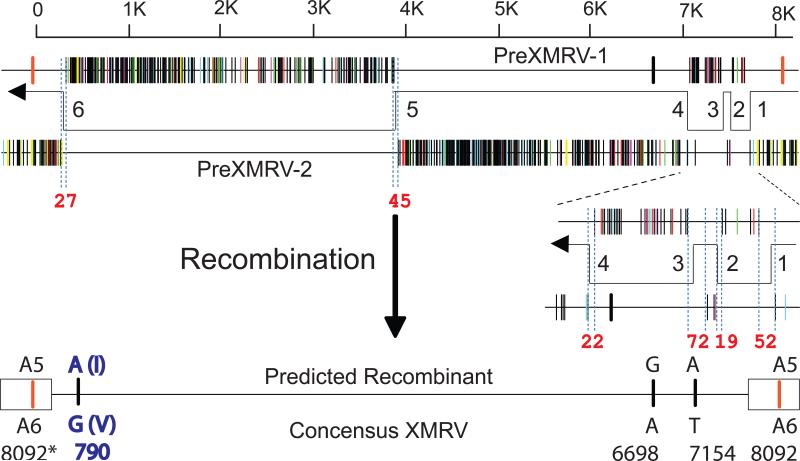
Predicted recombinant between PreXMRV-1 and PreXMRV-2 is nearly identical to XMRV. (A) Alignment of Hypermut plots of PreXMRV-1 and PreXMRV-2 reveals the reciprocal and largely nonoverlapping regions of near identity to XMRV. The direction of minus-strand DNA synthesis catalyzed by reverse transcriptase, and predicted template switching events (numbered 1-6) are shown. The lengths of nucleotide identity within the presumed template switching regions are indicated in red numbers. The predicted recombinant and the 4 nucleotide differences with consensus XMRV are shown. The nucleotide numbers refer to numbers of the 22Rv1 XMRV (Acc. No. FN692043). Note that nucleotide 8092 is within the U3 region, and is present in both LTRs (boxes). A5 and A6 refer to homopolymeric runs of 5 and 6 adenines, respectively. The A>G change at 790 results in an isoleucine (I) to valine (V) substitution. (B) Phylogenetic tree of all full-length XMRV sequences to date and the predicted recombinant implicates the predicted recombinant as the ancestor of all sequenced XMRV isolates. The tree shown is an enlargement of the XMRV-specific portion of the complete endogenous MLV tree (See Fig. S5A and ref 23).

Comment in

References

    1. Schlaberg R, Choe DJ, Brown KR, Thaker HM, Singh IR. XMRV is present in malignant prostatic epithelium and is associated with prostate cancer, especially high-grade tumors. Proc Natl Acad Sci U S A. 2009;106:16351. - PMC - PubMed
    1. Urisman A, et al. Identification of a novel Gammaretrovirus in prostate tumors of patients homozygous for R462Q RNASEL variant. PLoS Pathog. 2006;2:e25. - PMC - PubMed
    1. Lombardi VC, et al. Detection of an infectious retrovirus, XMRV, in blood cells of patients with chronic fatigue syndrome. Science. 2009;326:585. - PubMed
    1. Van der Kuyl AC, Cornelissen M, Berkhout B. Of mice and men: on the origin of XMRV. Frontiers in Microbiology. 2011;1 - PMC - PubMed
    1. Weiss RA. A cautionary tale of virus and disease. BMC Biol. 2010;8:124. - PMC - PubMed

Publication types

MeSH terms