. 2011 Jul 21;118(3):786-94.
doi: 10.1182/blood-2010-11-321406. Epub 2011 May 31.

Adam17-dependent shedding limits early neutrophil influx but does not alter early monocyte recruitment to inflammatory sites

Affiliations

Adam17-dependent shedding limits early neutrophil influx but does not alter early monocyte recruitment to inflammatory sites

Jingjing Tang et al. Blood. .

Abstract

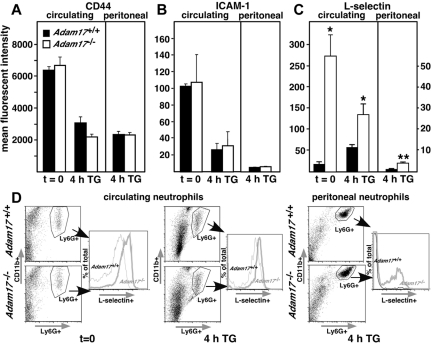
TNF-α-converting enzyme (TACE, herein denoted as Adam17) proteolytically sheds several cell-surface inflammatory proteins, but the physiologic importance of the cleavage of these substrates from leukocyte subsets during inflammation is incompletely understood. In this study, we show that Adam17-null neutrophils have a 2-fold advantage in their initial recruitment during thioglycollate-induced peritonitis, and they roll slower and adhere more readily in the cremaster model than wild-type neutrophils. Although CD44 and ICAM-1 are both in vitro substrates of Adam17, their surface levels are not altered on Adam17-null neutrophils. In contrast, L-selectin levels are elevated up to 10-fold in Adam17-null circulating neutrophils, and their accelerated peritoneal influx, slower rolling, and increased adhesion in the cremaster muscle are dependent on L-selectin. Analysis of mixed chimeras shows that enhanced L-selectin levels and accelerated influx were both cell-intrinsic properties of neutrophils lacking Adam17. In contrast, Adam17-null monocytes display no acceleration of infiltration into the peritoneum in spite of elevated L-selectin surface levels, and their peritoneal influx was independent of L-selectin. Therefore, our data demonstrate substrate and myeloid cell-type specificity of Adam17-mediated cleavage of its substrates, and show that neutrophils and monocytes use distinct mechanisms for infiltration of tissues.


Figures

Figure 1
Figure 1
Neutrophil recruitment is accelerated in Adam17-null hematopoietic chimeras in a model of sterile peritonitis. Neutrophil recruitment was analyzed in the sterile peritonitis model at different time points by evaluation of cell numbers using flow cytometry and an Ly6G antibody to specifically assess neutrophils. Circulating (A) and peritoneal (B) cells were collected (n = 5 per group). Data are representative of 4 experiments, including experiments at additional time points. * P = .02. (C) Mixed chimeras were generated containing 50% each WT (Ly5.1) and Adam17-null (Ly5.2) bone marrow. The relative contribution of Adam17+/+ and Adam17−/− neutrophils to total circulating (unstimulated, t = 0, n = 8) and peritoneal (4 hours after thioglycollate injection, n = 6) were evaluated. *P = .007 and **P = .01 for the change in neutrophil contribution from peritoneal to circulating. Mixed chimeras with different ratios of null and WT were evaluated in 2 other experiments, 1 at 2 hours and 1 at 4 hours after thioglycollate administration, with similar effects observed. All data are expressed as means ± SD.
Figure 2
Figure 2
Among 3 neutrophil adhesion substrates, only cell-surface levels of L-selectin are significantly elevated on Adam17−/− circulating and peritoneal neutrophils. (A-C) Cell-surface levels of Adam17 adhesion substrates CD-44 (A), ICAM-1 (B), and L-selectin (C) were evaluated on circulating and peritoneal neutrophils by flow cytometry. Data are expressed as means ± SD of mean fluorescent intensity. Significant elevation of cell-surface expression of only L-selectin was observed in Adam17−/− chimeras in both circulating and peritoneal neutrophils (*P = .03 and **P < .01, respectively, n = 5 per group). Multiple replicate experiments showed comparable differences. (D) Representative set of scatter plots is shown (left) for circulating and peritoneal neutrophils (evaluated by CD11b and Ly6G staining) with histograms of percentage of L-selectin+ cells from the total Ly6G+-gated population (right). Data are shown at 4 hours after thioglycollate injection and without thioglycollate injection for circulating neutrophils.
Figure 3
Figure 3
A significant decrease in leukocyte rolling velocity and increased adhesion of Adam17−/− leukocytes in vivo may contribute to their accelerated neutrophil emigration in the peritonitis model. (A) To investigate possible mechanisms involved in the accelerated neutrophil influx, leukocyte rolling velocity was analyzed by intravital microscopy of the exteriorized cremaster muscle of Adam17-null and WT chimeras. The cumulative frequency of velocities of rolling leukocytes in Adam17−/− (▵) and Adam17+/+ (●) chimeras demonstrated a significant reduction in rolling velocity in vivo in Adam17-null chimeras (P < .05). Rolling velocities of at least 75 cells per group (n ≥ 4 mice) were measured. (B) Addition of a hydroxamate metalloproteinase inhibitor diminished the rolling velocity in WT chimeras; however, the inhibitor had no effect on rolling velocity of Adam17−/− chimeras. To model the inflammatory response, TNF-α was administered 2 hours before intravital microscopy and the cumulative frequency of leukocyte rolling velocity was determined (C). (D) Leukocyte rolling velocity was also determined for Adam17+/+ and Adam17−/− chimeras in the presence of Fab fragments of L-selectin antibody MEL-14. The presence or absence of L-selectin MEL-14 Fab fragments was also used to analyze the rolling flux fraction (the number of rolling leukocytes as a fraction of total leukocytes flowing through the venule/unit time; *P = .01 relative to Adam17+/+ chimeras and P = .02 relative to Adam17−/− chimeras with MEL-14; E), and adhesion for Adam17+/+ and Adam17−/− chimeras (**P < .0001 relative to all other parameters; F). (G) Leukocyte extravasation was investigated using reflected light oblique transillumination microscopy. Emigrated cells were determined in an area reaching out 75 mm to each side of the vessel over a distance of 100-mm vessel length (***P = .0002). Data in panels B, E, F, and G are expressed as means ± SD.
Figure 4
Figure 4
Although surface levels of L-selectin are elevated on Adam17−/− monocytes relative to WT controls, their recruitment to the peritoneal cavity is not accelerated and L-selectin levels do not change on emigration into the peritoneal cavity. As described in the legend to Figure 1, the sterile peritonitis model was used to study monocytic cell recruitment to the peritoneal cavity. (A) Peritoneal cells were collected at the indicated time points after thioglycollate injection (n = 4-5 per group), as well as resident peritoneal cells without stimulation (t = 0). Individual cell numbers were determined and flow cytometry was performed using antibody staining to identify monocytic cells as F4/80+. (B) Cell-surface levels of L-selectin were evaluated on circulating and peritoneal monocytic cells by flow cytometry using antibody staining for CD11b+ and Ly6G cells. Data are expressed as means ± SD of mean fluorescent intensity (n = 4-5 per group). Statistical significance is indicated (*P < .01 and **P < .02), and these representative data were confirmed in at least 3 replicate experiments. (C) Mixed chimeras were generated containing 50% each WT (Ly5.1) and Adam17-null (Ly5.2) bone marrow. The relative contribution of Adam17+/+ and Adam17−/− monocytes to total circulating monocytes (unstimulated, t = 0, n = 4) and peritoneal macrophages (16 hours after thioglycollate injection, n = 4) were evaluated. Mixed chimeras were evaluated in one other experiment at 24 hours after thioglycollate administration, with similar effects observed. All data are expressed as means ± SD.
Figure 5
Figure 5
Accelerated neutrophil emigration in Adam17−/− chimeras after thioglycollate injection is completely blocked by the administration of L-selectin antibody, but MEL-14 has no effect on monocyte influx. Fab fragments of the blocking L-selectin antibody MEL-14 or control IgG (30 μg/mouse) were administered just before thioglycollate injection. (A) MEL-14 completely blocked the accelerated neutrophil emigration in Adam17−/− chimeras (n = 5 per group except Adam17+/+ with MEL-14, n = 4). Replicate experiments showed identical results. (B) Monocyte influx into the peritoneal cavity at 16 hours as described in the legend to Figure 4 was not altered by treatment with MEL-14 Fab. All data are expressed as means ± SD.
Figure 6
Figure 6
Administration of a hydroxamate inhibitor of MMPs and ADAMs promotes neutrophil emigration to an extent similar to Adam17−/− chimeras, but does not alter monocyte emigration. (A) Neutrophil emigration in C57BL/6 mice treated with a hydroxamate inhibitor or vehicle (n = 4 per group) was monitored as described in the legend to Figure 1. The experiment shown is representative of a total of 3 experiments. *P = .01. (B) Neutrophil emigration into the peritoneal cavity of Adam17+/+ and Adam17−/− chimeras was analyzed in the presence and absence of the hydroxamate inhibitor 4 hours after thioglycollate injection. **P < .0001. (C) Time course of monocyte emigration in C57BL/6 mice in the presence and absence of hydroxamate inhibitor as described in panel A is shown using an antibody to F4/80 to identify macrophages. (D) Monocyte emigration into the peritoneal cavity of Adam17+/+ and Adam17−/− chimeras was analyzed in the presence and absence of the hydroxamate inhibitor 16 hours after thioglycollate injection. **P < .0001. All data are expressed as means ± SD.

References

    1. Butcher EC. Leukocyte-endothelial cell recognition: three (or more) steps to specificity and diversity. Cell. 1991;67(6):1033–1036. - PubMed
    1. Springer TA. Traffic signals for lymphocyte recirculation and leukocyte emigration: the multistep paradigm. Cell. 1994;76(2):301–314. - PubMed
    1. Ley K, Laudanna C, Cybulsky MI, Nourshargh S. Getting to the site of inflammation: the leukocyte adhesion cascade updated. Nat Rev Immunol. 2007;7(9):678–689. - PubMed
    1. Dunon D, Piali L, Imhof BA. To stick or not to stick: the new leukocyte homing paradigm. Curr Opin Cell Biol. 1996;8(5):714–723. - PubMed
    1. Kishimoto TK, Jutila MA, Berg EL, Butcher EC. Neutrophil Mac-1 and MEL-14 adhesion proteins inversely regulated by chemotactic factors. Science. 1989;245(4923):1238–1241. - PubMed

Publication types

MeSH terms