. 2011 Jun;26(3):200-9.
doi: 10.1177/0748730411401740.

Effects of vasoactive intestinal peptide genotype on circadian gene expression in the suprachiasmatic nucleus and peripheral organs

Affiliations

Effects of vasoactive intestinal peptide genotype on circadian gene expression in the suprachiasmatic nucleus and peripheral organs

Dawn H Loh et al. J Biol Rhythms. 2011 Jun.

Abstract

The neuropeptide vasoactive intestinal polypeptide (VIP) has emerged as a key candidate molecule mediating the synchronization of rhythms in clock gene expression within the suprachiasmatic nucleus (SCN). In addition, neurons expressing VIP are anatomically well positioned to mediate communication between the SCN and peripheral oscillators. In this study, we examined the temporal expression profile of 3 key circadian genes: Per1, Per2 , and Bmal1 in the SCN, the adrenal glands and the liver of mice deficient for the Vip gene (VIP KO), and their wild-type counterparts. We performed these measurements in mice held in a light/dark cycle as well as in constant darkness and found that rhythms in gene expression were greatly attenuated in the VIP-deficient SCN. In the periphery, the impact of the loss of VIP varied with the tissue and gene measured. In the adrenals, rhythms in Per1 were lost in VIP-deficient mice, while in the liver, the most dramatic impact was on the phase of the diurnal expression rhythms. Finally, we examined the effects of the loss of VIP on ex vivo explants of the same central and peripheral oscillators using the PER2::LUC reporter system. The VIP-deficient mice exhibited low amplitude rhythms in the SCN as well as altered phase relationships between the SCN and the peripheral oscillators. Together, these data suggest that VIP is critical for robust rhythms in clock gene expression in the SCN and some peripheral organs and that the absence of this peptide alters both the amplitude of circadian rhythms as well as the phase relationships between the rhythms in the SCN and periphery.


Figures
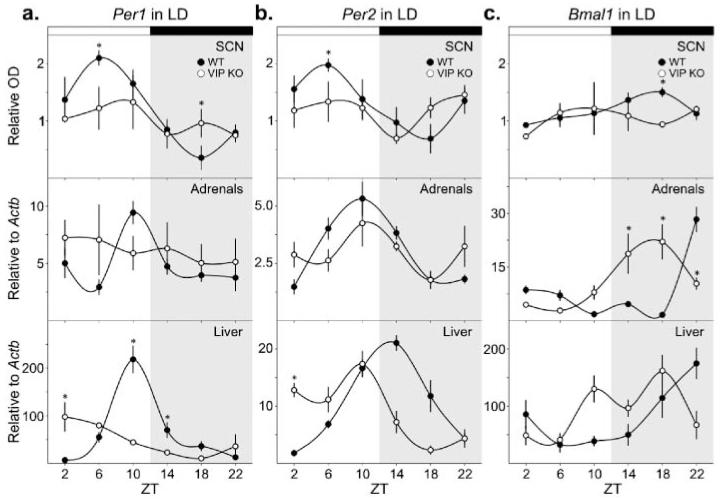
Figure 1
Figure 1
Diurnal expression patterns of circadian genes in the SCN, adrenal glands, and liver of WT and VIP KO mice. Rhythms in gene expression were determined by 1-way ANOVA (Table 1), and interactions between time and genotype were ascertained by 2-way ANOVA with post hoc determination of differences between genotypes at each time point (*). (a) Per1 expression was determined at ZT 2, 6, 10, 14, 18, and 22 from mice housed under a 12:12 LD cycle by ISH in the SCN (top) and by RT-PCR in the adrenal glands (middle) and liver (bottom). (b) Per2 expression in the SCN (top), adrenal glands (middle), and liver (bottom). (c) Bmal1 expression in the SCN (top), adrenal glands (middle), and liver (bottom).
Figure 2
Figure 2
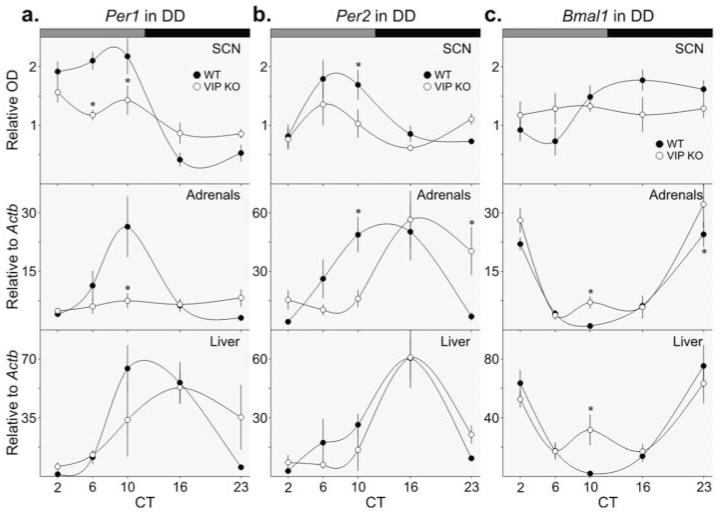
Circadian expression patterns of circadian genes in the SCN, adrenal glands, and liver of WT and VIP KO mice. Rhythms in gene expression were determined by 1-way ANOVA (Table 2), and interactions between time and genotype were ascertained by 2-way ANOVA with post hoc determination of differences between genotypes at each time point (*). (a) Per1 expression was determined at CT 2, 6, 10, 16, and 23 from mice housed for a minimum of 4 days under DD by ISH in the SCN (top) and by RT-PCR in the adrenal glands (middle) and liver (bottom). (b) Per2 expression in the SCN (top), adrenal glands (middle), and liver (bottom). (c) Bmal1 expression in the SCN (top), adrenal glands (middle), and liver (bottom).
Figure 3
Figure 3
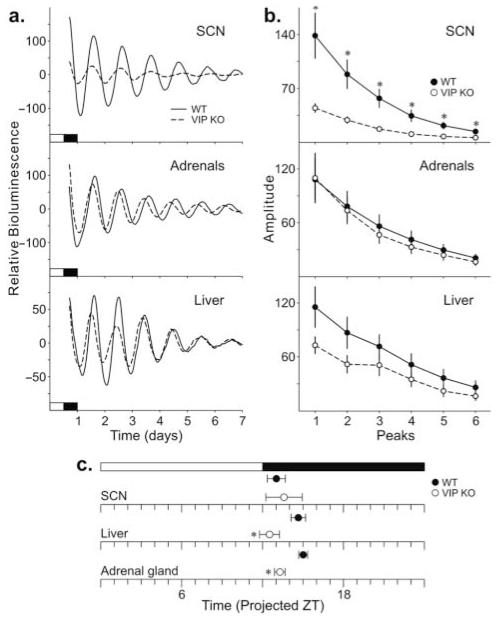
PER2::LUC rhythms as measured by PMT over 10 days in the SCN, adrenal glands, and liver. (a) Typical examples of bioluminescence of WT (solid) and VIP KO (dashed) SCN (top), adrenal glands (middle), and liver (bottom) explants. (b) Amplitude of WT and VIP KO SCN (top), adrenal glands (middle), and liver (bottom) explants. (c) Phase relationship between WT and VIP KO SCN, adrenal glands, and liver explants as determined by the first peak measured. Significant differences between genotypes as determined by Student t tests (*).

References

    1. Aton S, Block G, Tei H, Yamazaki S, Herzog E. Plasticity of circadian behavior and the suprachiasmatic nucleus following exposure to non-24-hour light cycles. J Biol Rhythms. 2004;19:198–207. - PubMed
    1. Aton S, Colwell C, Harmar A, Waschek J, Herzog E. Vasoactive intestinal polypeptide mediates circadian rhythmicity and synchrony in mammalian clock neurons. Nat Neurosci. 2005;8:476–483. - PMC - PubMed
    1. Balsalobre A, Brown S, Marcacci L, Tronche F, Kellendonk C, Reichardt H, Schütz G, Schibler U. Resetting of circadian time in peripheral tissues by glucocorticoid signaling. Science. 2000;289:2344–2347. - PubMed
    1. Brown S, Kunz D, Dumas A, Westermark P, Vanselow K, Tilmann-Wahnschaffe A, Herzel H, Kramer A. Molecular insights into human daily behavior. Proc Natl Acad Sci U S A. 2008;105:1602–1607. - PMC - PubMed
    1. Brown T, Hughes A, Piggins H. Gastrin-releasing peptide promotes suprachiasmatic nuclei cellular rhythmicity in the absence of vasoactive intestinal polypeptide-VPAC2 receptor signaling. J Neurosci. 2005;25:11155–11164. - PMC - PubMed

Publication types