


Electroacupuncture for residual insomnia associated with major depressive disorder: a randomized controlled trial
- PMID: 21629370
- PMCID: PMC3099500
- DOI: 10.5665/SLEEP.1056
Electroacupuncture for residual insomnia associated with major depressive disorder: a randomized controlled trial
Abstract
Study objectives: To evaluate the efficacy and safety of electroacupuncture as an additional treatment for residual insomnia associated with major depressive disorder (MDD).
Design: Randomized, placebo-controlled.
Setting: A psychiatric outpatient clinic.
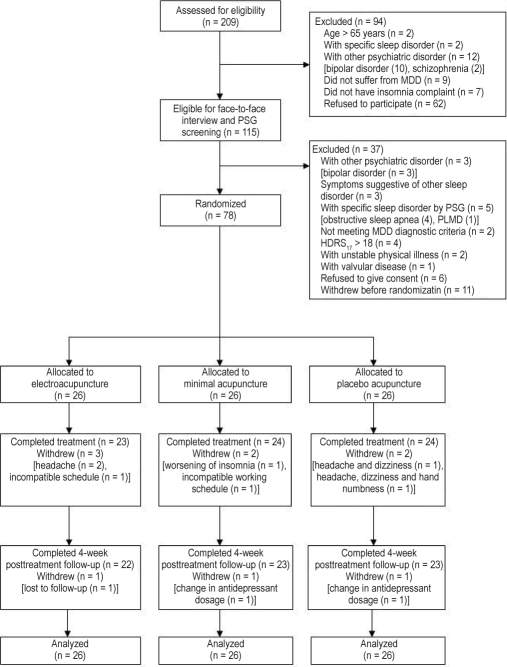
Participants: 78 Chinese patients with DSM-IV-diagnosed MDD, insomnia complaint, a Hamilton Rating Scale for Depression (HDRS(17)) score ≤ 18, and fixed antidepressant dosage.
Intervention: Electroacupuncture, minimal acupuncture (superficial needling at non-acupuncture points), or noninvasive placebo acupuncture 3 sessions weekly for 3 weeks.
Measurements and results: Insomnia Severity Index (ISI), Pittsburgh Sleep Quality Index (PSQI), HDRS(17), 1 week sleep diaries, and 3 day actigraphy were administered at baseline, 1 week post-treatment, and 4 week post-treatment. There was significant group by time interaction in ISI, PSQI, and sleep diary-derived sleep efficiency (mixed-effects models, P = 0.04, P = 0.03, and P = 0.01, respectively). Post hoc pairwise comparisons revealed that electroacupuncture and minimal acupuncture were more efficacious than placebo acupuncture in ISI and PSQI at 1 week and 4 week post-treatment. Minimal acupuncture resulted in greater improvement in sleep diary-derived sleep efficiency than placebo acupuncture at 1 week post-treatment. There was no significant between-group difference in actigraphy measures, depressive symptoms, daily functioning, and hypnotic consumption, and no difference in any measures between electroacupuncture and minimal acupuncture.
Conclusion: Compared with placebo acupuncture, electroacupuncture and minimal acupuncture resulted in greater improvement in subjective sleep measures at 1 week and 4 week post-treatment. No significant difference was found between electroacupuncture and minimal acupuncture, suggesting that the observed differences could be due to nonspecific effects of needling, regardless of whether it is done according to traditional Chinese medicine theory.
Trial registration: ClinicalTrials.gov NCT00838994.
Keywords: Acupuncture; electroacupuncture; insomnia; major depressive disorder; randomized controlled trial; residual insomnia.
References
-
- Kessler RC, Berglund P, Demler O, et al. The epidemiology of major depressive disorder: results from the National Comorbidity Survey Replication (NCS-R) JAMA. 2003;289:3095–105. - PubMed
-
- Nierenberg AA, Keefe BR, Leslie VC, et al. Residual symptoms in depressed patients who respond acutely to fluoxetine. J Clin Psychiatry. 1999;60:221–5. - PubMed
-
- Carney CE, Segal ZV, Edinger JD, et al. A comparison of rates of residual insomnia symptoms following pharmacotherapy or cognitive-behavioral therapy for major depressive disorder. J Clin Psychiatry. 2007;68:254–60. - PubMed
Publication types
MeSH terms
Substances
Associated data
LinkOut - more resources
Full Text Sources
Medical
