


Genetic structure of the tiger mosquito, Aedes albopictus, in Cameroon (Central Africa)
- PMID: 21629655
- PMCID: PMC3101236
- DOI: 10.1371/journal.pone.0020257
Genetic structure of the tiger mosquito, Aedes albopictus, in Cameroon (Central Africa)
Abstract
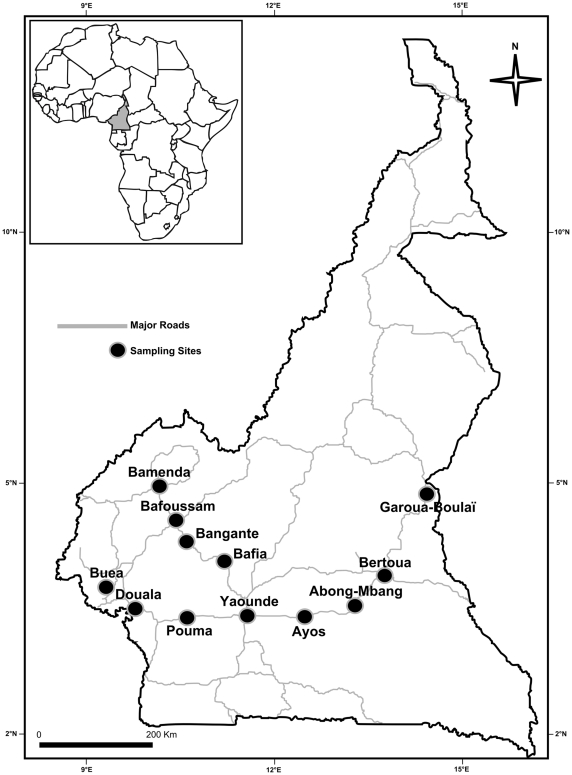
Background: Aedes albopictus (Skuse, 1884) (Diptera: Culicidae), a mosquito native to Asia, has recently invaded all five continents. In Central Africa it was first reported in the early 2000s, and has since been implicated in the emergence of arboviruses such as dengue and chikungunya in this region. Recent genetic studies of invasive species have shown that multiple introductions are a key factor for successful expansion in new areas. As a result, phenotypic characters such as vector competence and insecticide susceptibility may vary within invasive pest species, potentially affecting vector efficiency and pest management. Here we assessed the genetic variability and population genetics of Ae. albopictus isolates in Cameroon (Central Africa), thereby deducing their likely geographic origin.
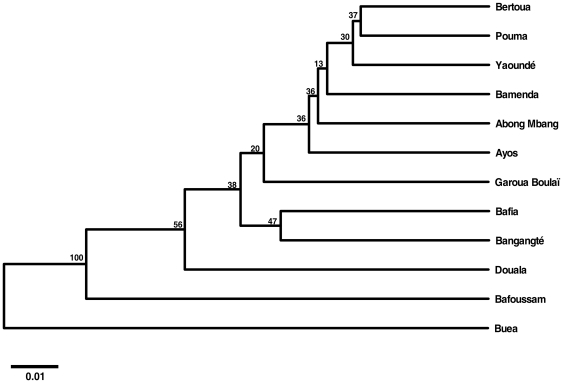
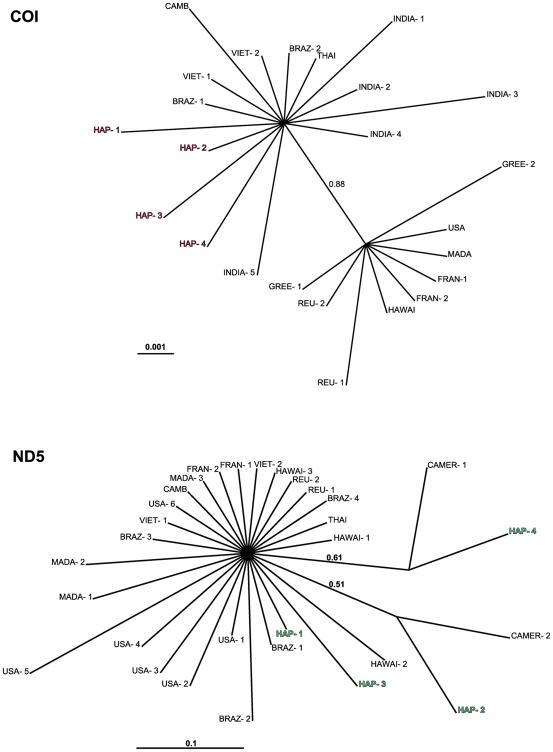
Methods and results: Mosquitoes were sampled in 2007 in 12 localities in southern Cameroon and analyzed for polymorphism at six microsatellite loci and in two mitochondrial DNA regions (ND5 and COI). All the microsatellite markers were successfully amplified and were polymorphic, showing moderate genetic structureamong geographic populations (F(ST) = 0.068, P < 0.0001). Analysis of mtDNA sequences revealed four haplotypes each for the COI and ND5 genes, with a dominant haplotype shared by all Cameroonian samples. The weak genetic variation estimated from the mtDNA genes is consistent with the recent arrival of Ae. albopictus in Cameroon. Phylogeographic analysis based on COI polymorphism indicated that Ae. albopictus populations from Cameroon are related to tropical rather than temperate or subtropical outgroups.
Conclusion: The moderate genetic diversity observed among Cameroonian Ae. albopictus isolates is in keeping with recent introduction and spread in this country. The genetic structure of natural populations points to multiple introductions from tropical regions.
Conflict of interest statement
Figures
References
-
- Kow CY, Koon LL, Pang FY. Detection of Dengue Viruses in Field Caught Male Aedes aegypti and Aedes albopictus (Diptera: Culicidae) in Singapore by Type-Specific PCR. J Med Entomol. 2001;38:475–479. - PubMed
-
- Reiter P, Fontenille D, Paupy C. Aedes albopictus as an epidemic vector of chikungunya virus: another emerging problem? Lancet Infect Dis. 2006;6:463–464. - PubMed
-
- Paupy C, Ollomo B, Kamgang B, Moutailler S, Rousset D, et al. Role of Ae. albopictus versus Ae. aegypti in dengue and chikungunya emergences in Central Africa: Laboratory and field evidence. Vector Borne Zoonotic Dis. 2010;10:259–266. - PubMed
-
- Smith CEG. The history of dengue in tropical Asia and its probable relationship to the mosquitoes Aedes aegypti. Journal of Tropical Medicine and Hygiene. 1956;59:3–11. - PubMed
-
- Gratz NG. Critical review of the vector status of Aedes albopictus. Med Vet Entomol. 2004;18:215–227. - PubMed
Publication types
MeSH terms
Substances
LinkOut - more resources
Full Text Sources
Research Materials
Miscellaneous
