. 2011 May;5(5):e1052.
doi: 10.1371/journal.pntd.0001052. Epub 2011 May 24.

PCR-based identification of Klebsiella pneumoniae subsp. rhinoscleromatis, the agent of rhinoscleroma

Affiliations

PCR-based identification of Klebsiella pneumoniae subsp. rhinoscleromatis, the agent of rhinoscleroma

Cindy Fevre et al. PLoS Negl Trop Dis. 2011 May.

Abstract

Rhinoscleroma is a chronic granulomatous infection of the upper airways caused by the bacterium Klebsiella pneumoniae subsp. rhinoscleromatis. The disease is endemic in tropical and subtropical areas, but its diagnosis remains difficult. As a consequence, and despite available antibiotherapy, some patients evolve advanced stages that can lead to disfiguration, severe respiratory impairment and death by anoxia. Because identification of the etiologic agent is crucial for the definitive diagnosis of the disease, the aim of this study was to develop two simple PCR assays. We took advantage of the fact that all Klebsiella pneumoniae subsp. rhinoscleromatis isolates are (i) of capsular serotype K3; and (ii) belong to a single clone with diagnostic single nucleotide polymorphisms (SNP). The complete sequence of the genomic region comprising the capsular polysaccharide synthesis (cps) gene cluster was determined. Putative functions of the 21 genes identified were consistent with the structure of the K3 antigen. The K3-specific sequence of gene Kr11509 (wzy) was exploited to set up a PCR test, which was positive for 40 K3 strains but negative when assayed on the 76 other Klebsiella capsular types. Further, to discriminate Klebsiella pneumoniae subsp. rhinoscleromatis from other K3 Klebsiella strains, a specific PCR assay was developed based on diagnostic SNPs in the phosphate porin gene phoE. This work provides rapid and simple molecular tools to confirm the diagnostic of rhinoscleroma, which should improve patient care as well as knowledge on the prevalence and epidemiology of rhinoscleroma.


Conflict of interest statement

The authors have declared that no competing interests exist.

Figures
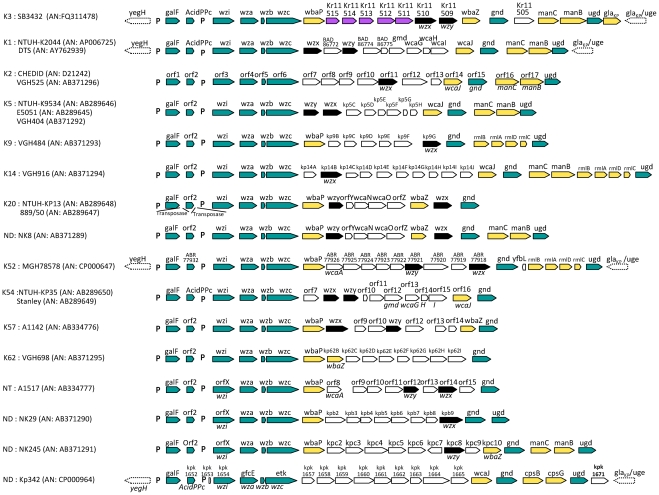
Figure 1
Figure 1. Gene composition of the cps region of Klebsiella capsular serotype K3 and comparison with other cps regions.
The comparative strains represent 11 serotypes (K1, K2, K3, K5, K9, K14, K20, K52, K54, K57 and K62), one new serotype (NT) and four undetermined serotypes (ND). Arrows with dotted lines belong to flanking regions of the cps cluster. Green arrows represent highly conserved genes present in all cps regions. Yellow arrows correspond to genes of the K3 cps with highly conserved sequences, but which presence/absence depends on capsular type. Serotype K3 genes having weaker or no homology with the other Klebsiella cps regions are represented by purple arrows. Black arrows correspond to genes wzx and wzy, which are highly variable at the sequence level. In the K3 cps region, the suggested names for the ORFs in green and yellow are based on amino-acid homology superior to 78%, with at least one annotated gene from another Klebsiella cps regions. For the previously published cps regions, names indicated above each gene correspond to annotations found in public databases, whereas names in italic under the genes are suggestions based on our pairwise comparisons (>65% amino acid identity except for wzx and wzy). The suggested wzx and wzy annotations are based on 30% to 48% and 23% to 26% of amino-acid similarity on most of their sequence length with the respective proteins of E. coli. As noted earlier , the presence of genes wbaP and wcaJ appeared mutually exclusive. P: promoter ; AN: Accession number.
Figure 2
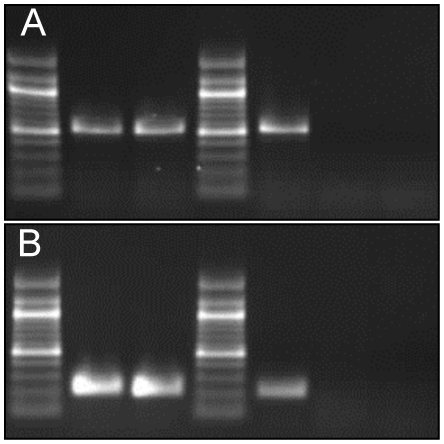
Figure 2. K3 and phoE PCR assays.
(A) Kr11509 (wzy) PCR amplification, which is specific for serotype K3 Klebsiella isolates. Serotype K3 isolates of K. pneumoniae subsp. pneumoniae (lane 2: strain SB3204 = CIP 52.146; lane 3: strain SB3206 = CIP 82.91T) and subsp. rhinoscleromatis (lane 5: strain SB3432) showed the expected PCR product of 549 bp. This result is representative of the 16 clone Rhinoscleromatis isolates and the 14 K3 K. pneumoniae subsp. pneumoniae strains tested in this study (Table S1). No PCR amplification was obtained with the 134 non-K3 Klebsiella isolates tested (Table S1) representing the 76 other serotypes, as shown for serotype K2 (lane 6: strain SB3341 = CIP 52.145) and serotype K4 (lane 7: strain SB3220 = K. pneumoniae subsp. ozaenae CIP 52.211T). Lanes 1 and 4: 100 bp ladder (New England Biolabs). (B) phoE PCR amplification, which is specific for members of clone Rhinoscleromatis. PCR performed with strains belonging to clone Rhinoscleromatis (lane 2: strain SB167 = C5046; lane 3: strain SB1782 = K. pneumoniae subsp. rhinoscleromatis CIP 52.210T and lane 5: strain SB3432) show the expected PCR amplification product of 209 bp. This product was observed for the 16 clone Rhinoscleromatis isolates tested in this study. PCR with non-Rhinoscleromatis Klebsiella strains (Table S1), including strains of serotype K3 and belonging to K. pneumoniae subsp. ozaenae gave no amplification (lane 6: SB3206 = CIP 82.91T; lane 7: K. pneumoniae subsp. ozaenae SB3220 = CIP 52.211T). Lanes 1 and 4: 100-bp ladder (New England Biolabs).

References

    1. Wechsler HL. Rhinoscleroma. Jama. 1964;190:847. - PubMed
    1. Hart CA, Rao SK. Rhinoscleroma. J Med Microbiol. 2000;49:395–396. - PubMed
    1. Canalis RF, Zamboni L. An interpretation of the structural changes responsible for the chronicity of rhinoscleroma. Laryngoscope. 2001;111:1020–1026. - PubMed
    1. Gaafar HA, Bassiouny M, El Mofty M, Badour NM, Nour YA. Experimental intravenous inoculation of Klebsiella rhinoscleromatis bacilli in albino rats: a histopathological and bacteriological study. Acta Otolaryngol. 2000;120:279–285. - PubMed
    1. Evrard I, Gruyer X, Desse P, Francois A, Marie JP, et al. Spheno-ethmoidal rhinoscleroma. Report of a case and review of the literature. Ann Otolaryngol Chir Cervicofac. 1998;115:85–88. - PubMed

Publication types

MeSH terms

Associated data