


The coexistence of multiple cardiovascular diseases is an independent predictor of the 30-day mortality of hospitalized patients with congestive heart failure: a study in Beijing
- PMID: 21630285
- PMCID: PMC6652710
- DOI: 10.1002/clc.20905
The coexistence of multiple cardiovascular diseases is an independent predictor of the 30-day mortality of hospitalized patients with congestive heart failure: a study in Beijing
Abstract
Background: Congestive heart failure (CHF) has become a major clinical and public health challenge with the aging of the population in China. However, the effect of the coexistence of multiple cardiovascular diseases on the prognosis of hospitalized patients with CHF remains unclear. A comparative analysis was performed to explore the etiology and comorbidities of CHF and in-hospital mortality in patients with CHF.
Hypothesis: The coexistence of multiple cardiovascular diseases is an independent predictor of the 30-day mortality of hospitalized patients with CHF.
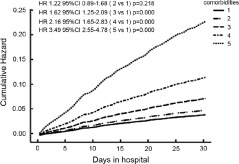
Methods: All 6949 patients (4344 males, 2605 females) in the database with a principal ICD-9-CM discharge diagnosis of CHF were identified and divided into 5 groups according to the number of comorbidities. Cox proportional hazards regression was used to examine the association between the number of comorbidities and in-hospital mortality in patients with CHF.
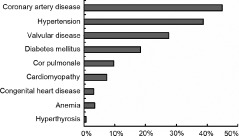
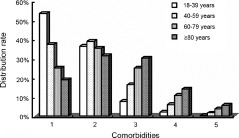
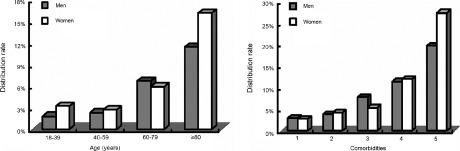
Results: A single comorbidity was predominant in younger patients (18-39 years, P<0.001), whereas multiple comorbidities were predominant in the elderly (≥80 years, P<0.001). The most common single etiology was valvular heart disease, and the most common triple etiology was hypertension and diabetes mellitus complicated by coronary artery disease. Cox regression analysis showed a higher hospital mortality rate associated with an increased number of comorbidities (hazard ratio [HR] from 1.22 [95% CI: 0.89-1.68] to HR 3.49 [95% CI: 2.55-4.78], P<0.001).
Conclusions: This study demonstrates the coexistence of multiple cardiovascular diseases is an independent predictor of the 30-day mortality of hospitalized patients with CHF.
© 2011 Wiley Periodicals, Inc.
Figures
References
-
- Zhang ZB, Cheng TO, Zhang YC. Introduction. In Textbook of CongestiveHeart Failure, p.15. Beijing, China: Science & Technology Publishers, 2003.
-
- Roger VL, Weston SA, Redfield MM, et al. Trends in heart failure incidence and survival in a community‐based population. JAMA. 2004;292:344–350. - PubMed
-
- Goldberg RJ, Spencer FA, Former C, et al. Incidence and hospital death rate associated with heart failure: a community‐wide perspective. Am J Med. 2005;118:728–734. - PubMed
-
- Zannad F, Briancon S, Juilliere Y, et al. Incidence, clinical and etiologic features, and outcomes of advanced chronic heart failure: the EPICAL Study. Epidémiologie de l'Insuffisance Cardiaque Avancée en Lorraine. J Am Coll Cardiol. 1999;33:734–742. - PubMed
-
- Adams KF Jr, Fonarow GC, Emerman CL, et al. ADHERE Scientific Advisory Committee and Investigators . Characteristics and outcomes of patients hospitalized for heart failure in the United States: rationale, design, and preliminary observations from the first 100,000 cases in the acute decompensated heart failure national registry (ADHERE). Am Heart J. 2005;149:209–216. - PubMed
MeSH terms
LinkOut - more resources
Full Text Sources
Medical
