Outcomes of treatment for hepatitis C virus infection by primary care providers
- PMID: 21631316
- PMCID: PMC3820419
- DOI: 10.1056/NEJMoa1009370
Outcomes of treatment for hepatitis C virus infection by primary care providers
Abstract
Background: The Extension for Community Healthcare Outcomes (ECHO) model was developed to improve access to care for underserved populations with complex health problems such as hepatitis C virus (HCV) infection. With the use of video-conferencing technology, the ECHO program trains primary care providers to treat complex diseases.
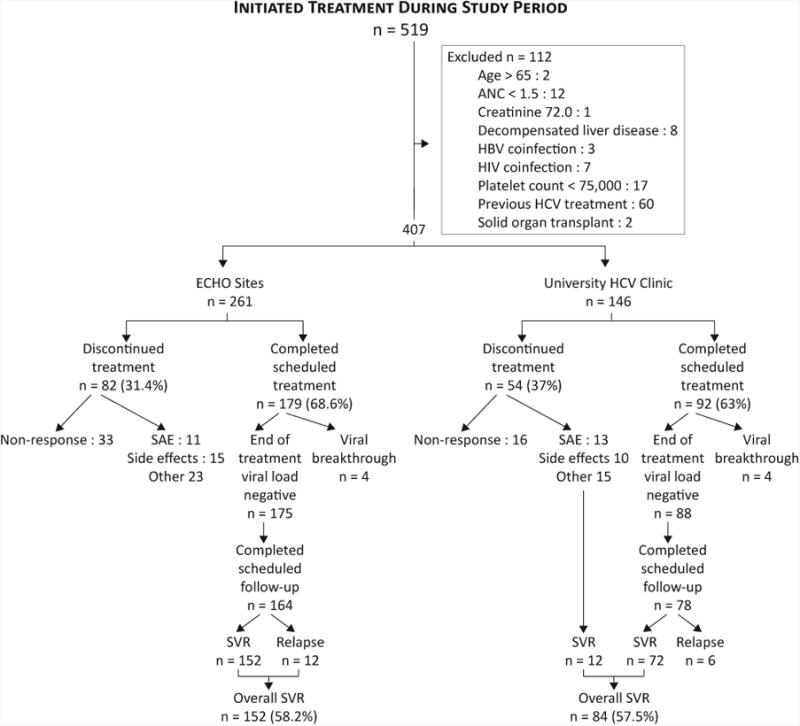
Methods: We conducted a prospective cohort study comparing treatment for HCV infection at the University of New Mexico (UNM) HCV clinic with treatment by primary care clinicians at 21 ECHO sites in rural areas and prisons in New Mexico. A total of 407 patients with chronic HCV infection who had received no previous treatment for the infection were enrolled. The primary end point was a sustained virologic response.
Results: A total of 57.5% of the patients treated at the UNM HCV clinic (84 of 146 patients) and 58.2% of those treated at ECHO sites (152 of 261 patients) had a sustained viral response (difference in rates between sites, 0.7 percentage points; 95% confidence interval, -9.2 to 10.7; P=0.89). Among patients with HCV genotype 1 infection, the rate of sustained viral response was 45.8% (38 of 83 patients) at the UNM HCV clinic and 49.7% (73 of 147 patients) at ECHO sites (P=0.57). Serious adverse events occurred in 13.7% of the patients at the UNM HCV clinic and in 6.9% of the patients at ECHO sites.
Conclusions: The results of this study show that the ECHO model is an effective way to treat HCV infection in underserved communities. Implementation of this model would allow other states and nations to treat a greater number of patients infected with HCV than they are currently able to treat. (Funded by the Agency for Healthcare Research and Quality and others.).
Comment in
-
Ensuring equal access to specialty care.N Engl J Med. 2011 Jun 9;364(23):2258-9. doi: 10.1056/NEJMe1103390. Epub 2011 Jun 1. N Engl J Med. 2011. PMID: 21631317 No abstract available.
-
Treatment of hepatitis C by primary care providers.N Engl J Med. 2011 Sep 8;365(10):959-60; author reply 960. doi: 10.1056/NEJMc1107892. N Engl J Med. 2011. PMID: 21899460 No abstract available.
-
An expanding role for primary care providers in the treatment of hepatitis C virus infection in the community.Hepatology. 2011 Dec;54(6):2258-60. doi: 10.1002/hep.24649. Hepatology. 2011. PMID: 22139703 No abstract available.
References
-
- Hepatitis C: WHO/CDS/CSR/LYO/2003? Hepatitis C: World Health Organization; 2002. [Accessed June 29, 2010]. at http://www.who.int/csr/disease/hepatitis/Hepc.pdf.
-
- [Access June 28, 2010];Hepatitis C FAQs for health professionals: Centers for Disease and Prevention. 2010 at http://www.cdc.gov/hepatitis/HCVfaq.htm.
Publication types
MeSH terms
Substances
Grants and funding
LinkOut - more resources
Full Text Sources
Medical