


Reducing the legal blood alcohol concentration limit for driving in developing countries: a time for change? Results and implications derived from a time-series analysis (2001-10) conducted in Brazil
- PMID: 21631625
- PMCID: PMC3184361
- DOI: 10.1111/j.1360-0443.2011.03521.x
Reducing the legal blood alcohol concentration limit for driving in developing countries: a time for change? Results and implications derived from a time-series analysis (2001-10) conducted in Brazil
Erratum in
- Addiction. 2012 Jan;107(1):236
Abstract
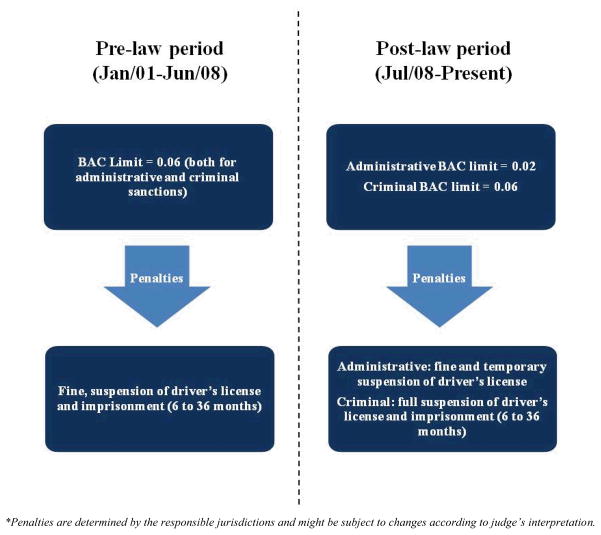
Aims: In Brazil, a new law introduced in 2008 has lowered the blood alcohol concentration limit for drivers from 0.06 to 0.02, but the effectiveness in reducing traffic accidents remains uncertain. This study evaluated the effects of this enactment on road traffic injuries and fatalities.
Design: Time-series analysis using autoregressive integrated moving average (ARIMA) modelling.
Setting: State and capital of São Paulo, Brazil.
Participants: A total of 1,471,087 non-fatal and 51,561 fatal road traffic accident cases in both regions.
Measurements: Monthly rates of traffic injuries and fatalities per 100,000 inhabitants from January 2001 to June 2010.
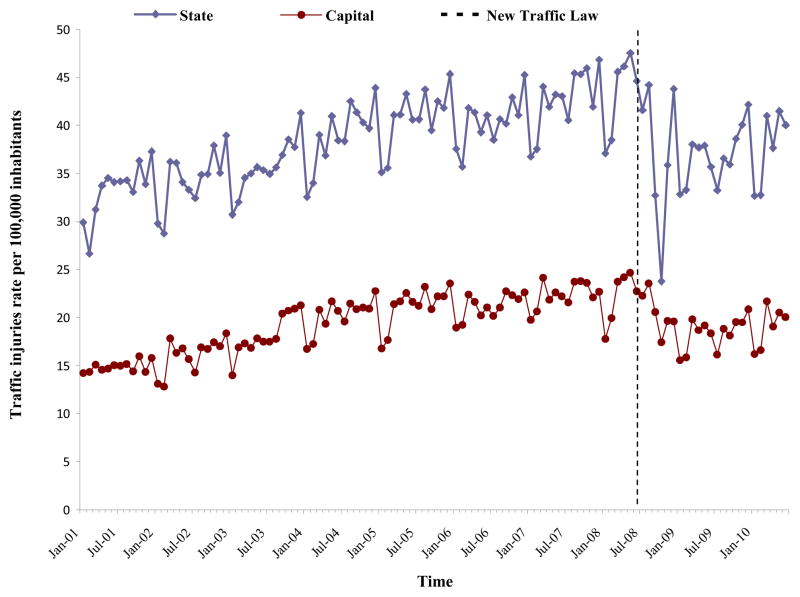
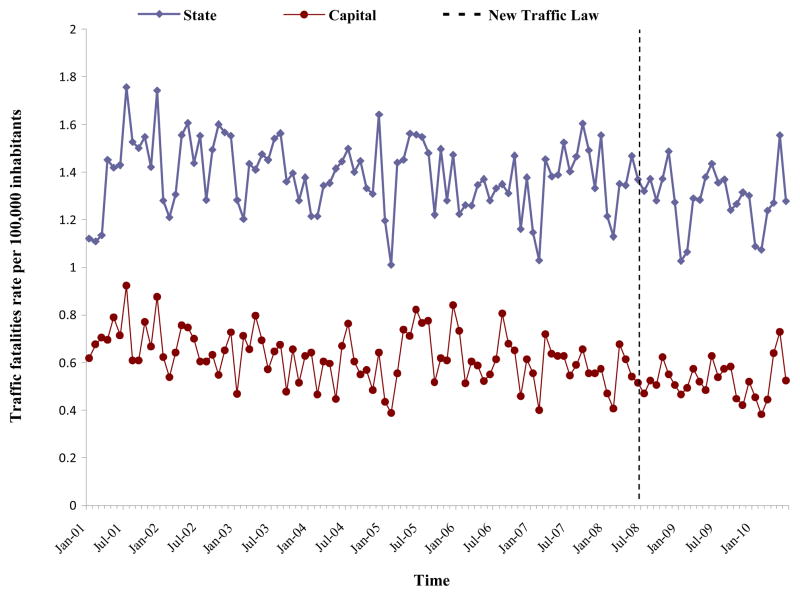
Findings: The new traffic law was responsible for significant reductions in traffic injury and fatality rates in both localities (P<0.05). A stronger effect was observed for traffic fatality (-7.2 and -16.0% in the average monthly rate in the State and capital, respectively) compared to traffic injury rates (-1.8 and -2.3% in the State and capital, respectively).
Conclusions: Lowering the blood alcohol concentration limit in Brazil had a greater impact on traffic fatalities than injuries, with a higher effect in the capital, where presumably the police enforcement was enhanced.
© 2011 The Authors, Addiction © 2011 Society for the Study of Addiction.
Conflict of interest statement
Figures
Comment in
-
Commentary on Andreuccetti et al. (2011): The gap between stricter blood alcohol concentration legislation and enforcement in Brazil.Addiction. 2011 Dec;106(12):2132-3. doi: 10.1111/j.1360-0443.2011.03604.x. Addiction. 2011. PMID: 22049983 No abstract available.
-
Re-analysing traffic-related mortality in São Paulo.Addiction. 2015 Mar;110(3):538. doi: 10.1111/add.12766. Epub 2014 Dec 5. Addiction. 2015. PMID: 25475076 No abstract available.
-
Rethinking the debate on drinking and driving laws in São Paulo: response to the letter by Volpe & Fantoni.Addiction. 2015 Mar;110(3):539-40. doi: 10.1111/add.12802. Epub 2014 Dec 5. Addiction. 2015. PMID: 25475125 No abstract available.
References
-
- WHO. The global burden of disease: 2004 update. Geneva: World Health Organization; 2008.
-
- IPEA/DENATRAN/ANTP. Impactos sociais e econômicos dos acidentes de trânsito nas rodovias brasileiras [Social and economic impact of traffic accidents on Brazilian roads] Brasilia: Institute for Applied Economic Research; 2006.
-
- Room R, Babor T, Rehm J. Alcohol and public health. Lancet. 2005;365(9458):519–30. - PubMed
-
- Kelly E, Darke S, Ross J. A review of drug use and driving: epidemiology, impairment, risk factors and risk perceptions. Drug Alcohol Rev. 2004;23(3):319–44. - PubMed
-
- Jones AW. Medicolegal Alcohol Determinations — Blood- or Breath-Alcohol Concentration? Forensic Sci Rev. 2000;12:23–47. - PubMed
Publication types
MeSH terms
Substances
Grants and funding
LinkOut - more resources
Full Text Sources
Medical
