


Cutaneous melanoma in situ: translational evidence from a large population-based study
- PMID: 21632457
- PMCID: PMC3228223
- DOI: 10.1634/theoncologist.2010-0340
Cutaneous melanoma in situ: translational evidence from a large population-based study
Abstract
Background: Cutaneous melanoma in situ (CMIS) is a nosologic entity surrounded by health concerns and unsolved debates. We aimed to shed some light on CMIS by means of a large population-based study.
Methods: Patients with histologic diagnosis of CMIS were identified from the Surveillance Epidemiology End Results (SEER) database.
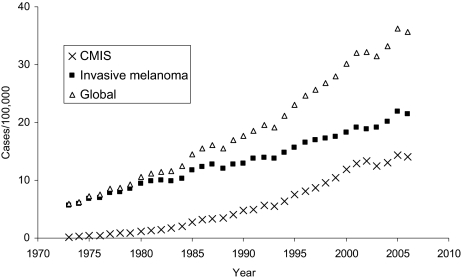
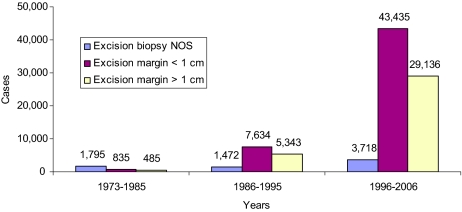
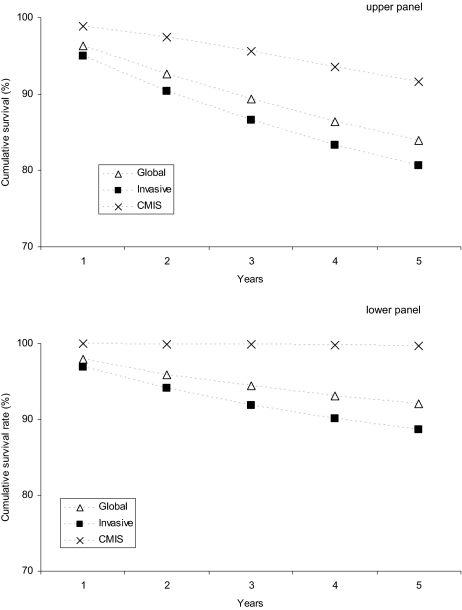
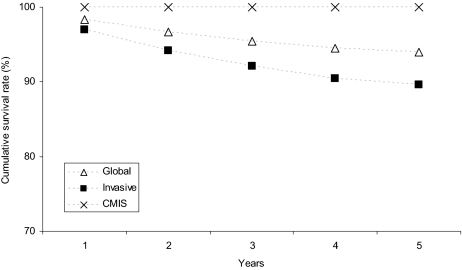
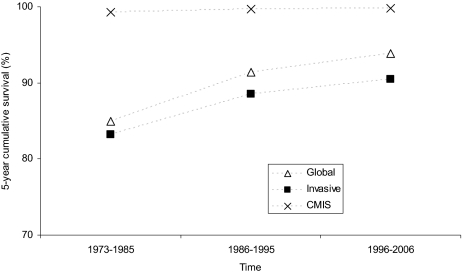
Results: The records of 93,863 cases of CMIS were available for analysis. CMIS incidence has been steadily increasing over the past 3 decades at a rate higher than any other in situ or invasive tumor, including invasive skin melanoma (annual percentage change [APC]: 9.5% versus 3.6%, respectively). Despite its noninvasive nature, CMIS is treated with excision margins wider than 1 cm in more than one third of cases. CMIS is associated with an increased risk of invasive melanoma (standardized incidence ratio [SIR]: 8.08; 95% confidence interval [CI]: 7.66-8.57), with an estimated 3:5 invasive/in situ ratio; surprisingly, it is also associated with a reduced risk of gastrointestinal (SIR: 0.78, CI: 0.72-0.84) and lung (SIR: 0.65, CI: 0.59-0.71) cancers. Relative survival analysis shows that persons with CMIS have a life expectancy equal to that of the general population.
Conclusions: CMIS is increasingly diagnosed and is often overtreated, although it does not affect the life expectancy of its carriers. Patients with CMIS have an increased risk of developing invasive melanoma (which warrants their enrollment in screening programs) but also a reduced risk of some epithelial cancers, which raises the intriguing hypothesis that genetic/environmental risk factors for some tumors may oppose the pathogenesis of others.
Conflict of interest statement
The content of this article has been reviewed by independent peer reviewers to ensure that it is balanced, objective, and free from commercial bias. No financial relationships relevant to the content of this article have been disclosed by the authors or independent peer reviewers.
Figures
References
-
- Garbe C, Leiter U. Melanoma epidemiology and trends. Clin Dermatol. 2009;27:3–9. - PubMed
-
- StatBite: Distribution of melanoma incidence and mortality by age, 2001–2005. J Natl Cancer Inst. 2008;100:1498. - PubMed
-
- Thompson JF, Scolyer RA, Kefford RF. Cutaneous melanoma. Lancet. 2005;365:687–701. - PubMed
-
- Tsao H, Atkins MB, Sober AJ. Management of cutaneous melanoma. N Engl J Med. 2004;351:998–1012. - PubMed
MeSH terms
LinkOut - more resources
Full Text Sources
Medical
Miscellaneous
