


Review
doi: 10.1172/JCI45888.
Epub 2011 Jun 1.
Sixteen years and counting: an update on leptin in energy balance
Affiliations
- PMID: 21633176
- PMCID: PMC3104762
- DOI: 10.1172/JCI45888
Item in Clipboard
Review
Sixteen years and counting: an update on leptin in energy balance
J Clin Invest.
2011 Jun.
Abstract
Cloned in 1994, the ob gene encodes the protein hormone leptin, which is produced and secreted by white adipose tissue. Since its discovery, leptin has been found to have profound effects on behavior, metabolic rate, endocrine axes, and glucose fluxes. Leptin deficiency in mice and humans causes morbid obesity, diabetes, and various neuroendocrine anomalies, and replacement leads to decreased food intake, normalized glucose homeostasis, and increased energy expenditure. Here, we provide an update on the most current understanding of leptin-sensitive neural pathways in terms of both anatomical organization and physiological roles.
Figures
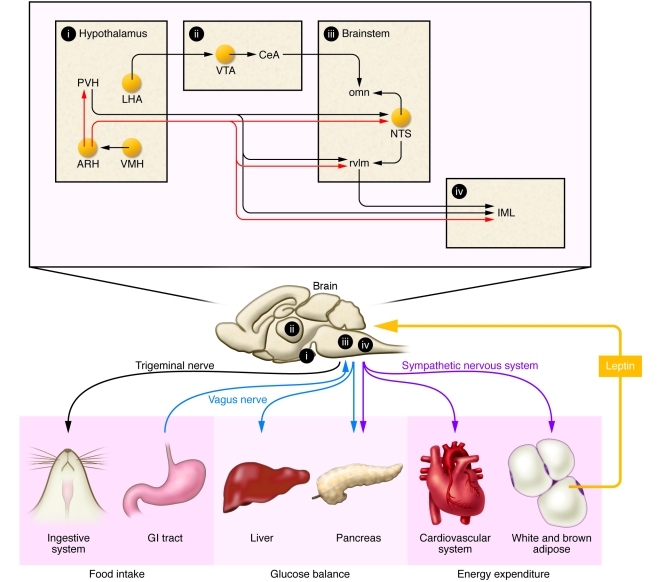
Leptin secreted by adipocytes is transported across the blood-brain barrier to act on specific leptin-sensitive brain sites (yellow circles). In particular, leptin exerts opposite effects on the activity of ARH neurons that produce αMSH and AgRP, two important endogenous ligands of the MC4R (MC4R-dependent pathways appear in red). In response to leptin, these peptides are released in brain sites important in the control of glucose homeostasis, energy expenditure, and feeding within the hypothalamus and brainstem. Recent studies also found that leptin signaling in the VTA and LHA plays a critical role in feeding and reward processes. Finally, different branches of the autonomic nervous system make connections with peripheral tissues (liver, pancreas, etc.) and ultimately mediate leptin actions on peripheral metabolic processes. Overall, leptin modulates the activity of intricate neural circuits that are distributed through many different brain regions. Tg, trigeminal nerve; X, vagus nerve; SNS, sympathetic nervous system; omn, oral masticatory nuclei; rvlm, rostroventral medulla; CeA, central amygdala.
References
-
- Bray GA. Historical framework for the development of ideas about obesity. In: Bray GA, Bouchard C, James WPT, eds.Handbook of Obesity . 2nd ed. Boca Raton, Florida, USA: CRC Press; 1998:6.
-
- Anand BK, Brobeck JR. Localization of a “feeding center” in the hypothalamus of the rat. Proc Soc Exp Biol Med. 1951;77(2):323–324. - PubMed
-
- Hetherington AW, Ranson SW. Hypothalamic lesions and adiposity in the rat. Anat Rec. 1940;78(2):149–172.
Publication types
MeSH terms
Substances
LinkOut - more resources
Full Text Sources
Other Literature Sources
Miscellaneous
