Effects of Palliative Care Training Program on Knowledge, Attitudes, Beliefs and Experiences Among Student Physiotherapists: A Preliminary Quasi-experimental Study
- PMID: 21633621
- PMCID: PMC3098543
- DOI: 10.4103/0973-1075.78449
Effects of Palliative Care Training Program on Knowledge, Attitudes, Beliefs and Experiences Among Student Physiotherapists: A Preliminary Quasi-experimental Study
Abstract
Background: Physiotherapists play an inherent role in the multidisciplinary palliative care team. Existing knowledge, attitudes, beliefs and experiences influence their team participation in palliative care.
Aims: The objective of this study was to assess the changes in knowledge, attitudes, beliefs and experiences among student physiotherapists who attended a palliative care training program.
Settings and design: Preliminary quasi-experimental study design, conducted at an academic institution.
Materials and methods: Fifty-two student physiotherapists of either gender (12 male, 40 female) of age (20.51±1.78 years) who attended a palliative care training program which comprised lectures and case examples of six-hours duration participated in this study. The study was performed after getting institutional approval and obtaining participants' written informed consent. The lecture content comprised WHO definition of palliative care, spiritual aspects of life, death and healing, principles, levels and models of palliative care, and role of physiotherapists in a palliative care team. The physical therapy in palliative care-knowledge, attitudes, beliefs and experiences scale (PTiPC-KABE Scale)- modified from palliative care attitudes scale were used for assessing the participants before and after the program.
Statistical analysis: Paired t-test and Wilcoxon signed rank test at 95% confidence interval using SPSS 11.5 for Windows.
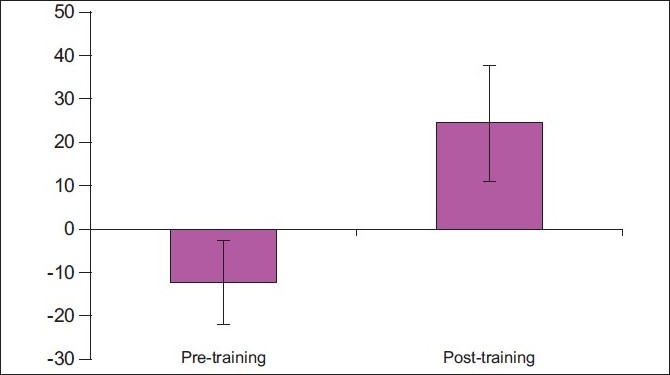
Results: Statistically significant differences (P<0.05) were noted for all four subscales- knowledge (7.84±4.61 points), attitudes (9.46±8.06 points), beliefs (4.88±3.29 points) and experiences (15.8±11.28 points) out of a total score of 104 points.
Conclusions: The focus-group training program produced a significant positive change about palliative care in knowledge, attitudes, beliefs and experiences among student physiotherapists.
Keywords: Curriculum development; Educational intervention; Professional training; Program evaluation; Training effectiveness.
Conflict of interest statement
Figures
References
-
- Fineberg IC, Wenger NS, Forrow L. Interdisciplinary education: evaluation of a palliative care training intervention for pre-professionals. Acad Med. 2004;79:769–76. - PubMed
-
- Toot J. Physical therapy and hospice- concept and practice. Phys Ther. 1984;64:665–71. - PubMed
-
- Dahlin Y, Heiwe S. Patients’ experiences of physical therapy within palliative cancer care. J Palliat Care. 2009;25:12–20. - PubMed
-
- Glazer-Waldman HR, Hart JP, LeVeau BF. Health beliefs and health behaviors of physical therapists. Phys Ther. 1989;69:204–10. - PubMed
LinkOut - more resources
Full Text Sources