. 2011 Aug 5;286(31):27706-17.
doi: 10.1074/jbc.M110.213553. Epub 2011 Jun 2.

Isotopomer profiling of Leishmania mexicana promastigotes reveals important roles for succinate fermentation and aspartate uptake in tricarboxylic acid cycle (TCA) anaplerosis, glutamate synthesis, and growth

Affiliations

Isotopomer profiling of Leishmania mexicana promastigotes reveals important roles for succinate fermentation and aspartate uptake in tricarboxylic acid cycle (TCA) anaplerosis, glutamate synthesis, and growth

Eleanor C Saunders et al. J Biol Chem. .

Abstract

Leishmania parasites proliferate within nutritionally complex niches in their sandfly vector and mammalian hosts. However, the extent to which these parasites utilize different carbon sources remains poorly defined. In this study, we have followed the incorporation of various (13)C-labeled carbon sources into the intracellular and secreted metabolites of Leishmania mexicana promastigotes using gas chromatography-mass spectrometry and (13)C NMR. [U-(13)C]Glucose was rapidly incorporated into intermediates in glycolysis, the pentose phosphate pathway, and the cytoplasmic carbohydrate reserve material, mannogen. Enzymes involved in the upper glycolytic pathway are sequestered within glycosomes, and the ATP and NAD(+) consumed by these reactions were primarily regenerated by the fermentation of phosphoenolpyruvate to succinate (glycosomal succinate fermentation). The initiating enzyme in this pathway, phosphoenolpyruvate carboxykinase, was exclusively localized to the glycosome. Although some of the glycosomal succinate was secreted, most of the C4 dicarboxylic acids generated during succinate fermentation were further catabolized in the TCA cycle. A high rate of TCA cycle anaplerosis was further suggested by measurement of [U-(13)C]aspartate and [U-(13)C]alanine uptake and catabolism. TCA cycle anaplerosis is apparently needed to sustain glutamate production under standard culture conditions. Specifically, inhibition of mitochondrial aconitase with sodium fluoroacetate resulted in the rapid depletion of intracellular glutamate pools and growth arrest. Addition of high concentrations of exogenous glutamate alleviated this growth arrest. These findings suggest that glycosomal and mitochondrial metabolism in Leishmania promastigotes is tightly coupled and that, in contrast to the situation in some other trypanosomatid parasites, the TCA cycle has crucial anabolic functions.


Figures
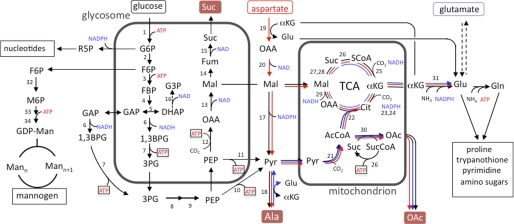
FIGURE 1.
FIGURE 1.
Schematic representation of glucose, aspartate, and alanine metabolism in Leishmania promastigotes. Pathways of glucose (black lines), aspartate (red lines), and alanine (blue lines) metabolism inferred from 13C-tracer experiments in this study. The numbered reactions and their subcellular localization are supported by previous biochemical studies and genome-wide annotations (38). Note that C4 dicarboxylic acids other than malate may be exported from the glycosomes and used to replenish TCA cycle reactions in the mitochondria. Abbreviations used are as follows: AcCoA, acetyl-CoA; Asp, aspartate; 1,3BPG, 1,3-bisphosphoglycerate; Cit, citrate; FBP, fructose-1,6-bisphosphatase; Fum, fumarate; G3P, glycerol 3-phosphate; G6P, glucose 6-phosphate; Gro, glycerol; F6P, fructose 6-phosphate; M6P, mannose 6-phosphate; Mal, malate; Mann, mannogen oligomers with n mannose residues; OAA, oxaloacetic acid; OAc, acetate; 3PG, 3-phosphoglycerate; Pyr, pyruvate; R5P, ribose 5-phosphate; SCoA, succinyl-CoA; Suc, succinate. Enzyme steps are as follows; 1, hexokinase; 2, glucose-6-phosphate isomerase; 3, phosphofructokinase; 4, aldolase; 5, triose-phosphate isomerase; 6, glyceraldehyde-3-phosphate dehydrogenase (glycosome and cytosolic isoforms); 7, phosphoglycerate kinase (glycosome and cytosolic isoforms); 8, phosphoglycerate mutase; 9, enolase, 10, pyruvate kinase; 11, pyruvate dikinase; 12, phosphoenolpyruvate carboxykinase (PEPCK); 13, malate dehydrogenase, 14, fumarase; 15, NADH-dependent fumarate reductase; 16, NADH-dependent glycerol-3-phosphate dehydrogenase; 17, malic enzyme; 18, alanine aminotransferase; 19, aspartate aminotransferase; 20, malate dehydrogenase (cytosolic isoform); 21, pyruvate dehydrogenase complex; 22, citrate synthase; 23, aconitase; 24, NADPH-dependent isocitrate dehydrogenase; 25, α-ketoglutarate dehydrogenase; 26, succinyl-CoA synthetase; 27, succinate dehydrogenase; 28, fumarase; 29, malate dehydrogenase; 30, acetate:succinyl-CoA-transferase; 31, NADPH-dependent glutamate dehydrogenase; 32, mannose-6-phosphate isomerase; 33, mannose-6-phosphate mutase; 34, GDP-Man pyrophosphorylase.
FIGURE 2.
FIGURE 2.
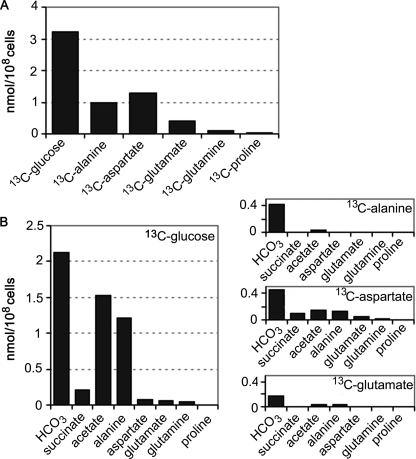
Carbon source utilization by L. mexicana promastigotes. A, L. mexicana promastigotes were cultivated in compositionally equivalent CDM containing either [U-13C]glucose, [U-13C]alanine, [U-13C]aspartate, [U-13C]glutamate, [13C]glutamine, or [U-13C]proline, in place of the corresponding unlabeled carbon source. The rate of uptake of different 13C-labeled carbon sources was assessed by 13C NMR analysis of the medium after 24 h of incubation. B, promastigotes were cultivated in compositionally equivalent CDM containing [U-13C]glucose, [U-13C]alanine, [U-13C]aspartate, or [U-13C]glutamate, and the major secreted end products in the medium were quantitated by 13C NMR analysis after 24 h of incubation. The major secreted metabolites were carbon dioxide (detected as production of H13CO3), succinate, acetate, alanine, aspartate, glutamate, and glutamine (listed below each box).
FIGURE 3.
FIGURE 3.
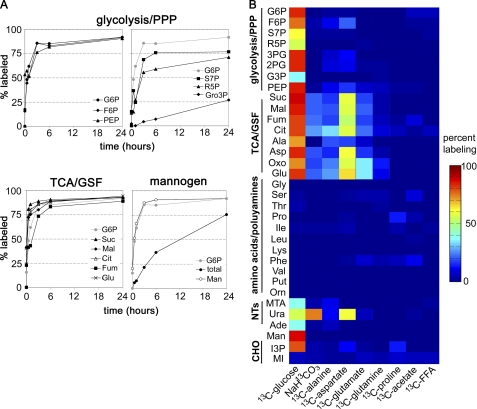
Isotopic enrichment in intracellular metabolite pools following cultivation with different 13C-labeled carbon sources. A, L. mexicana promastigotes were cultivated in CDM containing [U-13C]glucose, and parasites were metabolically quenched at indicated time points. Isotopic enrichment in key intracellular intermediates was determined by GC-MS (percent labeling indicates mole percent of intracellular pool labeled with one or more 13C atoms after correction for natural isotopic abundance). Kinetics of labeling of selected intermediates in glycolysis (G6P, F6P, and PEP), the pentose phosphate pathway (PPP) (S7P and R5P), glycerol metabolism (Gro3P), succinate fermentation and the TCA cycle (Suc, Mal, Cit, Fum, and Glu) and the synthesis of small mannogen oligomers (Man) or the total mannogen pool (total) are shown. B, L. mexicana promastigotes were cultivated in compositionally equivalent CDM containing the indicated 13C-labeled carbon source in place of the equivalent unlabeled nutrient. Parasites were metabolically quenched after 3 h of incubation and isotopic enrichments in 33 intermediates in central carbon metabolism determined by GC-MS and represented in the heat map. Abbreviations used are as follows: refer to Fig. 1 and MTA, 5-methylthioadenosine; Ura, uracil; Ade, adenine; Gro3P, glycerol 3-phosphate; MIP, inositol-3-phosphate; MI, myo-inositol; Mann, mannogen oligomers; S7P, sedoheptulose-7-phosphate; 13C-FFA, mixture of 13C-U-fatty acids bound to bovine serum albumin.
FIGURE 4.
FIGURE 4.
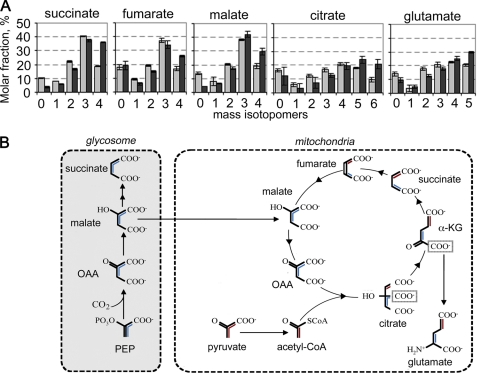
Isotopomer analysis of key succinate fermentation/TCA cycle intermediates in [U-13C]glucose-fed promastigotes. A, L. mexicana promastigotes were cultivated in CDM containing [U-13C]glucose and harvested at 3 h (gray bar) and 24 h (black bar). The relative abundance (mole percent) of the mass isotopomers (M0, M1, M2, etc. containing 0, 1, 2, etc. of labeled carbons) of key intermediates in succinate fermentation and the TCA cycle were determined following correction for natural isotopic abundance (error bars, S.E., n = 3). B, metabolic scheme showing expected labeling of glycosomal C4 dicarboxylic acids and TCA cycle intermediates with fully labeled PEP (blue) or pyruvate (red).
FIGURE 5.
FIGURE 5.
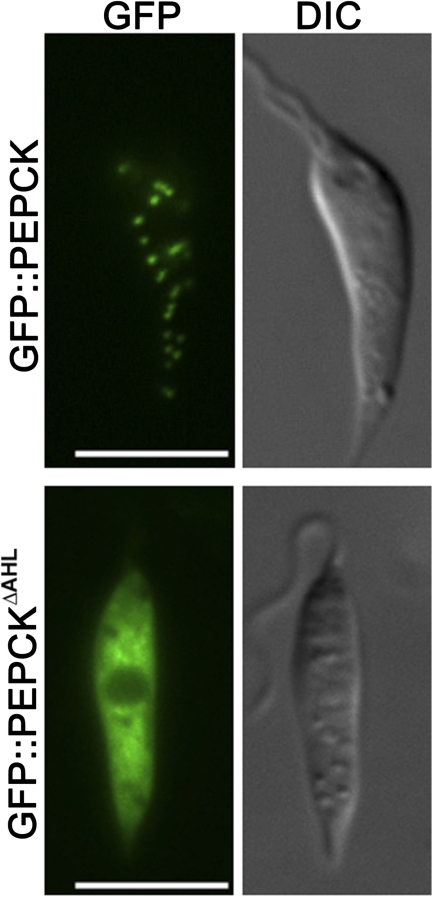
Localization of PEP carboxykinase (PEPCK) to glycosomes. Full-length and truncated PEP carboxykinase were expressed as GFP fusion proteins in promastigotes, and localization was determined by fluorescence microscopy. Top, full-length GFP::PEP carboxykinase chimera. Bottom, GFP::PEP carboxykinase chimera lacking the C-terminal tripeptide AHL (GFP::PEPCKΔAHL). Parasites were visualized by fluorescence and differential interference contrast (DIC) microscopy. Scale bar, 5 μm.
FIGURE 6.
FIGURE 6.
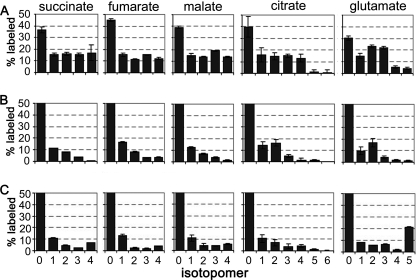
Isotopomer analysis of central carbon metabolites in [U-13C]aspartate, [U-13C]alanine, and [U-13C]glutamate-fed parasites. L. mexicana promastigotes were cultivated in CDM containing either 1.5 mm [U-13C]aspartate (A), 1.9 mm [U-13C]alanine (B), or 1.5 mm [U-13C]glutamate (C) for 3 h, and the mass isotopomers (M0, M1, M2, etc. containing 0, 1, 2, etc. labeled carbons) of key intermediates in succinate fermentation and the TCA cycle quantitated by GC-MS (error bars, S.E., n = 3).
FIGURE 7.
FIGURE 7.
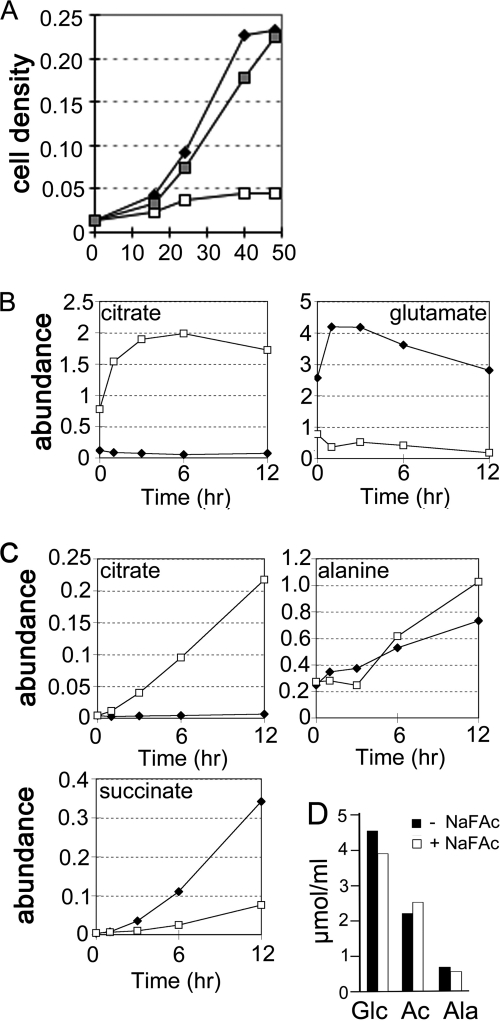
TCA cycle is required for L. mexicana growth. A, L. mexicana promastigotes were cultured in M199 medium containing 0.3 mm glutamate with (open square) or without (closed diamond) the aconitase inhibitor, NaFAc. Supplementation of the medium with 3 mm glutamate (gray squares) prevented the growth arrest induced by NaFAc. Promastigote proliferation was monitored by change in A600. B and C, L. mexicana promastigotes were cultured in M199 medium, with (open squares) or without (black diamonds) 5 mm NaFAc and changes in intracellular levels of citrate and glutamate (B) or the secreted metabolites, citrate, alanine, and succinate (C) determined at the indicated time points by GC-MS. D, utilization of [U-13C]glucose (Glc) and secretion of 13C-labeled end products (acetate (Ac) and alanine (Ala)) by L. mexicana promastigotes cultivated in M199 medium in the presence (filled bars) or absence (open bars) 0.5 mm NaFAc. Values are based on 13C NMR quantitation of [13C]glucose, [13C]acetate, and [13C]alanine in the culture medium after 24 h of incubation.
FIGURE 8.
FIGURE 8.
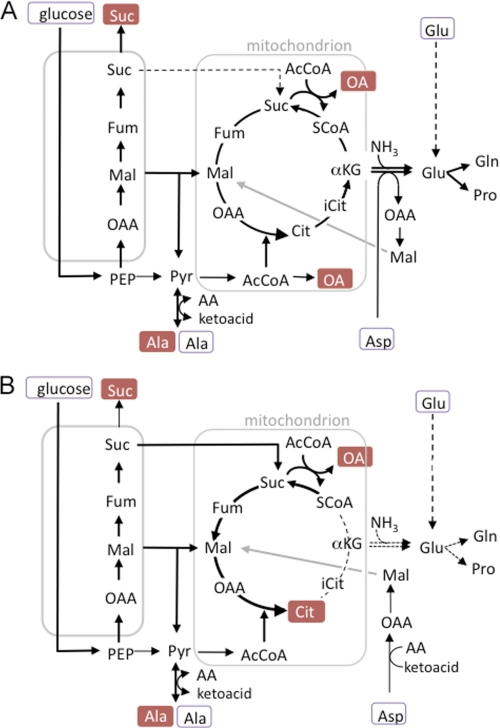
Predicted changes in metabolic fluxes in L. mexicana promastigote following inhibition of the TCA cycle. A, C4 dicarboxylic acids generated by succinate glycosomal fermentation and exogenous aspartate are used to replenish TCA intermediates, such as α-ketoglutarate that are removed for glutamate biosynthesis by reductive amination or transamination reactions. The glycosome contains transporters for malate, fumarate, and succinate, all of which could be transported to the mitochondria for TCA cycle anaplerosis (only transport of malate and succinate shown). Excess succinate is secreted. B, NaFAc treatment inhibits the mitochondrial aconitase resulting in the intracellular accumulation and secretion of citrate, with a concomitant decrease in cellular glutamate levels. Intracellular pools of glutamate can be restored by uptake of glutamate, but only when exogenous concentrations are high (dotted line). Other steps in the TCA cycle are maintained by the diversion of glycosomal succinate to the mitochondria and its conversion to succinyl-CoA (by acetate:succinyl-CoA transferase) or citrate. Abbreviations are as used in Fig. 1.
FIGURE 9.
FIGURE 9.
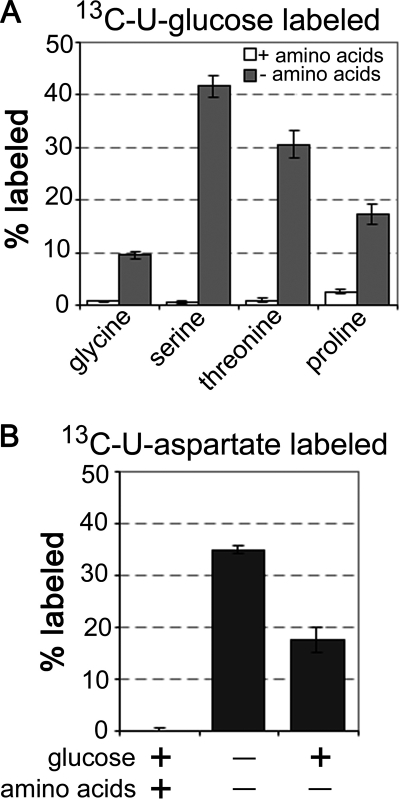
Regulation of amino acid biosynthesis and detection of de novo threonine biosynthesis in L. mexicana promastigotes. A, L. mexicana promastigotes were cultivated in CDM containing [U-13C]glucose with or without amino acids for 3 h. Percent labeling of intracellular pools of glycine, serine, threonine, and proline was determined by GC-MS. B, promastigotes were cultivated in [U-13C]aspartate-containing CDM with or without glucose or other amino acids for 3 h. Percent labeling of intracellular pool of threonine was determined by GC-MS.

References

    1. Murray H. W., Berman J. D., Davies C. R., Saravia N. G. (2005) Lancet 366, 1561–1577 - PubMed
    1. Croft S. L., Sundar S., Fairlamb A. H. (2006) Clin. Microbiol. Rev. 19, 111–126 - PMC - PubMed
    1. Opperdoes F. R., Coombs G. H. (2007) Trends Parasitol. 23, 149–158 - PubMed
    1. Saunders E. C., DE Souza D. P., Naderer T., Sernee M. F., Ralton J. E., Doyle M. A., Macrae J. I., Chambers J. L., Heng J., Nahid A., Likic V. A., McConville M. J. (2010) Parasitology 137, 1303–1313 - PubMed
    1. Burchmore R. J., Rodriguez-Contreras D., McBride K., Merkel P., Barrett M. P., Modi G., Sacks D., Landfear S. M. (2003) Proc. Natl. Acad. Sci. U.S.A. 100, 3901–3906 - PMC - PubMed

Publication types

LinkOut - more resources