Preliminary results for an adaptive family treatment for drug abuse in Hispanic youth
- PMID: 21639636
- PMCID: PMC3626405
- DOI: 10.1037/a0024016
Preliminary results for an adaptive family treatment for drug abuse in Hispanic youth
Abstract
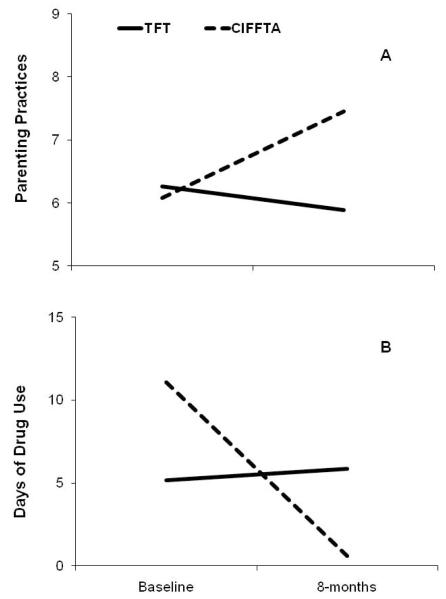
A small randomized trial investigated a new family-based intervention for Hispanic adolescents who met DSM-IV criteria for substance abuse disorder. The Culturally Informed and Flexible Family-Based Treatment for Adolescents (CIFFTA) is a tailored/adaptive intervention that includes a flexible treatment manual and multiple treatment components. The study used an "add on" design to isolate the effects on substance abuse, behavior problems, and parenting practices attributable to the newly developed components. Twenty-eight Hispanic adolescents and their families were randomized either to the experimental treatment or to traditional family therapy (TFT) and were assessed at baseline and 8-month follow-up. Despite the small sample, results revealed statistically significant time × treatment effects on both self-reported drug use (marijuana + cocaine), F(1, 22) = 10.59, p < .01, η² = .33 and adolescent reports of parenting practices, F(1, 22) = 9.01, p < .01, η² = .29. Both sets of analyses favored CIFFTA participants. There was a significant time × treatment effect, F(1, 22) = 6.72, p = .02, η² = .23, favoring CIFFTA on parent report of parenting practices using a composite that matched the variables used for adolescents, but only a nonsignificant trend, F(1, 22) = 2.43, p = .13, η² = .10, with a composite that used all parenting subscales. Parent reports of adolescent behavior problems did not show a significant time or time × treatment effect. These results show the promise of this adaptive treatment for substance abuse in Hispanic adolescents and suggest the need for a larger randomized trial to fully investigate this treatment.
Figures

References
-
- Achenbach TM. Integrative guide for the 1991 CBCL/4-18, YSR, and TRF profiles. University of Vermont Department of Psychiatry; Burlington, VT: 1991.
-
- Bernal G, Scharron-Del-Rio MR. Are empirically supported treatments valid for ethnic minorities? Toward an alternative approach for treatment research. Cultural Diversity and Ethnic Minority Psychology. 2001;7:328–342. doi: 10.1037/1099-9809.7.4.328. - PubMed
-
- Chorpita BF. Modular cognitive-behavioral therapy for childhood anxiety disorders. Guilford Press; New York, NY: 2007.
-
- Cohen J. Statistical power analysis for the behavioral sciences. 2nd ed Lawrence Erlbaum Associates; Hillsdale, NJ: 1988.
-
- Dennis M, Godley SH, Diamond G, Tims FM, Babor T, Donaldson J, Funk R. The Cannabis Youth Treatment (CTY) Study: Main findings from two randomized trials. Journal of Substance Abuse Treatment. 2004;27:197–213. doi: 10.1016/j.jsat.2003.09.005. - PubMed
Publication types
MeSH terms
Grants and funding
LinkOut - more resources
Full Text Sources
Medical
Miscellaneous