


Severe adverse events after cataract surgery among medicare beneficiaries
- PMID: 21640382
- PMCID: PMC3328508
- DOI: 10.1016/j.ophtha.2011.02.024
Severe adverse events after cataract surgery among medicare beneficiaries
Abstract
Purpose: To determine rates and risk factors associated with severe postoperative complications after cataract surgery and whether they have been changing over the past decade.
Design: Retrospective longitudinal cohort study.
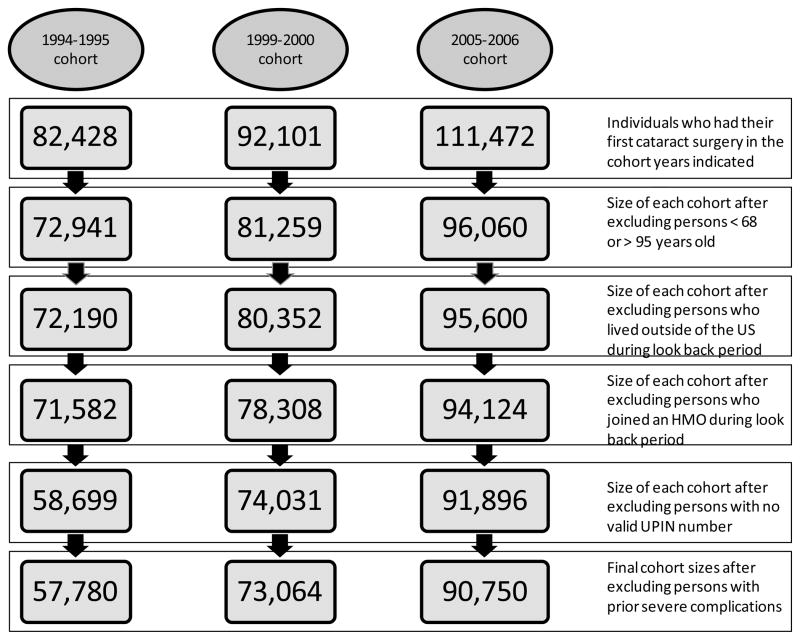
Participants: A total of 221 594 Medicare beneficiaries who underwent cataract surgery during 1994-2006.
Methods: Beneficiaries were stratified into 3 cohorts: those who underwent initial cataract surgery during 1994-1995, 1999-2000, or 2005-2006. One-year rates of postoperative severe adverse events (endophthalmitis, suprachoroidal hemorrhage, retinal detachment) were determined for each cohort. Cox regression analyses determined the hazard of developing severe adverse events for each cohort with adjustment for demographic factors, ocular and medical conditions, and surgeon case-mix.
Main outcome measures: Time period rates of development of severe postoperative adverse events.
Results: Among the 221 594 individuals who underwent cataract surgery, 0.5% (1086) had at least 1 severe postoperative complication. After adjustment for confounders, individuals who underwent cataract surgery during 1994-1995 had a 21% increased hazard of being diagnosed with a severe postoperative complication (hazard ratio [HR] 1.21; 95% confidence interval [CI], 1.05-1.41) relative to individuals who underwent cataract surgery during 2005-2006. Those who underwent cataract surgery during 1999-2000 had a 20% increased hazard of experiencing a severe complication (HR 1.20; 95% CI, 1.04-1.39) relative to the 2005-2006 cohort. Risk factors associated with severe adverse events include a prior diagnosis of proliferative diabetic retinopathy (HR 1.62; 95% CI, 1.07-2.45) and cataract surgery combined with another intraocular surgical procedure on the same day (HR 2.51; 95% CI, 2.07-3.04). Individuals receiving surgery by surgeons with the case-mix least prone to developing a severe adverse event (HR 0.52; 95% CI, 0.44-0.62) had a 48% reduced hazard of a severe adverse event relative to recipients of cataract surgery performed by surgeons with the case-mix most prone to developing such outcomes.
Conclusions: Rates of sight-threatening adverse events after cataract surgery declined during 1994-2006. Future efforts should be directed to identifying ways to reduce severe adverse events in high-risk groups.
Copyright © 2011 American Academy of Ophthalmology. Published by Elsevier Inc. All rights reserved.
Figures
References
-
- Javitt JC, Kendix M, Tielsch JM, et al. Geographic variation in utilization of cataract surgery. Med Care. 1995;33:90–105. - PubMed
-
- Escarce JJ. Would eliminating differences in physician practice style reduce geographic variations in cataract surgery rates? Med Care. 1993;31:1106–18. - PubMed
-
- Goldzweig CL, Mittman BS, Carter GM, et al. Variations in cataract extraction rates in Medicare prepaid and fee-for-service settings. JAMA. 1997;277:1765–8. - PubMed
-
- American Academy of Ophthalmology Cataract and Anterior Segment Panel. Cataract in the Adult Eye. San Francisco, CA: American Academy of Ophthalmology; 2006. [Accessed on February 9, 2011]. Preferred Practice Pattern; p. 8. Available at: http://one.aao.org/CE/PracticeGuidelines/PPP.aspx.
-
- Javitt JC, Vitale S, Canner JK, et al. National outcomes of cataract extraction: endophthalmitis following inpatient surgery. Arch Ophthalmol. 1991;109:1085–9. - PubMed
Publication types
MeSH terms
Grants and funding
LinkOut - more resources
Full Text Sources
Other Literature Sources
Medical
Miscellaneous
