


Meticillin-resistant Staphylococcus aureus with a novel mecA homologue in human and bovine populations in the UK and Denmark: a descriptive study
- PMID: 21641281
- PMCID: PMC3829197
- DOI: 10.1016/S1473-3099(11)70126-8
Meticillin-resistant Staphylococcus aureus with a novel mecA homologue in human and bovine populations in the UK and Denmark: a descriptive study
Abstract
Background: Animals can act as a reservoir and source for the emergence of novel meticillin-resistant Staphylococcus aureus (MRSA) clones in human beings. Here, we report the discovery of a strain of S aureus (LGA251) isolated from bulk milk that was phenotypically resistant to meticillin but tested negative for the mecA gene and a preliminary investigation of the extent to which such strains are present in bovine and human populations.
Methods: Isolates of bovine MRSA were obtained from the Veterinary Laboratories Agency in the UK, and isolates of human MRSA were obtained from diagnostic or reference laboratories (two in the UK and one in Denmark). From these collections, we searched for mecA PCR-negative bovine and human S aureus isolates showing phenotypic meticillin resistance. We used whole-genome sequencing to establish the genetic basis for the observed antibiotic resistance.
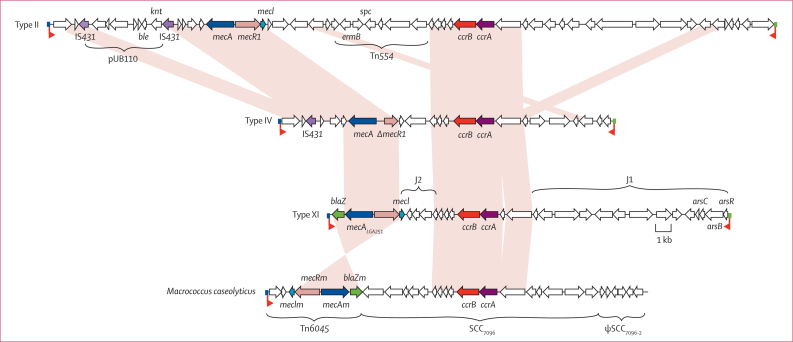
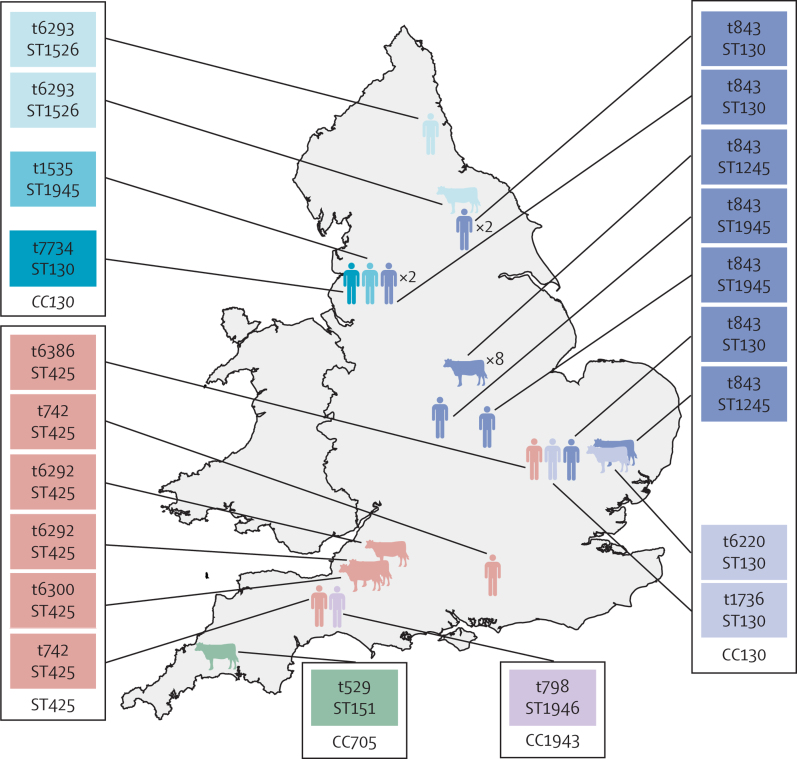
Findings: A divergent mecA homologue (mecA(LGA251)) was discovered in the LGA251 genome located in a novel staphylococcal cassette chromosome mec element, designated type-XI SCCmec. The mecA(LGA251) was 70% identical to S aureus mecA homologues and was initially detected in 15 S aureus isolates from dairy cattle in England. These isolates were from three different multilocus sequence type lineages (CC130, CC705, and ST425); spa type t843 (associated with CC130) was identified in 60% of bovine isolates. When human mecA-negative MRSA isolates were tested, the mecA(LGA251) homologue was identified in 12 of 16 isolates from Scotland, 15 of 26 from England, and 24 of 32 from Denmark. As in cows, t843 was the most common spa type detected in human beings.
Interpretation: Although routine culture and antimicrobial susceptibility testing will identify S aureus isolates with this novel mecA homologue as meticillin resistant, present confirmatory methods will not identify them as MRSA. New diagnostic guidelines for the detection of MRSA should consider the inclusion of tests for mecA(LGA251).
Funding: Department for Environment, Food and Rural Affairs, Higher Education Funding Council for England, Isaac Newton Trust (University of Cambridge), and the Wellcome Trust.
Copyright © 2011 Elsevier Ltd. All rights reserved.
Figures
Comment in
-
What to do with MRSA with a novel mec gene?Lancet Infect Dis. 2011 Aug;11(8):580-1. doi: 10.1016/S1473-3099(11)70180-3. Lancet Infect Dis. 2011. PMID: 21798457 No abstract available.
-
Missing mec.Clin Infect Dis. 2011 Nov;53(10):iii-iv. doi: 10.1093/cid/cir648. Clin Infect Dis. 2011. PMID: 22002989 No abstract available.
References
-
- Lowy FD. Staphylococcus aureus infections. N Engl J Med. 1998;339:520–532. - PubMed
-
- Andrews JM, Testing BWPoS. BSAC standardized disc susceptibility testing method (version 8) J Antimicrob Chemother. 2009;64:454–489. - PubMed
-
- Brown DF, Walpole E. Evaluation of the Mastalex latex agglutination test for methicillin resistance in Staphylococcus aureus grown on different screening media. J Antimicrob Chemother. 2001;47:187–189. - PubMed
Publication types
MeSH terms
Substances
Associated data
- Actions
- Actions
Grants and funding
LinkOut - more resources
Full Text Sources
Other Literature Sources
Medical
Molecular Biology Databases
