


Use of gene expression and pathway signatures to characterize the complexity of human melanoma
- PMID: 21641377
- PMCID: PMC3124358
- DOI: 10.1016/j.ajpath.2011.02.037
Use of gene expression and pathway signatures to characterize the complexity of human melanoma
Abstract
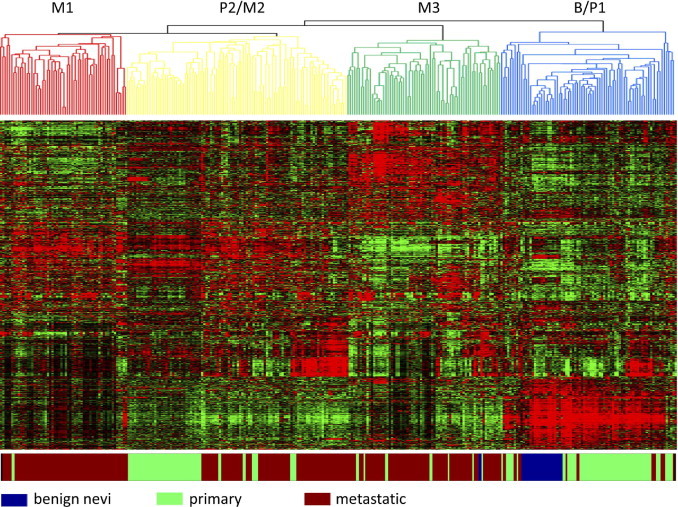
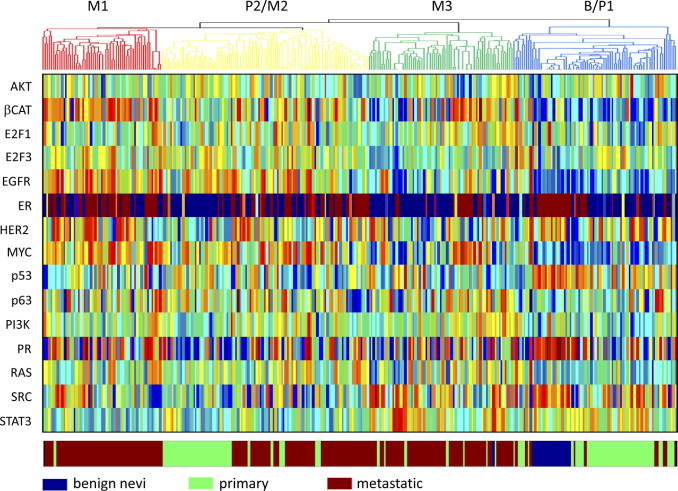
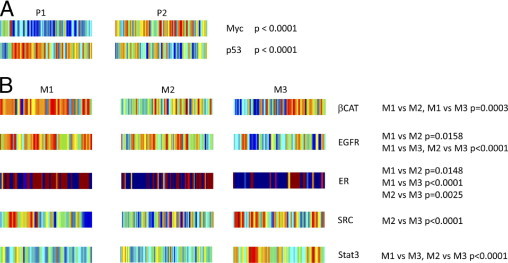
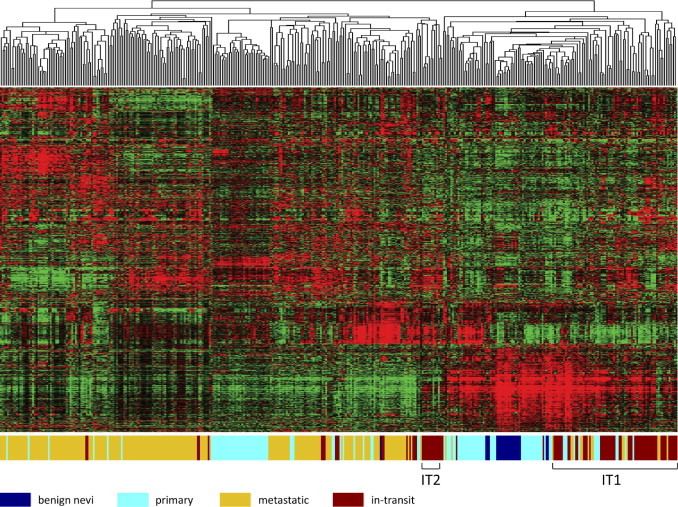
A defining characteristic of most human cancers is heterogeneity, resulting from the somatic acquisition of a complex array of genetic and genomic alterations. Dissecting this heterogeneity is critical to developing an understanding of the underlying mechanisms of disease and to paving the way toward personalized treatments of the disease. We used gene expression data sets from the analysis of primary and metastatic melanomas to develop a molecular description of the heterogeneity that characterizes this disease. Unsupervised hierarchical clustering, gene set enrichment analyses, and pathway activity analyses were used to describe the genetic heterogeneity of melanomas. Patterns of gene expression that revealed two distinct classes of primary melanoma, two distinct classes of in-transit melanoma, and at least three subgroups of metastatic melanoma were identified. Expression signatures developed to predict the status of oncogenic signaling pathways were used to explore the biological basis underlying these differential patterns of expression. This analysis of activities revealed unique pathways that distinguished the primary and metastatic subgroups of melanoma. Distinct patterns of gene expression across primary, in-transit, and metastatic melanomas underline the genetic heterogeneity of this disease. This heterogeneity can be described in terms of deregulation of signaling pathways, thus increasing the knowledge of the biological features underlying individual melanomas and potentially directing therapeutic opportunities to individual patients with melanoma.
Copyright © 2011 American Society for Investigative Pathology. Published by Elsevier Inc. All rights reserved.
Figures
References
-
- Sjoblom T., Jones S., Wood L.D., Parsons D.W., Lin J., Barber T.D., Mandelker D., Leary R.J., Ptak J., Silliman N., Szabo S., Buckhaults P., Farrell C., Meeh P., Markowitz S.D., Willis J., Dawson D., Willson J.K., Gazdar A.F., Hartigan J., Wu L., Liu C.C., Parmigiani G., Park B.H., Bachman K.E., Papadopoulos N., Vogelstein B., Kinzler K.W., Velculescu V.E. The consensus coding sequences of human breast and colorectal cancers. Science. 2006;314:268–274. - PubMed
-
- Wood L.D., Parsons D.W., Jones S., Lin J., Sjoblom T., Leary R.J., Shen D., Boca S.M., Barber T., Ptak J., Silliman N., Szabo S., Dezso Z., Ustyanksky V., Nikolskaya T., Nikolsky Y., Karchin R., Wilson P.A., Kaminker J.S., Zhang Z., Croshaw R., Willis J., Dawson D., Shipitsin M., Willson J.K., Sukumar S., Polyak K., Park B.H., Pethiyagoda C.L., Pant P.V., Ballinger D.G., Sparks A.B., Hartigan J., Smith D.R., Suh E., Papadopoulos N., Buckhaults P., Markowitz S.D., Parmigiani G., Kinzler K.W., Velculescu V.E., Vogelstein B. The genomic landscapes of human breast and colorectal cancers. Science. 2007;318:1108–1113. - PubMed
-
- Hudis C.A. Trastuzumab: mechanism of action and use in clinical practice. N Engl J Med. 2007;357:39–51. - PubMed
-
- Mullighan C.G., Goorha S., Radtke I., Miller C.B., Coustan-Smith E., Dalton J.D., Girtman K., Mathew S., Ma J., Pounds S.B., Su X., Pui C.H., Relling M.V., Evans W.E., Shurtleff S.A., Downing J.R. Genome-wide analysis of genetic alterations in acute lymphoblastic leukaemia. Nature. 2007;446:758–764. - PubMed
Publication types
MeSH terms
Grants and funding
LinkOut - more resources
Full Text Sources
Other Literature Sources
Medical
