


A serrated colorectal cancer pathway predominates over the classic WNT pathway in patients with hyperplastic polyposis syndrome
- PMID: 21641392
- PMCID: PMC3124356
- DOI: 10.1016/j.ajpath.2011.02.023
A serrated colorectal cancer pathway predominates over the classic WNT pathway in patients with hyperplastic polyposis syndrome
Abstract
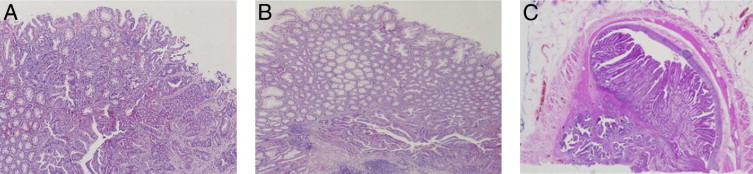
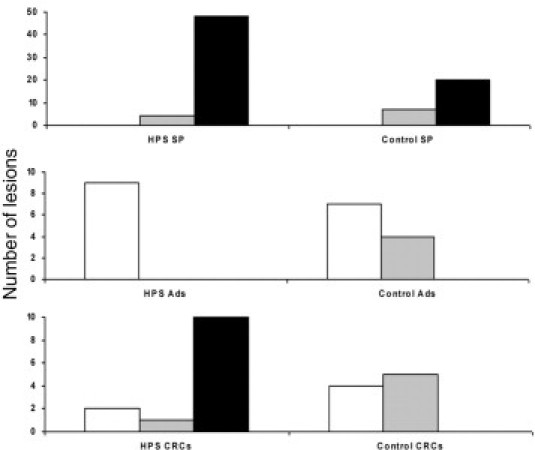
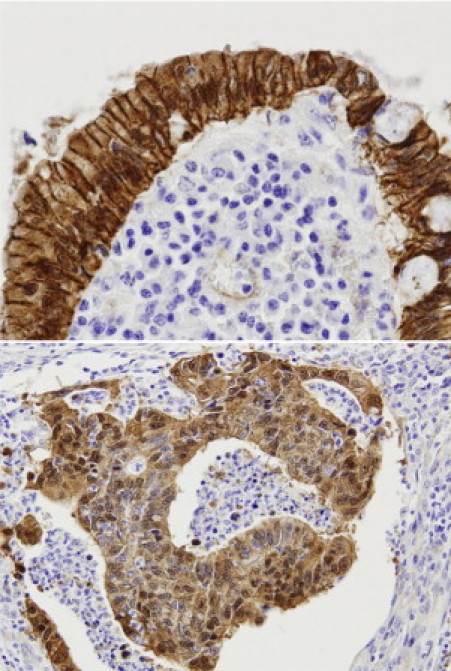
Hyperplastic polyposis syndrome (HPS) is characterized by the presence of multiple colorectal serrated polyps and is associated with an increased colorectal cancer (CRC) risk. The mixture of distinct precursor lesion types and malignancies in HPS provides a unique model to study the canonical pathway and a proposed serrated CRC pathway in humans. To establish which CRC pathways play a role in HPS and to obtain new support for the serrated CRC pathway, we assessed the molecular characteristics of polyps (n = 84) and CRCs (n = 19) in 17 patients with HPS versus control groups of various sporadic polyps (n = 59) and sporadic microsatellite-stable CRCs (n = 16). In HPS and sporadic polyps, APC mutations were exclusively identified in adenomas, whereas BRAF mutations were confined to serrated polyps. Six of 19 HPS CRCs (32%) were identified in a serrated polyp. Mutation analysis performed in the CRC and the serrated component of these lesions showed identical BRAF mutations. One HPS CRC was located in an adenoma, both components harboring an identical APC mutation. Overall, 10 of 19 HPS CRCs (53%) carried a BRAF mutation versus none in control group CRCs (P = 0.001). Six BRAF-mutated HPS CRCs (60%) were microsatellite unstable owing to MLH1 methylation. These findings provide novel supporting evidence for the existence of a predominant serrated CRC pathway in HPS, generating microsatellite-stable and microsatellite-instable CRCs.
Copyright © 2011 American Society for Investigative Pathology. Published by Elsevier Inc. All rights reserved.
Figures
References
-
- Jemal A., Thun M.J., Ries L.A., Howe H.L., Weir H.K., Center M.M., Ward E., Wu X.C., Eheman C., Anderson R., Ajani U.A., Kohler B., Edwards B.K. Annual report to the nation on the status of cancer, 1975–2005, featuring trends in lung cancer, tobacco use, and tobacco control. J Natl Cancer Inst. 2008;100:1672–1694. - PMC - PubMed
-
- Fearon E.R., Vogelstein B. A genetic model for colorectal tumorigenesis. Cell. 1990;61:759–767. - PubMed
-
- Vogelstein B., Fearon E.R., Hamilton S.R., Kern S.E., Preisinger A.C., Leppert M., Nakamura Y., White R., Smits A.M., Bos J.L. Genetic alterations during colorectal-tumor development. N Engl J Med. 1988;319:525–532. - PubMed
-
- Hawkins N.J., Ward R.L. Sporadic colorectal cancers with microsatellite instability and their possible origin in hyperplastic polyps and serrated adenomas. J Natl Cancer Inst. 2001;93:1307–1313. - PubMed
MeSH terms
Substances
LinkOut - more resources
Full Text Sources
Medical
Research Materials
Miscellaneous
