


mRNA expression signatures of human skeletal muscle atrophy identify a natural compound that increases muscle mass
- PMID: 21641545
- PMCID: PMC3120768
- DOI: 10.1016/j.cmet.2011.03.020
mRNA expression signatures of human skeletal muscle atrophy identify a natural compound that increases muscle mass
Abstract
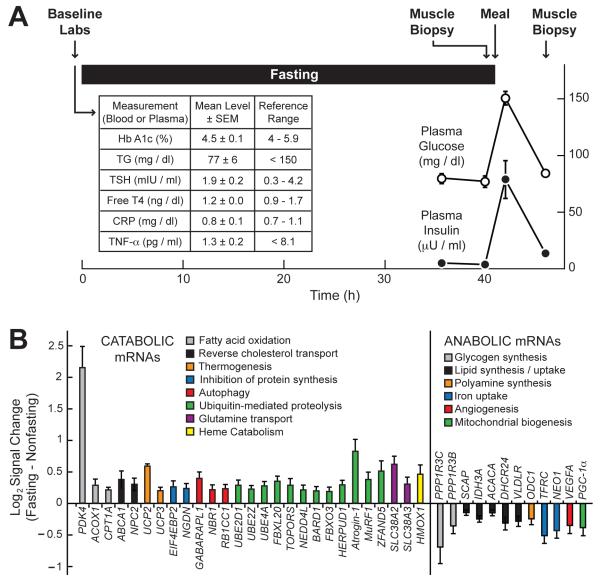
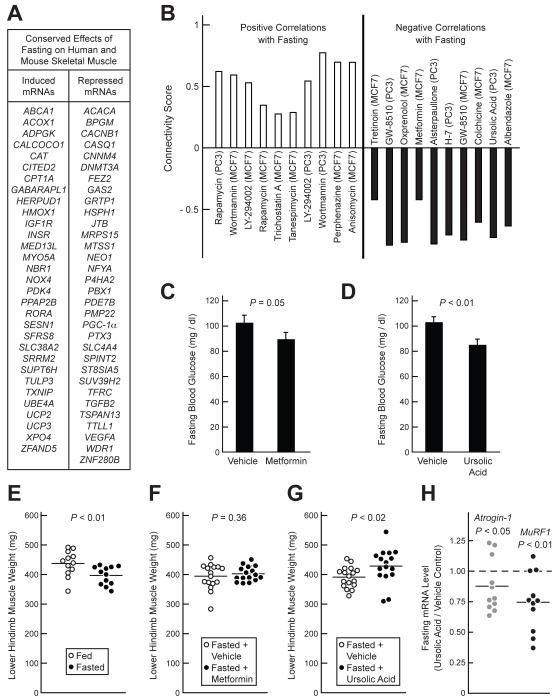
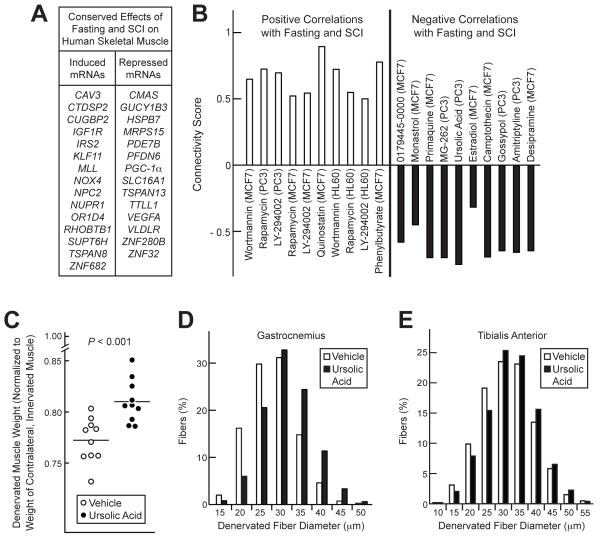
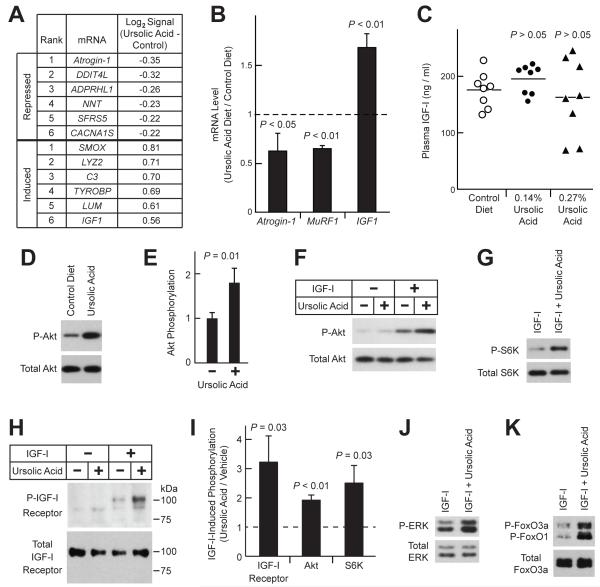
Skeletal muscle atrophy is a common and debilitating condition that lacks a pharmacologic therapy. To develop a potential therapy, we identified 63 mRNAs that were regulated by fasting in both human and mouse muscle, and 29 mRNAs that were regulated by both fasting and spinal cord injury in human muscle. We used these two unbiased mRNA expression signatures of muscle atrophy to query the Connectivity Map, which singled out ursolic acid as a compound whose signature was opposite to those of atrophy-inducing stresses. A natural compound enriched in apples, ursolic acid reduced muscle atrophy and stimulated muscle hypertrophy in mice. It did so by enhancing skeletal muscle insulin/IGF-I signaling and inhibiting atrophy-associated skeletal muscle mRNA expression. Importantly, ursolic acid's effects on muscle were accompanied by reductions in adiposity, fasting blood glucose, and plasma cholesterol and triglycerides. These findings identify a potential therapy for muscle atrophy and perhaps other metabolic diseases.
Copyright © 2011 Elsevier Inc. All rights reserved.
Figures


Comment in
-
Obesity and diabetes: lipid boosts muscle and shrinks fat.Nat Rev Drug Discov. 2011 Aug 1;10(8):576. doi: 10.1038/nrd3522. Nat Rev Drug Discov. 2011. PMID: 21804591 No abstract available.
References
-
- Adams GR, Haddad F. The relationships among IGF-1, DNA content, and protein accumulation during skeletal muscle hypertrophy. J. Appl. Physiol. 1996;81:2509–2516. - PubMed
-
- Adams GR, Haddad F, Baldwin KM. Time course of changes in markers of myogenesis in overloaded rat skeletal muscles. J. Appl. Physiol. 1999;87:1705–1712. - PubMed
-
- Bodine SC, Latres E, Baumhueter S, Lai VK, Nunez L, Clarke BA, Poueymirou WT, Panaro FJ, Na E, Dharmarajan K, Pan ZQ, Valenzuela DM, DeChiara TM, Stitt TN, Yancopoulos GD, Glass DJ. Identification of ubiquitin ligases required for skeletal muscle atrophy. Science. 2001a;294:1704–1708. - PubMed
-
- Bodine SC, Stitt TN, Gonzalez M, Kline WO, Stover GL, Bauerlein R, Zlotchenko E, Scrimgeour A, Lawrence JC, Glass DJ, Yancopoulos GD. Akt/mTOR pathway is a crucial regulator of skeletal muscle hypertrophy and can prevent muscle atrophy in vivo. Nat. Cell Biol. 2001b;3:1014–1019. - PubMed
Publication types
MeSH terms
Substances
Associated data
- Actions
- Actions
Grants and funding
LinkOut - more resources
Full Text Sources
Other Literature Sources
Medical
Molecular Biology Databases
