Review
. 2011 Jun;23(6):2010-32.
doi: 10.1105/tpc.111.084988. Epub 2011 Jun 3.

Coping with stresses: roles of calcium- and calcium/calmodulin-regulated gene expression

Affiliations
Review

Coping with stresses: roles of calcium- and calcium/calmodulin-regulated gene expression

Anireddy S N Reddy et al. Plant Cell. 2011 Jun.

Abstract

Abiotic and biotic stresses are major limiting factors of crop yields and cause billions of dollars of losses annually around the world. It is hoped that understanding at the molecular level how plants respond to adverse conditions and adapt to a changing environment will help in developing plants that can better cope with stresses. Acquisition of stress tolerance requires orchestration of a multitude of biochemical and physiological changes, and most of these depend on changes in gene expression. Research during the last two decades has established that different stresses cause signal-specific changes in cellular Ca(2+) level, which functions as a messenger in modulating diverse physiological processes that are important for stress adaptation. In recent years, many Ca(2+) and Ca(2+)/calmodulin (CaM) binding transcription factors (TFs) have been identified in plants. Functional analyses of some of these TFs indicate that they play key roles in stress signaling pathways. Here, we review recent progress in this area with emphasis on the roles of Ca(2+)- and Ca(2+)/CaM-regulated transcription in stress responses. We will discuss emerging paradigms in the field, highlight the areas that need further investigation, and present some promising novel high-throughput tools to address Ca(2+)-regulated transcriptional networks.


Figures
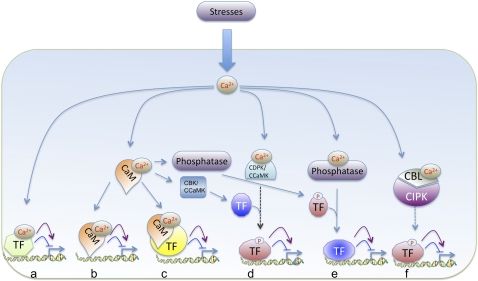
Figure 1.
Figure 1.
Signal-Induced Elevation of Cellular Calcium ([Ca2+]cyt and/or [Ca2+]nuc) Can Regulate Transcription by Different Mechanisms. Elevated Ca2+ levels result in its binding to a Ca2+ sensor, which directly binds to specific DNA sequences and modulates gene expression (a and b). Activated calcium sensors (Ca2+/CaM or Ca2+/CML) interact with DNA binding proteins and modulate their activity resulting in altered transcription (c). Finally, an elevated level of calcium activates a protein kinase (CDPK, CBK, and/or CCaMK) either directly or through CaM or a protein phosphatase, which in turn phosphorylates or dephosphorylates a TF, respectively, resulting in activation or repression of transcription (d to f). Solid arrows indicate pathways with experimental evidence. Pathways lacking evidence are represented by broken arrows. Purple arrows indicate activation of gene expression; blue lines with a horizontal line represent repression.
Figure 2.
Figure 2.
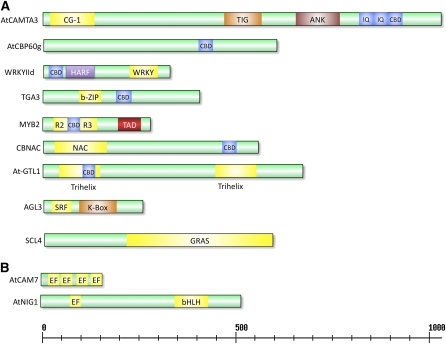
Schematic Diagram of Ca2+ or Ca2+/CaM Binding DNA Proteins Showing Various Domains. (A) Ca2+/CaM binding TFs. One representative member in each CaM binding TF family is shown. For a list of all Ca2+/CaM binding TFs, see Supplemental Table 1 online. (B) DNA binding proteins that bind directly to Ca2+. CG-1, DNA binding domain; TIG, a nonspecific DNA binding domain; ANK, ankyrin repeats that are implicated in protein–protein interaction; IQ, Ca2+-independent CaM binding domain; CBD, CaM binding domain; HARF, conserved domain composed of these residues; WRKY, conserved domain containing these residues; R2R3, Myb DNA binding domain; TAD, transcription activation domain; NAC, conserved domain present in NAM-ATF-CUC proteins; SRF, serum response factor; K-Box, protein–protein interaction domain; GRAS, conserved domain in GAI-RGA-SCR proteins; EF, calcium binding motif; bHLH, basic helix-loop-helix domain. All proteins are drawn to scale. Numbers on the scale indicate the length of the protein in amino acids.
Figure 3.
Figure 3.
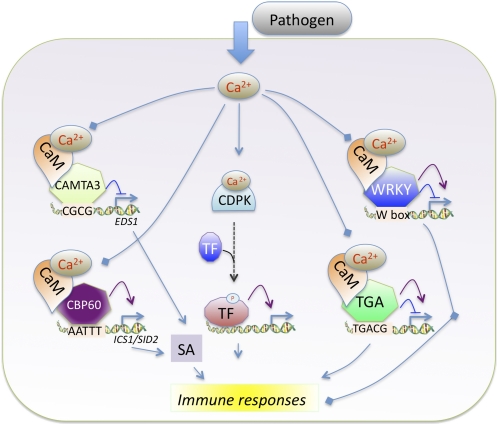
Diagram Illustrating the Known Roles of Ca2+ and Ca2+/CaM Binding TFs in Regulating Expression of Genes Involved in Plant Immunity. Purple arrows indicate activation of gene expression; blue lines with a horizontal line indicate repression. Pathways lacking evidence are represented by broken arrows. Diamonds at the lines’ end indicate that the effect of Ca2+/CaM binding on TFs function is not known. See text for details.
Figure 4.
Figure 4.
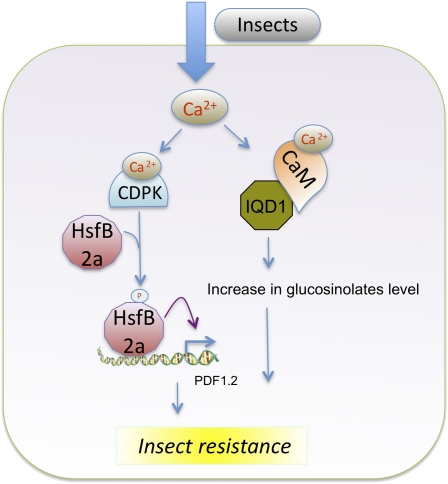
Ca2+ and Ca2+/CaM Binding Proteins’ Role in Expression of Genes Controlling Herbivory. IQD1, IQ-domain 1, a Ca2+/CaM binding region; HsfB2a, Heat shock factor B2a. Purple arrow indicates activation of gene expression. See text for details.
Figure 5.
Figure 5.
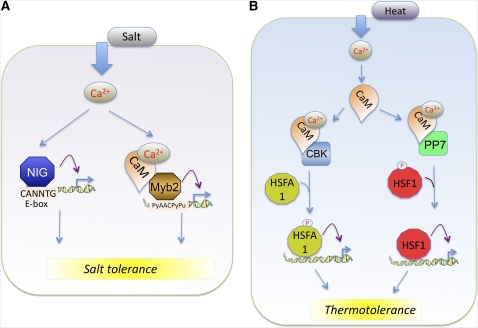
Regulation of Genes Involved in Abiotic Stresses by Ca2+ and Ca2+/CaM Binding TFs. Salt (A) and heat (B). Purple arrows indicate activation of gene expression. NIG, NaCl-inducible gene 1, an EF-hand–containing TF; PP7, Ca2+-CaM binding protein phosphatase 7; HSF, heat shock factor. See text for details.
Figure 6.
Figure 6.
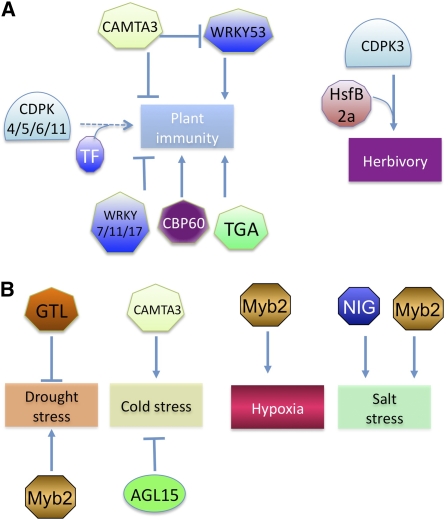
Overview of Negative and Positive Regulation of Biotic and Abiotic Stresses by Ca2+ and Ca2+/CaM Binding TFs. Biotic (A) and abiotic (B) stresses. Positive regulation is indicated by an arrow, and negative regulation is indicated by lines with a horizontal line. Pathways lacking evidence are represented by broken arrows.

References

    1. Abe H., Urao T., Ito T., Seki M., Shinozaki K., Yamaguchi-Shinozaki K. (2003). Arabidopsis AtMYC2 (bHLH) and AtMYB2 (MYB) function as transcriptional activators in abscisic acid signaling. Plant Cell 15: 63–78 - PMC - PubMed
    1. Abe H., Yamaguchi-Shinozaki K., Urao T., Iwasaki T., Hosokawa D., Shinozaki K. (1997). Role of Arabidopsis MYC and MYB homologs in drought- and abscisic acid-regulated gene expression. Plant Cell 9: 1859–1868 - PMC - PubMed
    1. Agarwal P.K., Agarwal P., Reddy M.K., Sopory S.K. (2006). Role of DREB transcription factors in abiotic and biotic stress tolerance in plants. Plant Cell Rep. 25: 1263–1274 - PubMed
    1. Ali G.S., Reddy V.S., Lindgren P.B., Jakobek J.L., Reddy A.S. (2003). Differential expression of genes encoding calmodulin-binding proteins in response to bacterial pathogens and inducers of defense responses. Plant Mol. Biol. 51: 803–815 - PubMed
    1. Ali R., Ma W., Lemtiri-Chlieh F., Tsaltas D., Leng Q., von Bodman S., Berkowitz G.A. (2007). Death don’t have no mercy and neither does calcium: Arabidopsis CYCLIC NUCLEOTIDE GATED CHANNEL2 and innate immunity. Plant Cell 19: 1081–1095 - PMC - PubMed

Publication types

MeSH terms

LinkOut - more resources