. 2011 Apr 1;255(7-8):619-634.
doi: 10.1016/j.ccr.2010.09.002.

Metal Complexes for DNA-Mediated Charge Transport

Affiliations

Metal Complexes for DNA-Mediated Charge Transport

Jacqueline K Barton et al. Coord Chem Rev. .

Abstract

In all organisms, oxidation threatens the integrity of the genome. DNA-mediated charge transport (CT) may play an important role in the generation and repair of this oxidative damage. In studies involving long-range CT from intercalating Ru and Rh complexes to 5'-GG-3' sites, we have examined the efficiency of CT as a function of distance, temperature, and the electronic coupling of metal oxidants bound to the base stack. Most striking is the shallow distance dependence and the sensitivity of DNA CT to how the metal complexes are stacked in the helix. Experiments with cyclopropylamine-modified bases have revealed that charge occupation occurs at all sites along the bridge. Using Ir complexes, we have seen that the process of DNA-mediated reduction is very similar to that of DNA-mediated oxidation. Studies involving metalloproteins have, furthermore, shown that their redox activity is DNA-dependent and can be DNA-mediated. Long range DNA-mediated CT can facilitate the oxidation of DNA-bound base excision repair proteins to initiate a redox-active search for DNA lesions. DNA CT can also activate the transcription factor SoxR, triggering a cellular response to oxidative stress. Indeed, these studies show that within the cell, redox-active proteins may utilize the same chemistry as that of synthetic metal complexes in vitro, and these proteins may harness DNA-mediated CT to reduce damage to the genome and regulate cellular processes.


Figures
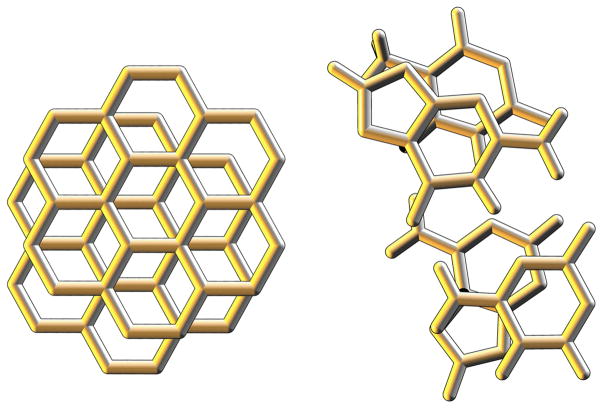
Figure 1
Figure 1
The structure and geometry of stacked graphene sheets (left) is similar to that of stacked DNA base pairs (right).
Figure 2
Figure 2
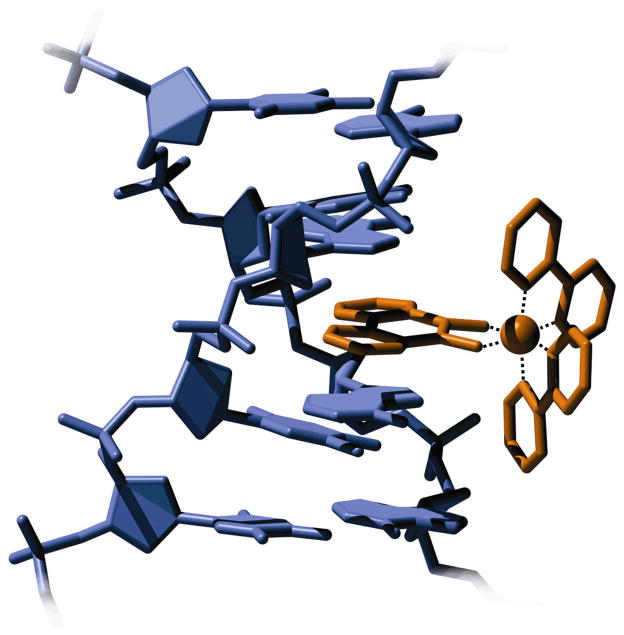
Intercalative binding to DNA results in an increase of the rise at the site of binding, as well as a slight unwinding of the helix. Shown is a model of Rh(phi)(bpy)23+ (orange) bound to DNA (blue), adapted from the crystal structure of a similar construct [11].
Figure 3
Figure 3
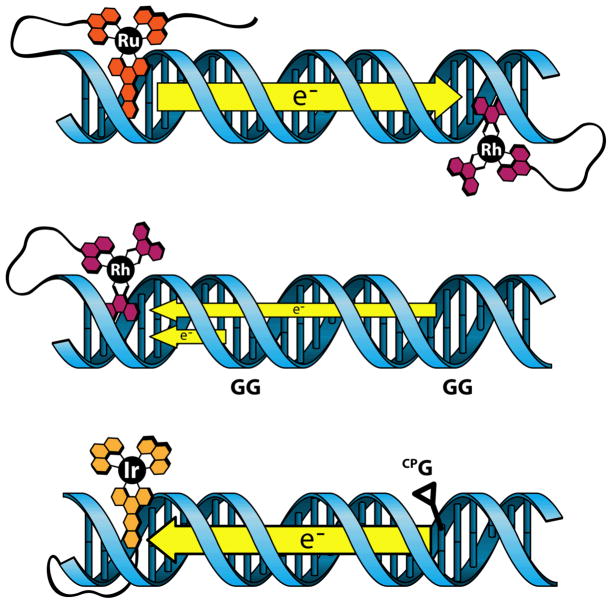
Metal complex-DNA conjugates used to study DNA-mediated CT. Top: covalent tethering of Ru(phen’)2(dppz)2+ and Rh(phi)2(phen’)3+ to complementary DNA strands enables the study of DNA-mediated CT over large distances. Middle: bound Rh(phi)2(bpy’)3+ is competent to oxidize 5′-GG-3′ sites from a distance. Bottom: cyclopropylamine traps enable the fast capture of a charge as it travels along the DNA bridge.
Figure 4
Figure 4
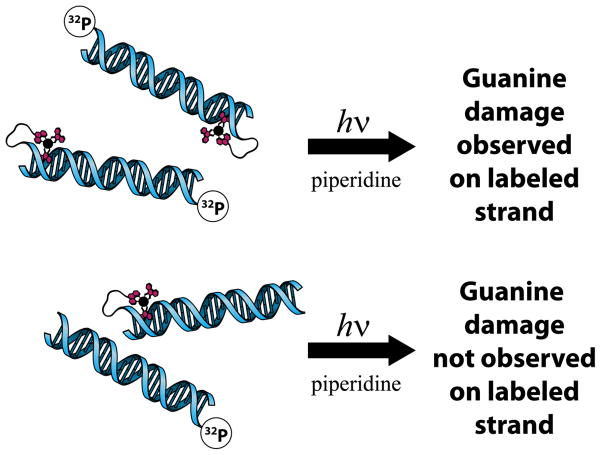
DNA-mediated oxidation is an intraduplex process. Top: guanine damage is observed by PAGE following irradiation and piperidine treatment of photooxidant-DNA conjugates that contain a 32P label. Bottom: no guanine damage is observed following the irradiation and piperidine treatment of mixtures which contain unlabeled photooxidant-DNA conjugates and labeled DNA that has no photooxidant bound.
Figure 5
Figure 5
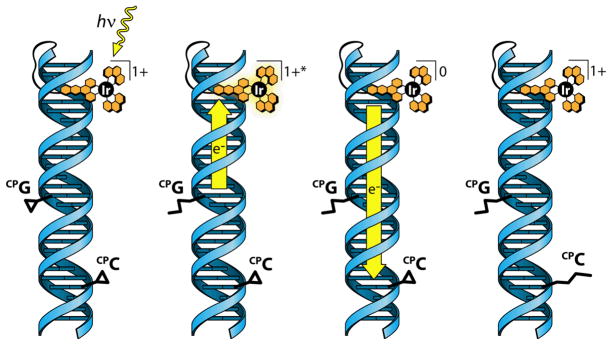
Ping-pong electron transfer. From left to right: photoexcitation of the Ir complex results in DNA-mediated ET from the CPG base. Subsequent ET from the Ir complex reduces the CPC base.
Figure 6
Figure 6
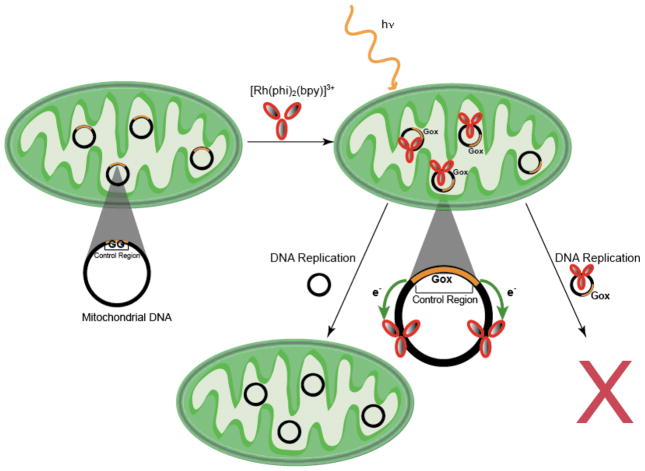
Multiple copies of mitochondrial DNA (black) are found in mitochondria (green) organelles within the cell. Irradiation of Rh(phi)2(bpy)3+ photooxidant results in oxidation of sites with low oxidation potential (Gox). Damage in the genome is funneled (green arrows), via DNA-mediated electron transfer (e) to the control region (orange), preventing replication of the lesion-filled plasmid (bottom right). DNA replication of undamaged DNA occurs, aiding in the survival functional error-free mitochondria (bottom left).
Figure 7
Figure 7
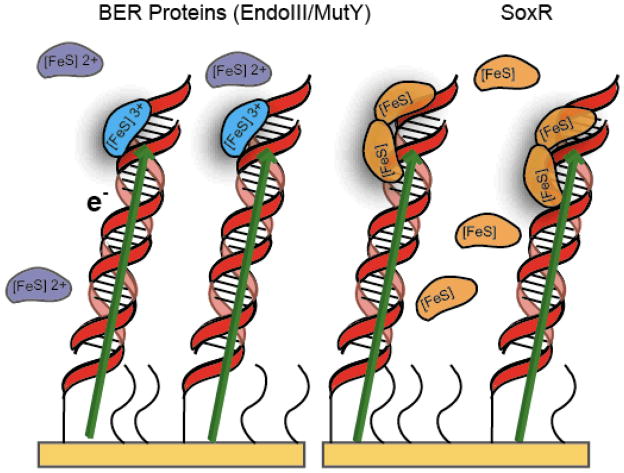
Examples of surfaces used for DNA/protein electrochemistry of BER proteins (left) or SoxR (right). DNA duplexes are attached to the gold via a 5′ thiol linker. Mercaptohexanol (curved lines) is used to backfill so that the duplexes are in an upright position. Electrons travel (arrow) from the gold surface to the bound protein. EndoIII and MutY are bound when the [4Fe4S] cluster is in the 3+ oxidation state, and SoxR binds as a dimer.
Figure 8
Figure 8
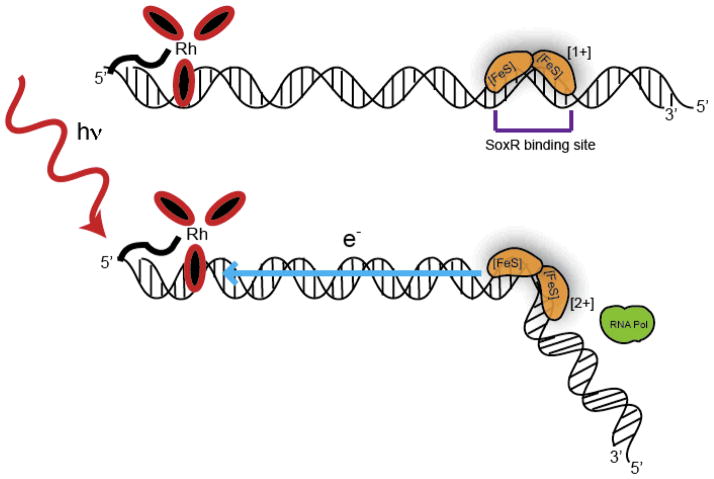
Rh(phi2)(bpy’)3+ is tethered to a duplex of DNA containing the SoxR binding site. SoxR is bound in the reduced (+1) state (yellow protein). Photoactivation of the metal complex triggers electron transfer, oxidizing SoxR (2+), which may then kink the DNA and recruit transcription machinery such as RNA polymerase (green).
Scheme 1
Scheme 1
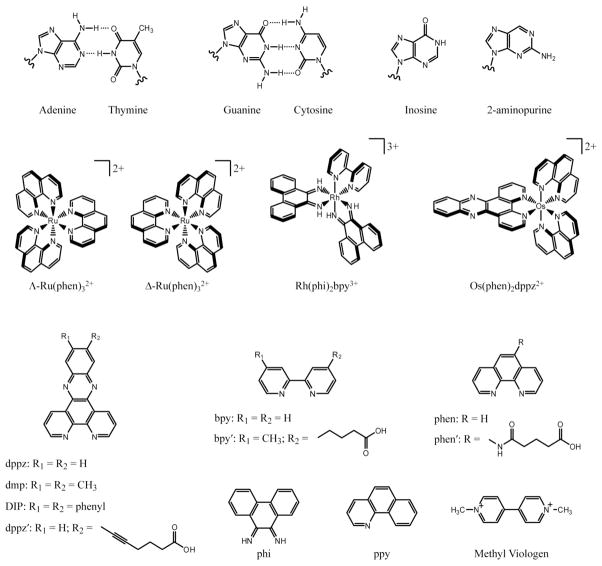
Structures of DNA bases and representative metal complexes used in DNA-CT experiments.
Scheme 2
Scheme 2
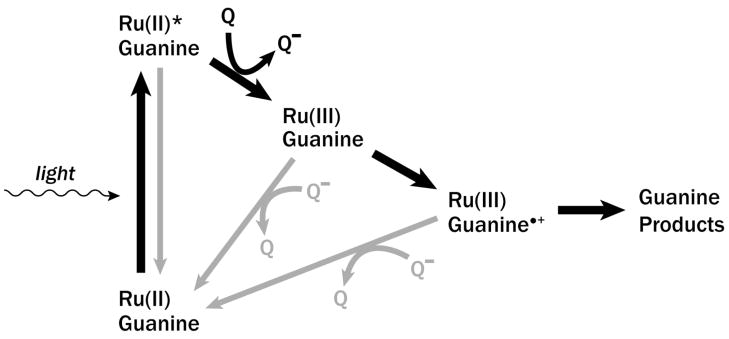
The flash-quench technique. Following photoexcitation, Ru(II)* is oxidized by a diffusing quencher to form the powerful ground state oxidant Ru(III), which can then proceed to oxidize guanine within the base stack. Several back electron transfer pathways lower the efficiency of formation of guanine damage products.
Scheme 3
Scheme 3
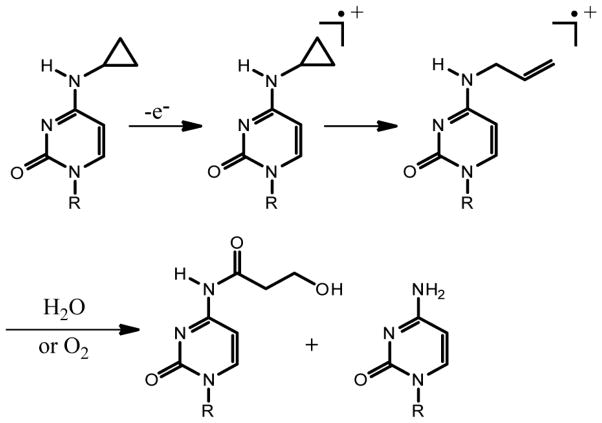
The CPC ring-opening mechanism.
Scheme 4
Scheme 4
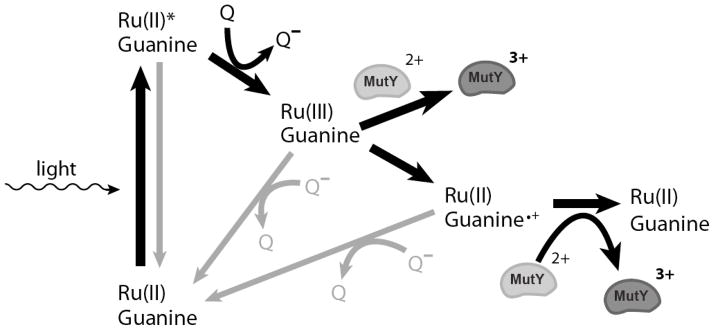
The flash-quench technique used to generate Ru(III) and subsequently oxidize DNA-bound MutY. Following photoexcitation, Ru(II)* is quenched forming powerful ground state oxidant Ru(III) which can then proceed to oxidize guanine within the base stack. The guanine radical not only forms oxidative products but also oxidizes proteins, such as MutY. Back electron transfer reactions are shown in gray.

References

    1. van Loon B, Markkanen E, Hübscher U. DNA Repair. 2010;9:604. - PubMed
    1. David SS, O’Shea VL, Kundu S. Nature. 2007;477:941. - PMC - PubMed
    1. Møller P, Folkmann JK, Forchhammer L, Bräuner EV, Danielsen PH, Risom L, Loft S. Cancer Lett. 2008;266:84. - PubMed
    1. Cooke MS, Evans MD, Dizdaroglu M. J Lunec FASEB J. 2003;17:1195. - PubMed
    1. Nishikawa M. Cancer Lett. 2008;266:53. - PubMed

LinkOut - more resources