


Obstructive sleep apnea and cardiovascular disease: evidence and underlying mechanisms
- PMID: 21643544
- PMCID: PMC3106988
Obstructive sleep apnea and cardiovascular disease: evidence and underlying mechanisms
Abstract
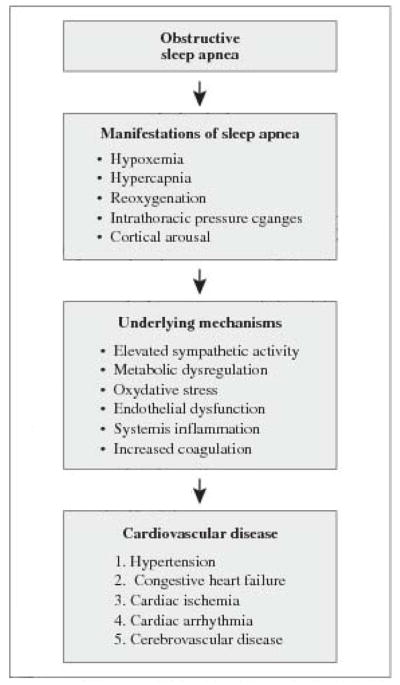
A body of epidemiologic and clinical evidence dating back to the early 1960s establishes the relationships between sleep apnea and cardiovascular disease (CVD). Individuals with obstructive sleep apnea, the most common type of sleep-disordered breathing, are at increased risk for coronary artery disease, congestive heart failure, and stroke. Evidence that treatment of sleep apnea with continuous positive airway pressure reduces blood pressure, improves left ventricular systolic function, and diminishes platelet activation further supports linkage between obstructive sleep apnea and CVD. Notwithstanding, complex associations between these two conditions remain largely unexplained due to dearth of systematic experimental studies. Arguably, several intermediary mechanisms including sustained sympathetic activation, intrathoracic pressure changes, and oxidative stress might be involved. Other abnormalities such as dysfunctions in coagulation factors, endothelial damage, platelet activation, and increased systemic inflammation might also play a fundamental role. This review examines evidence for the associations between obstructive sleep apnea and CVD and suggested underlying anatomical and physiological mechanisms. Specific issues pertaining to definition, prevalence, diagnosis, and treatment of sleep apnea are also discussed. Consistent with rising interest in the potential role of the metabolic syndrome, this review explores the hypothesized mediating effects of each of the components of the metabolic syndrome.
Figures


References
-
- Coccagna G, Mantovani M, Brignani F, Parchi C, Lugaresi E. Tracheostomy in hypersomnia with periodic breathing. Bull Physiopathol Respir. 1972;8:1217–27. - PubMed
-
- Coccagna G, Mantovani M, Brignani F, Parchi C, Lugaresi E. Continuous recording of the pulmonary and systemic arterial pressure during sleep in syndromes of hypersomnia with periodic breathing. Bull Physiopathol Respir. 1972;8:1159–72. - PubMed
-
- Hedner J, Ejnell H, Sellgren J, Hedner T, Wallin G. Is high and fluctuating muscle nerve sympathetic activity in the sleep apnoea syndrome of pathogenetic importance for the development of hypertension? J Hypertens Suppl. 1988;6:SS29–S31. - PubMed
-
- Stoohs RA, Guilleminault C, Itoi A, Dement WC. Traffic accidents in commercial long-haul truck drivers: the influence of sleep-disordered breathing and obesity. Sleep. 1994;17:619–23. - PubMed
-
- El Ad B, Lavie P. Effect of sleep apnea on cognition and mood. Int Rev Psychiatry. 2005;17:277–82. - PubMed
Grants and funding
LinkOut - more resources
Full Text Sources
Other Literature Sources