Review
. 2011 Aug;118(4):490-8.
doi: 10.1111/j.1471-4159.2011.07338.x. Epub 2011 Jul 1.

Advances in understanding the peptide neurotransmitter NAAG and appearance of a new member of the NAAG neuropeptide family

Affiliations
Review

Advances in understanding the peptide neurotransmitter NAAG and appearance of a new member of the NAAG neuropeptide family

Joseph H Neale et al. J Neurochem. 2011 Aug.

Abstract

A substantial body of data was reported between 1984 and 2000 demonstrating that the neuropeptide N-acetylaspartylglutamate (NAAG) not only functions as a neurotransmitter but also is the third most prevalent transmitter in the mammalian nervous system behind glutamate and GABA. By 2005, this conclusion was validated further through a series of studies in vivo and in vitro. The primary enzyme responsible for the inactivation of NAAG following its synaptic release had been cloned, characterized and knocked out. Potent inhibitors of this enzyme were developed and their efficacy has been extensively studied in a series of animal models of clinical conditions, including stroke, peripheral neuropathy, traumatic brain injury, inflammatory and neuropathic pain, cocaine addiction, and schizophrenia. Considerable progress also has been made in defining further the mechanism of action of these peptidase inhibitors in elevating synaptic levels of NAAG with the consequent inhibition of transmitter release via the activation of pre-synaptic metabotropic glutamate receptor 3 by this peptide. Very recent discoveries include identification of two different nervous system enzymes that mediate the synthesis of NAAG from N-acetylaspartate and glutamate and the finding that one of these enzymes also mediates the synthesis of a second member of the NAAG family of neuropeptides, N-acetylaspartylglutamylglutamate.


Figures

Figure 1
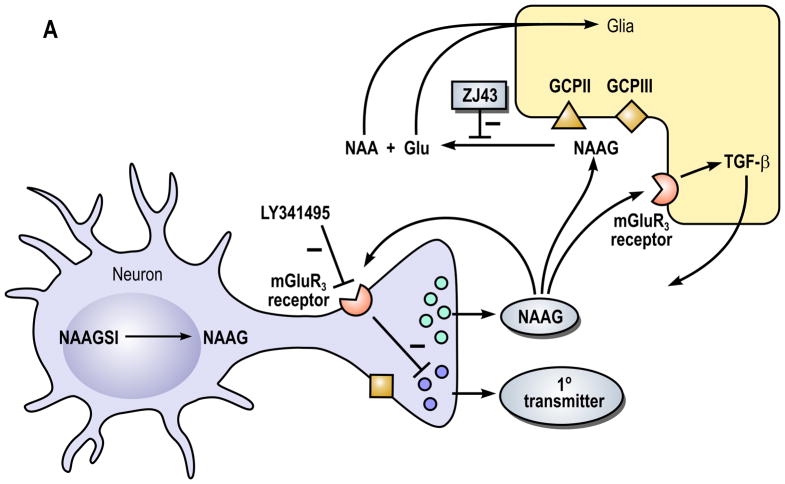
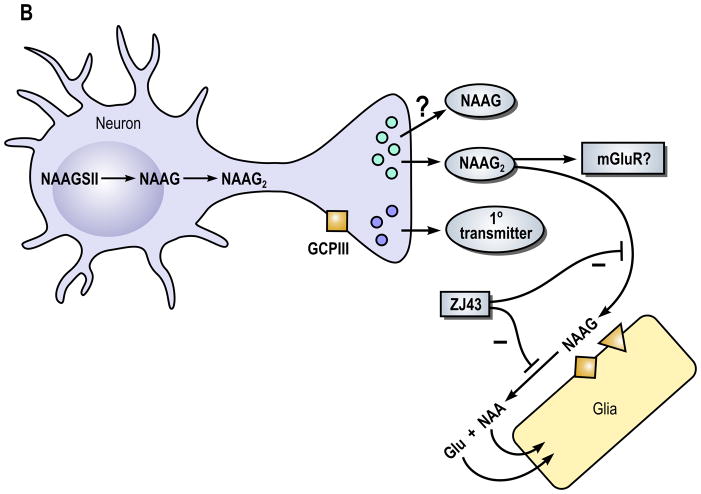
Figure 1. A model of the role of N-acetylaspartylglutamate (NAAG) peptidase inhibition and its influence on (A) NAAG and (B) N-acetylaspartylglutamylglutamate (NAAG2) in the nervous system
In part A, the neuron expresses NAAG synthetase I (NAAGS I), an enzyme that mediates the synthesis of NAAG but not NAAG2. In this cell, NAAG is co-released with a primary amine transmitter, such as glutamate, under conditions of elevated neuronal activity. While the primary transmitter is released into the immediate synaptic space, the peptide is released perisynaptically where it activates presynaptic and glial type 3 metabotropic glutamate receptors (mGluR3). NAAG is inactivated by glutamate carboxypeptidases II (GCPII) and III (GCPIII), forming N-acetylaspartate (NAA) and glutamate (Glu), which are transported into glial cells. While GCPIII is expressed by neurons and glia in cell culture (Bzdega et al., 2004), its localization on presynaptic ending is purely speculative. High levels of glutamate-mediated neurotransmission are associated with several clinical disorders including traumatic brain injury, stroke, peripheral neuropathy, inflammatory pain and schizophrenia. NAAG inhibits glutamate release by activation of presynaptic mGluR3 receptors. Inhibition of the peptidases GCPII and GCPIII by a NAAG peptidase inhibitor, such as ZJ43, reduces inactivation of NAAG. In animal models of these disorders, the NAAG peptidase inhibitor-mediated elevation of peptide levels increases the activation of mGlu3 receptors on axon endings, inhibiting further glutamate release and reducing the pathology. In a second neuroprotective pathway, NAAG activation of mGlu3 receptors on glial cells stimulates the release of a trophic factor, transforming growth factor β (TGF-β). In Part B, the neuron expresses NAAG synthetase II (NAAGSII), an enzyme that mediates the synthesis of NAAG and NAAG2. In this model, we propose that NAAG2 and perhaps NAAG are co-released with a primary amine transmitter, again as it the case for other neuropeptides, under conditions of elevated neuronal activity. The receptor that NAAG2 might activate has not been identified but is likely to be defined in the near future. Since GCPII hydrolyzes both NAAG and NAAG2, peptidase inhibitors such as ZJ43 can be predicted also to elevate levels of NAAG2 and increase its activity.
Figure 1
Figure 1. A model of the role of N-acetylaspartylglutamate (NAAG) peptidase inhibition and its influence on (A) NAAG and (B) N-acetylaspartylglutamylglutamate (NAAG2) in the nervous system
In part A, the neuron expresses NAAG synthetase I (NAAGS I), an enzyme that mediates the synthesis of NAAG but not NAAG2. In this cell, NAAG is co-released with a primary amine transmitter, such as glutamate, under conditions of elevated neuronal activity. While the primary transmitter is released into the immediate synaptic space, the peptide is released perisynaptically where it activates presynaptic and glial type 3 metabotropic glutamate receptors (mGluR3). NAAG is inactivated by glutamate carboxypeptidases II (GCPII) and III (GCPIII), forming N-acetylaspartate (NAA) and glutamate (Glu), which are transported into glial cells. While GCPIII is expressed by neurons and glia in cell culture (Bzdega et al., 2004), its localization on presynaptic ending is purely speculative. High levels of glutamate-mediated neurotransmission are associated with several clinical disorders including traumatic brain injury, stroke, peripheral neuropathy, inflammatory pain and schizophrenia. NAAG inhibits glutamate release by activation of presynaptic mGluR3 receptors. Inhibition of the peptidases GCPII and GCPIII by a NAAG peptidase inhibitor, such as ZJ43, reduces inactivation of NAAG. In animal models of these disorders, the NAAG peptidase inhibitor-mediated elevation of peptide levels increases the activation of mGlu3 receptors on axon endings, inhibiting further glutamate release and reducing the pathology. In a second neuroprotective pathway, NAAG activation of mGlu3 receptors on glial cells stimulates the release of a trophic factor, transforming growth factor β (TGF-β). In Part B, the neuron expresses NAAG synthetase II (NAAGSII), an enzyme that mediates the synthesis of NAAG and NAAG2. In this model, we propose that NAAG2 and perhaps NAAG are co-released with a primary amine transmitter, again as it the case for other neuropeptides, under conditions of elevated neuronal activity. The receptor that NAAG2 might activate has not been identified but is likely to be defined in the near future. Since GCPII hydrolyzes both NAAG and NAAG2, peptidase inhibitors such as ZJ43 can be predicted also to elevate levels of NAAG2 and increase its activity.

References

    1. Adedoyin MO, Vicini S, Neale JH. Endogenous N-acetylaspartylglutamate (NAAG) inhibits synaptic plasticity/transmission in the amygdala in a mouse inflammatory pain model. Molecular Pain. 2010;6:60–77. - PMC - PubMed
    1. Ambrosio M, Zurn A, Lohse M. Sensing G protein-coupled protein activation. Neuropharmacology. 2011;60:45–51. - PubMed
    1. Anderson KJ, Monaghan DT, Cangro CB, Namboodiri MA, Neale JH, Cotman CW. Localization of N-acetylaspartylglutamate-like immunoreactivity in selected areas of the rat brain. Neurosci Lett. 1986;72:14–20. - PubMed
    1. Arun P, Madhavarao CN, Moffett JR, Namboodiri MA. Regulation of N-acetylaspartate and N-acetylaspartylglutamate biosynthesis by protein kinase activators. J Neurochem. 2006;98:2034–2942. - PubMed
    1. Bacich DJ, Pinto JT, Tong WP, Heston WD. Cloning, expression, genomic localization, and enzymatic activities of the mouse homolog of prostate-specific membrane antigen/NAALADase/folate hydrolase. Mamm Genome. 2001;12:117–123. - PubMed

Publication types

MeSH terms