Review
. 2011 Jun;33(11):1991-2002.
doi: 10.1111/j.1460-9568.2011.07715.x.

Neural mechanisms of saccade target selection: gated accumulator model of the visual-motor cascade

Affiliations
Review

Neural mechanisms of saccade target selection: gated accumulator model of the visual-motor cascade

Jeffrey D Schall et al. Eur J Neurosci. 2011 Jun.

Abstract

We review a new computational model developed to understand how evidence about stimulus salience in visual search is translated into a saccade command. The model uses the activity of visually responsive neurons in the frontal eye field as evidence for stimulus salience that is accumulated in a network of stochastic accumulators to produce accurate and timely saccades. We discovered that only when the input to the accumulation process was gated could the model account for the variability in search performance and predict the dynamics of movement neuron discharge rates. This union of cognitive modeling and neurophysiology indicates how the visual-motor transformation can occur, and provides a concrete mapping between neuron function and specific cognitive processes.


Figures

FIGURE 1
FIGURE 1
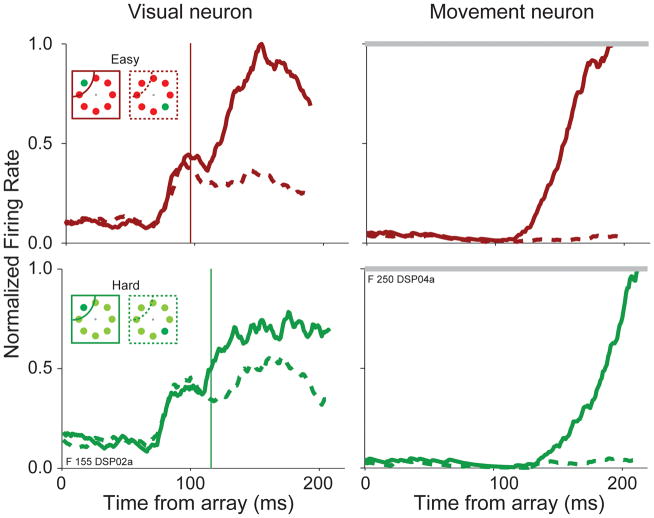
Representative visual and movement neurons recorded in the frontal eye field of a macaque monkey performing visual search for a target that was easy (red) or hard (green) to distinguish from distractors. The activity when the target (solid) or distractor (dashed) fell in the receptive field or movement field is compared. Note the delay in the time when the visual neuron distinguishes the target from the distractor in hard as compared to easy search. Note the corresponding delay in the time when the movement neuron activity begins to accumulate to a threshold.
FIGURE 2
FIGURE 2
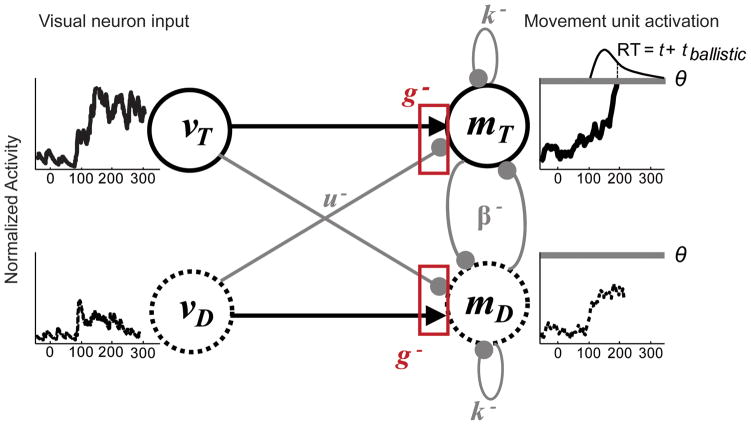
Model architecture. Perceptual evidence supporting a saccade to the target, vT, and supporting a saccade to a distractor, vD, were derived directly from observed discharge rates of FEF visually selective neurons (see text for details). These inputs were integrated by accumulator units representing a saccade to the target, mT, or a saccade to a distractor, mD. A response was initiated when accumulated support for a particular saccade reached a fixed threshold, ⊖, plus ~15 ms ballistic time for the eye movement to be executed. The parameter k determined the strength of leakage and g determined the level of the gate. The parameter u determined the strength of feed-forward inhibition and was fixed to one for the diffusion model. Beta determined the strength of lateral inhibition and was free to vary for the competitive model.
FIGURE 3
FIGURE 3
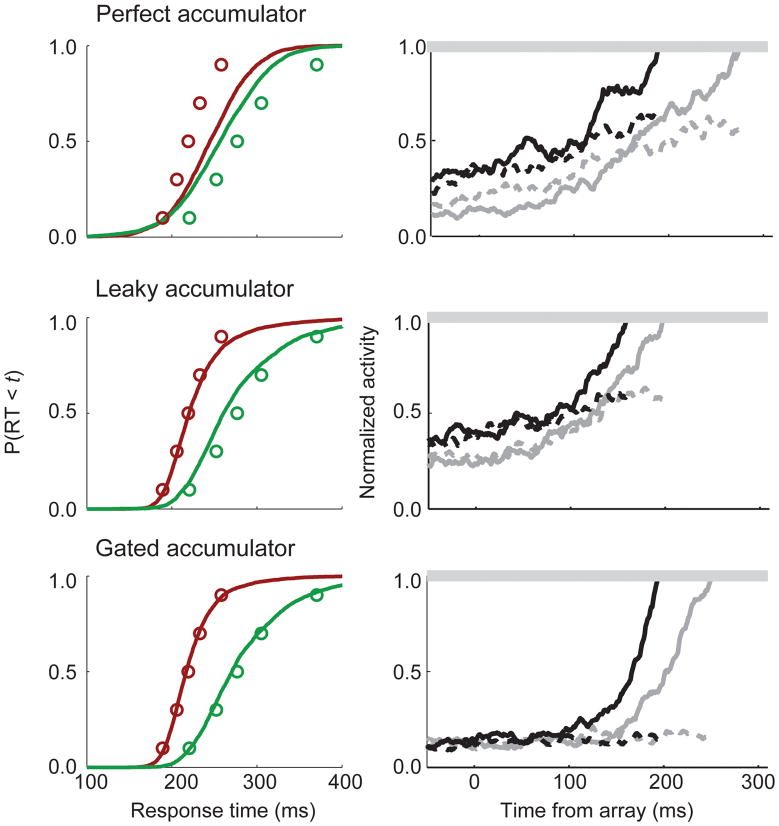
Behavioral fits and neural predictions of the perfect, leaky, and gated accumulator models. Left, observed saccade response time quantiles (open circles) and predicted cumulative response time distribution (solid lines) for the easy (red) and difficult (green) search task. Right, model trajectories for trials which resulted in a fast (black) or slow (grey) saccade response time.
FIGURE 4
FIGURE 4
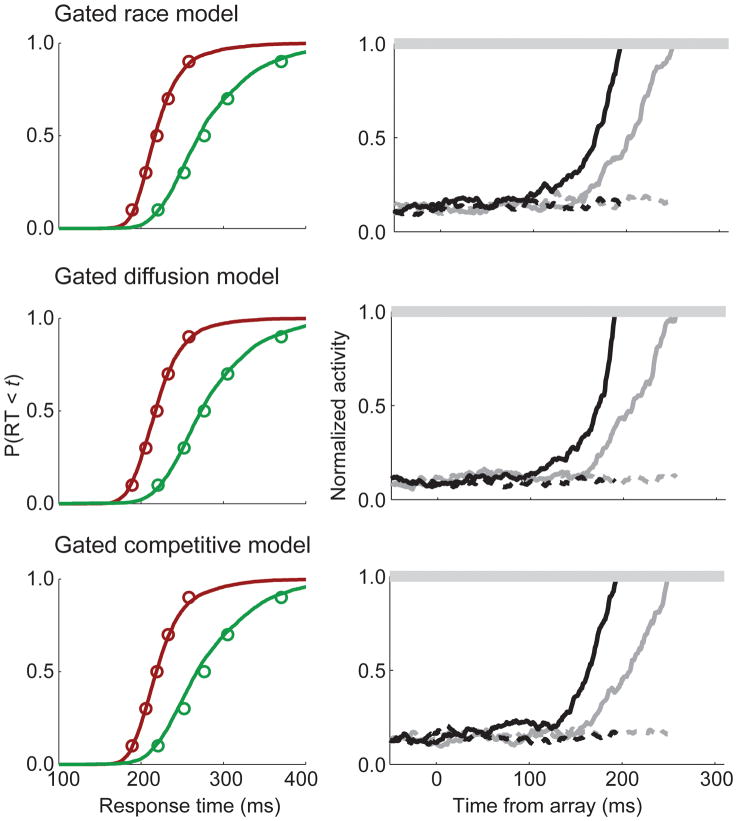
Behavioral fits and neural predictions of the gated race, gated diffusion, and gated competitive accumulator models. Conventions as in Figure 3.

References

    1. Balan PF, Oristaglio J, Schneider DM, Gottlieb J. Neuronal correlates of the set-size effect in monkey lateral intraparietal area. PLoS Biol. 2008;6:158. - PMC - PubMed
    1. Basso MA, Wurtz RH. Modulation of neuronal activity in superior colliculus by changes in target probability. Journal of Neuroscience. 1998;18:7519–7534. - PMC - PubMed
    1. Basso MA, Wurtz RH. Neuronal activity in substantia nigra pars reticulata during target selection. Journal of Neuroscience. 2002;22:1883. - PMC - PubMed
    1. Beck JM, Ma WJ, Kiani R, Hanks T, Churchland AK, Roitman J, Shadlen MN, Latham PE, Pouget A. Probabilistic population codes for Bayesian decision making. Neuron. 2008;60:1142–1152. - PMC - PubMed
    1. Bichot NP, Schall JD. Effects of similarity and history on neural mechanisms of visual selection. Nature Neuroscience. 1999;2:549–554. - PubMed

Publication types