. 2011 Jul;81(2):500-14.
doi: 10.1111/j.1365-2958.2011.07708.x. Epub 2011 Jun 5.

Niche-specific contribution to streptococcal virulence of a MalR-regulated carbohydrate binding protein

Affiliations

Niche-specific contribution to streptococcal virulence of a MalR-regulated carbohydrate binding protein

Samuel A Shelburne 3rd et al. Mol Microbiol. 2011 Jul.

Abstract

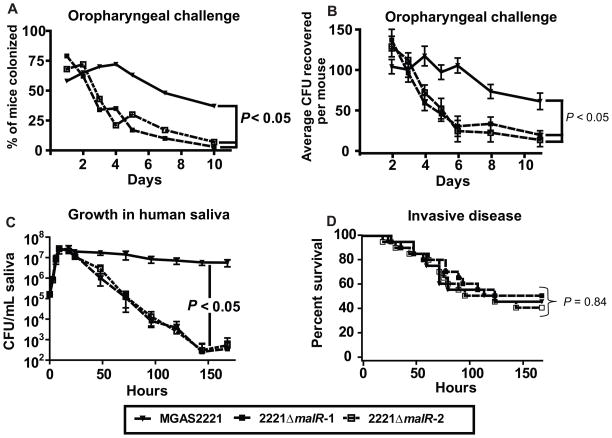
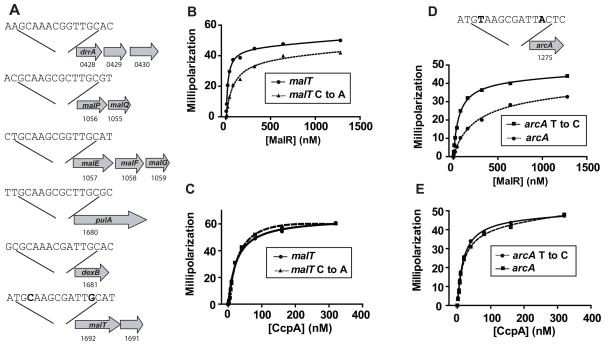
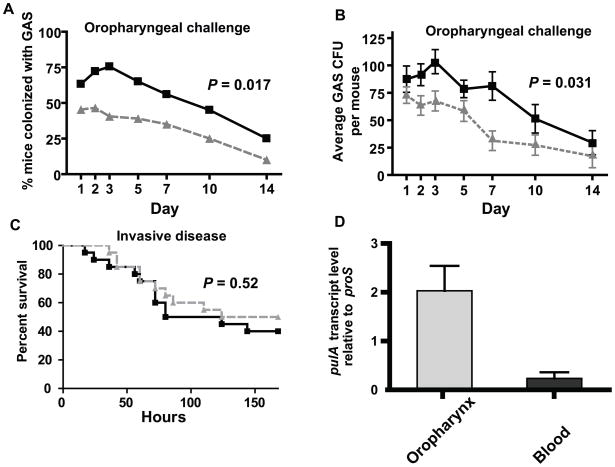
Low G+C Gram-positive bacteria typically contain multiple LacI/GalR regulator family members, which often have highly similar amino-terminal DNA binding domains, suggesting significant overlap in target DNA sequences. The LacI/GalR family regulator catabolite control protein A (CcpA) is a global regulator of the Group A Streptococcus (GAS) transcriptome and contributes to GAS virulence in diverse infection sites. Herein, we studied the role of the maltose repressor (MalR), another LacI/GalR family member, in GAS global gene expression and virulence. MalR inactivation reduced GAS colonization of the mouse oropharynx but did not detrimentally affect invasive infection. The MalR transcriptome was limited to only 25 genes, and a highly conserved MalR DNA-binding sequence was identified. Variation of the MalR binding sequence significantly reduced MalR binding in vitro. In contrast, CcpA bound to the same DNA sequences as MalR but tolerated variation in the promoter sequences with minimal change in binding affinity. Inactivation of pulA, a MalR regulated gene which encodes a cell surface carbohydrate binding protein, significantly reduced GAS human epithelial cell adhesion and mouse oropharyngeal colonization but did not affect GAS invasive disease. These data delineate a molecular mechanism by which hierarchical regulation of carbon source utilization influences bacterial pathogenesis in a site-specific fashion.


Figures

Fig. 1
Fig. 1
MalR affects GAS pathogenesis in a site-specific fashion. (A, B) Indicated GAS strains were inoculated into the nares of 35 CD-1 outbred mice per strain. (A) Percent of mice colonized in the oropharynx with GAS by day. (B) Average number of GAS CFUs isolated from the oropharynx of mice by day with data graphed being mean ± standard error the mean. (C) Indicated GAS strains were grown in human saliva as described (Shelburne et al., 2005a). Strains were grown in duplicate on two separate occasions with data graphed being mean ± standard deviation. For (A–C) P values were derived from a repeated measures analysis followed by Bonferroni’s correction for multiple comparisons. (D) Indicated GAS strains were inoculated intraperitoneally into 20 CD-1 outbred mice per strain. Data graphed are Kaplan-Meier survival analysis with P value derived from a log-rank test.
Fig. 2
Fig. 2
Identification of MalR consensus binding sequence and functional MalR binding studies. (A) Schematic of putative MalR binding sites in the promoter regions of the indicated operons that were negatively influenced by MalR in the transcriptome analysis. Numbers below genes refer to designation in the MGAS5005 genome (Sumby et al., 2005). (B, C) Recombinant GAS MalR (B) or CcpA (C) was titrated into a binding buffer containing 1 nM fluorescein-labeled malT promoter DNA (circle) or 1 nM fluorescein labeled malT promoter DNA with the 4th/13th C/G changed to A/T (called malT C to A, triangle, dashed line). Note that the changed nucleotides are bold in the malT portion of (A). Millipolarization units are plotted against the protein concentration (nM). (D, E) Recombinant GAS MalR (D) or CcpA (E) was titrated into a binding buffer containing 1 nM fluorescein-labeled arcA promoter DNA (circle, dashed line) or 1 nM fluorescein labeled arcA promoter DNA with the 4th/13th T/A changed to C/G (called arcA T to C, triangle, solid line). The changed nucleotides are bold in the arcA promoter region schematic shown above the binding data. For (B–E), each experiment was done on three occasions with representative data from one experiment shown. Lines indicate fit of binding data derived from non-linear regression.
Fig. 3
Fig. 3
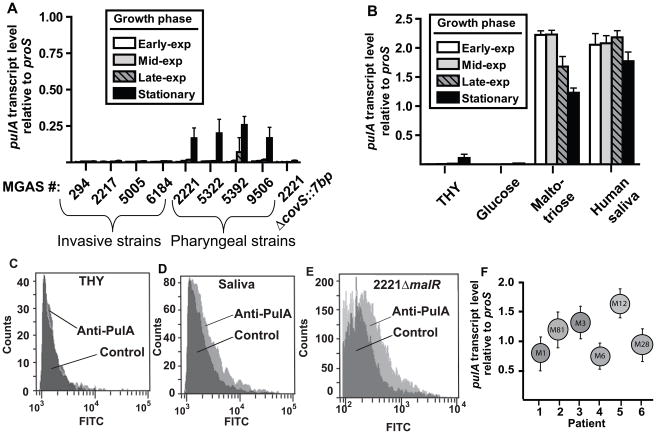
Analysis of pulA transcript levels in laboratory conditions and in vivo. (A) pulA transcript level in serotype M1 GAS strains of defined patient and CovR/S phenotype (Table 1). (B) pulA transcript level in strain MGAS2221 in indicated growth medium. For (A) and (B) white bars indicate early exponential growth, grey bars mid-exponential growth, striped bars late exponential growth, and black bars stationary phase. For (A) and (B) data graphed are mean ± standard deviation of 8 data points. (C–E) Flow cytometric analysis of PulA cell-surface expression. Light grey represents anti-PulA antibody whereas dark grey indicates a control antibody. (C) Strain MGAS2221 grown in THY. (D) Strain MGAS2221 grown in human saliva. (E) Strain 2221 malR-1 grown in THY. (F) pulA transcript levels for 6 patients with GAS pharyngitis were determined by TaqMan real-time PCR. The M serotype of the infecting GAS strain is shown in the circle. Error bars represent standard deviation with each experiment done in quadruplicate on two separate occasions.
Fig. 4
Fig. 4
PulA contributes to GAS eukaryotic cell adherence. (A) Adherence of wild-type (MGAS2221 – white bars) and ΔpulA derivative strains (2221 ΔpulA-1, grey bars; 2221 ΔpulA-2, striped bars) to D562 pharyngeal epithelial cells following cultivation in THY or human saliva as indicated. Representative pictures of adherence of strains 2221 (B) and 2221 ΔpulA-1 (C) to D562 cells following cultivation in THY. Representative pictures of adherence of strains 2221 (D) and 2221 ΔpulA-1 (E) to D562 cells following cultivation in human saliva. (F) Adherence of wild-type (MGAS2221 – white bars) and ΔpulA derivative strains (2221 ΔpulA-1, grey bars; 2221 ΔpulA-2, striped bars) to normal human tracheobronchial epithelial (NHTBE) cells following cultivation in THY or human saliva as indicated. Representative pictures of adherence of strains 2221 (G) and 2221 ΔpulA-1 (H) to NHTBE cells following cultivation in THY. Representative pictures of adherence of strains 2221 (I) and 2221 ΔpulA-2 (J) to NHTBE cells following cultivation in human saliva. For (A) and (F) data graphed are mean numbers of adherent bacteria with error bars indicating standard error of the mean with each experiment done in triplicate on four separate occasions. (K–P) Representative pictures of GAS adherence using strains expressing Gfp and fluorescence microscopy. (K–M) Adherence of strain MGAS2221(pSB100) to NHTBE cells following cultivation in human saliva. (K) Fluorescence alone; (L) Differential phase microscopy; (M) Merge of (K) and (L). (N–P) Adherence of strain 2221 ΔpulA-1(pSB100) to NHTBE cells following cultivation in human saliva. (N) Fluorescence alone; (O) Differential phase microscopy; (P) Merge of (N) and (O).
Fig. 5
Fig. 5
SpyDx contributes to GAS epithelial cell adhesion through binding of α-glucans. (A) The N-terminus, carbohydrate binding portion of PulA (SpyDx) was overexpressed and purified to apparent homogeneity (shown is purified SpyDx run on 4–15% gradient SDS-PAGE). (B–D) Isothermal titration calorimetry data of recombinant SpyDx for (B) glycogen, (C) maltotetraose, and (D) glucose. Note binding shape curve for (B) and (C) indicates heat-release upon binding whereas (D) shows no evidence of specific binding. (E) Recombinant HPr was purified to apparent homogeneity and analyzed as in (A). (F, G) Binding of strain MGAS2221 to D562 human epithelial cells following growth in human saliva. Indicated recombinant proteins (F), antibodies (F), and carbohydrates (G) were added as described in Material and Methods. For (F and G) data graphed are mean numbers of adherent bacteria with error bars indicating standard error of the mean with each experiment done in triplicate on four separate occasions.
Fig. 6
Fig. 6
PulA contributes to GAS oropharyngeal colonization but not invasive disease. (A, B) Indicated GAS strains were inoculated into the nares of 35 CD-1 outbred mice per strain. (A) Percent of mice colonized in the oropharynx with GAS by day. (B) Average number of GAS CFUs isolated from the oropharynx of mice by day with data graphed being mean ± standard error the mean. For (A, B) P values were derived from a repeated measures analysis. (C) Indicated GAS strains were inoculated intraperitoneally into 20 CD-1 outbred mice per strain. Data graphed are Kaplan-Meier analysis with P value derived from log-rank test. (D) GAS RNA was isolated from mouse oropharynx on day 2 following intranasal inoculation and from mouse blood on day 2 following intraperitoneal inoculation. Data graphed are mean transcript level ± standard deviation for four animals analyzed in duplicate.

References

    1. Abranches J, Nascimento MM, Zeng L, Browngardt CM, Wen ZT, Rivera MF, Burne RA. CcpA regulates central metabolism and virulence gene expression in Streptococcus mutans. J Bacteriol. 2008;190:2340–2349. - PMC - PubMed
    1. Allen JH, Utley M, van Den Bosch H, Nuijten P, Witvliet M, McCormick BA, Krogfelt KA, Licht TR, Brown D, Mauel M, Leatham MP, Laux DC, Cohen PS. A functional cra gene is required for Salmonella enterica serovar typhimurium virulence in BALB/c mice. Infect Immun. 2000;68:3772–3775. - PMC - PubMed
    1. Almengor AC, Kinkel TL, Day SJ, McIver KS. The catabolite control protein CcpA binds to Pmga and influences expression of the virulence regulator Mga in the group A Streptococcus. J Bacteriol. 2007;189:8405–8416. - PMC - PubMed
    1. Alteri CJ, Smith SN, Mobley HL. Fitness of Escherichia coli during urinary tract infection requires gluconeogenesis and the TCA cycle. PLoS Pathog. 2009;5:e1000448. - PMC - PubMed
    1. Andersson U, Radstrom P. Physiological function of the maltose operon regulator, MalR, in Lactococcus lactis. BMC Microbiol. 2002;2:28. - PMC - PubMed

Publication types

MeSH terms