


Improving delirium care in the intensive care unit: the design of a pragmatic study
- PMID: 21645330
- PMCID: PMC3123563
- DOI: 10.1186/1745-6215-12-139
Improving delirium care in the intensive care unit: the design of a pragmatic study
Abstract
Background: Delirium prevalence in the intensive care unit (ICU) is high. Numerous psychotropic agents are used to manage delirium in the ICU with limited data regarding their efficacy or harms.
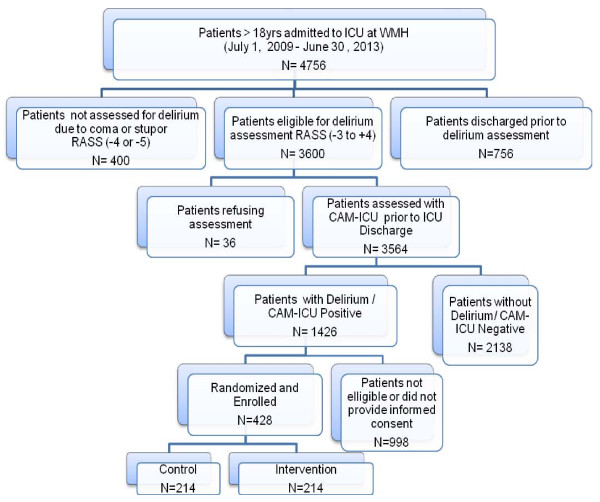
Methods/design: This is a randomized controlled trial of 428 patients aged 18 and older suffering from delirium and admitted to the ICU of Wishard Memorial Hospital in Indianapolis. Subjects assigned to the intervention group will receive a multicomponent pharmacological management protocol for delirium (PMD) and those assigned to the control group will receive no change in their usual ICU care. The primary outcomes of the trial are (1) delirium severity as measured by the Delirium Rating Scale revised-98 (DRS-R-98) and (2) delirium duration as determined by the Confusion Assessment Method for the ICU (CAM-ICU). The PMD protocol targets the three neurotransmitter systems thought to be compromised in delirious patients: dopamine, acetylcholine, and gamma-aminobutyric acid. The PMD protocol will target the reduction of anticholinergic medications and benzodiazepines, and introduce a low-dose of haloperidol at 0.5-1 mg for 7 days. The protocol will be delivered by a combination of computer (artificial intelligence) and pharmacist (human intelligence) decision support system to increase adherence to the PMD protocol.
Discussion: The proposed study will evaluate the content and the delivery process of a multicomponent pharmacological management program for delirium in the ICU.
Trial registration: ClinicalTrials.gov: NCT00842608.
Figures
References
-
- Cooper LM, Lindle-Zwirble TW. Medicare Intensive Care Unit Use: Analysis of incidence, cost, and payment. Crit Care Med. 2004;32:2247–2253. - PubMed
-
- National Hospital Discharge Survey. Public use data file documentation. U.S. Department of Health and Human Services. Centers for Disease Control and Prevention. National Center for Health Statistics. Division of Health Care Statistics. Hospital Care Statistics Branch; 2005. http://www.cdc.gov/nchs/about/major/hdasd/nhds.htm (accessed May 8, 2007)
-
- DeFrances CJ, Podgornik MN. National Center for Health Statistics. Hyattsville, MD; 2006. 2004 National Hospital Discharge Survey. Advance data from vital and health statistics. no 371. - PubMed
-
- Jacobi J, Fraser GL, Coursin DB, Riker RR, Fontaine D, Wittbrodt ET, Chalfin DB, Masica MF, Bjerke HS, Coplin WM. Task Force of the American College of Critical Care Medicine (ACCM) of the Society of Critical Care Medicine (SCCM); American Society of Health-System Pharmacists (ASHP); American College of Chest Physicians et al. Clinical practice guidelines for the sustained use of sedatives and analgesics in the critically ill adult. Crit Care Med. 2002;30(1):119–141. doi: 10.1097/00003246-200201000-00020. - DOI - PubMed
-
- Jackson JC, Gordon SM, Hopkins RO. et al. The association between delirium and cognitive decline: A review of the empirical literature. Neuropsychol Rev. 2004;14:87–98. - PubMed
Publication types
MeSH terms
Substances
Associated data
Grants and funding
LinkOut - more resources
Full Text Sources
Medical
