


Evidence for association of hyperprolinemia with schizophrenia and a measure of clinical outcome
- PMID: 21645996
- PMCID: PMC3161723
- DOI: 10.1016/j.schres.2011.05.006
Evidence for association of hyperprolinemia with schizophrenia and a measure of clinical outcome
Abstract
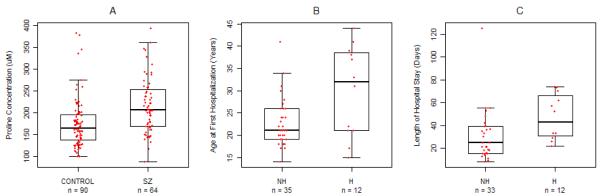
There are multiple genetic links between schizophrenia and a deficit of proline dehydrogenase (PRODH) enzyme activity. However, reports testing for an association of schizophrenia with the resulting proline elevation have been conflicting. The objectives of this study were to investigate whether hyperprolinemia is associated with schizophrenia, and to measure the relationship between plasma proline, and clinical features and symptoms of schizophrenia. We performed a cross-sectional case-control study, comparing fasting plasma proline in 90 control subjects and 64 schizophrenic patients and testing for association of mild to moderate hyperprolinemia with schizophrenia. As secondary analyses, the relationship between hyperprolinemia and five measures of clinical onset, symptoms and outcome were investigated. Patients had significantly higher plasma proline than matched controls (p<0.0001), and categorical analysis of gender adjusted hyperprolinemia showed a significant association with schizophrenia (OR 6.15, p=0.0003). Hyperprolinemic patients were significantly older at their first hospitalization (p=0.015 following correction for multiple testing). While plasma proline level was not related to total, positive or negative symptoms, hyperprolinemic status had a significant effect on length of hospital stay (p=0.005), following adjustment for race, BPRS score, and cross-sectional time from admission to proline measurement. Mild to moderate hyperprolinemia is a significant risk factor for schizophrenia, and may represent an intermediate phenotype in the disease. Hyperprolinemic patients have a significantly later age of first psychiatric hospitalization, suggestive of later onset, and hospital stays 46% longer than non-hyperprolinemic subjects. These findings have implications in the etiology of schizophrenia, and for the clinical management of these patients.
Copyright © 2011 Elsevier B.V. All rights reserved.
Figures
References
-
- Afenjar A, Moutard ML, Doummar D, Guet A, Rabier D, Vermersch AI, et al. Early neurological phenotype in 4 children with biallelic PRODH mutations. Brain Dev. 2007;29(9):547–52. - PubMed
-
- Baxter CF, Baldwin RA, Davis JL, Flood JF. High proline levels in the brains of mice as related to specific learning deficits. Pharmacol Biochem Behav. 1985;22(6):1053–9. - PubMed
-
- Braff D, Stone C, Callaway E, Geyer M, Glick I, Bali L, et al. Prestimulus effects on human startle reflex in normals and schizophrenics. Psychophysiology. 1978;15(4):339–43. - PubMed
-
- Bremer HJ, Duran M, Kamerling JP, Przyrembel H, Wadman SK, et al. Disturbances of amino acid metabolism: Clinical chemistry and diagnosis. Urban & Schwarzenberg, Inc.; Baltimore-Munich: 1981.
Publication types
MeSH terms
Substances
Supplementary concepts
Grants and funding
LinkOut - more resources
Full Text Sources
Other Literature Sources
Medical
Research Materials
