


Visual perception and saccadic eye movements
- PMID: 21646014
- PMCID: PMC3175312
- DOI: 10.1016/j.conb.2011.05.012
Visual perception and saccadic eye movements
Abstract
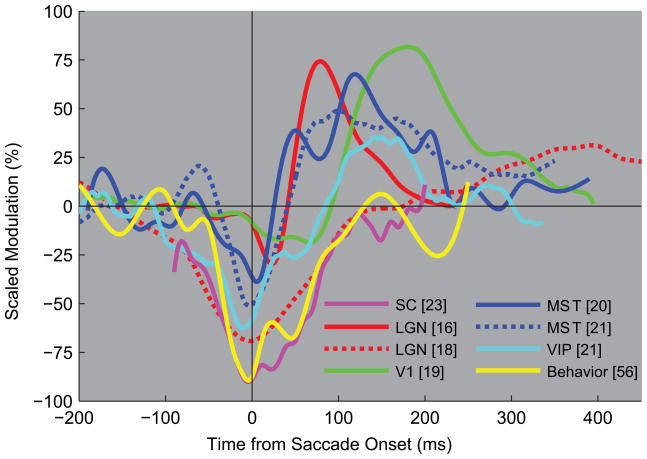
We use saccades several times per second to move the fovea between points of interest and build an understanding of our visual environment. Recent behavioral experiments show evidence for the integration of pre- and postsaccadic information (even subliminally), the modulation of visual sensitivity, and the rapid reallocation of attention. The recent physiological literature has identified a characteristic modulation of neural responsiveness-perisaccadic reduction followed by a postsaccadic increase-that is found in many visual areas, but whose source is as yet unknown. This modulation seems optimal for reducing sensitivity during and boosting sensitivity between saccades, but no study has yet established a direct causal link between neural and behavioral changes.
Copyright © 2011 Elsevier Ltd. All rights reserved.
Figures
References
-
- Teichert T, Klingenhoefer S, Wachtler T, Bremmer F. Perisaccadic mislocalization as optimal percept. J Vis. 2010;10:19. - PubMed
-
- Lee J, Lee C. Changes in orientation discrimination at the time of saccadic eye movements. Vision Res. 2008;48:2213–2223. - PubMed
-
- Schutz AC, Braun DI, Gegenfurtner KR. Object recognition during foveating eye movements. Vision Res. 2009;49:2241–2253. - PubMed
Publication types
MeSH terms
Grants and funding
LinkOut - more resources
Full Text Sources
