Review
. 2011 Aug;21(4):553-8.
doi: 10.1016/j.conb.2011.05.012. Epub 2011 Jun 7.

Visual perception and saccadic eye movements

Affiliations
Review

Visual perception and saccadic eye movements

Michael Ibbotson et al. Curr Opin Neurobiol. 2011 Aug.

Abstract

We use saccades several times per second to move the fovea between points of interest and build an understanding of our visual environment. Recent behavioral experiments show evidence for the integration of pre- and postsaccadic information (even subliminally), the modulation of visual sensitivity, and the rapid reallocation of attention. The recent physiological literature has identified a characteristic modulation of neural responsiveness-perisaccadic reduction followed by a postsaccadic increase-that is found in many visual areas, but whose source is as yet unknown. This modulation seems optimal for reducing sensitivity during and boosting sensitivity between saccades, but no study has yet established a direct causal link between neural and behavioral changes.


Figures

Figure 1
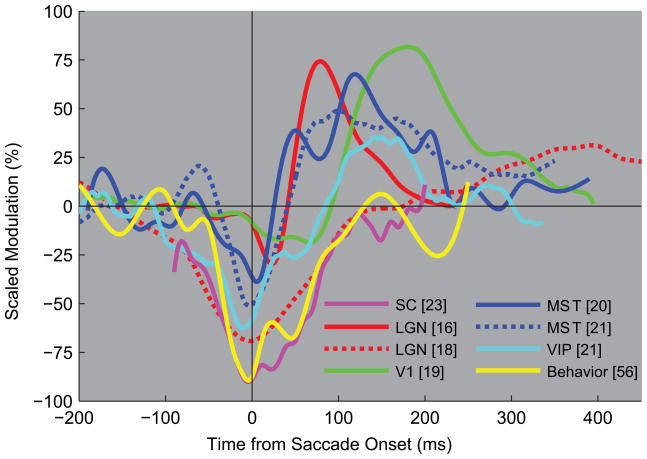
Figure 1. The pattern of perisaccadic modulation
The horizontal axis shows the time relative to saccade onset at which stimuli were presented. The vertical axis shows the scaled modulation of the average firing rate for different areas in the primate brain as well as the scaled average detection performance of two human observers [57]. Zero on the vertical axis represents the average firing rate/performance during steady fixation. In SC experiments, monkeys made small fixational saccades (<30’), in LGN experiments monkeys made voluntary saccades (1.2°–12°) between targets [16] or made small (20’–40’) involuntary saccades during fixation [18]. In V1 experiments [19], voluntary and fixational saccades ranged in size up to 2.4°. In experiments on parietal areas the monkeys made voluntary saccades of 10° [23] or 20°[22]. In the human experiments subjects made 12° saccades[57]. The stimuli were moving or flashed bars (SC, V1, MST, and VIP), large-field textures (MST), gratings (humans), whole-field luminance modulations (LGN), or pseudorandom white noise (LGN). Two studies [18,19] used gaze-contingent stimulus presentation to keep the stimulus within the receptive field. In our view these experimental differences likely contribute to considerable differences in the absolute size of the perisaccadic response modulations. Therefore, to avoid unwarranted comparisons of absolute modulation strength across studies, we scaled the curves per study to set the range (difference between the highest/best and lowest/worst time point) to 1. As a result, the vertical scale is somewhat arbitrary, but this scaling maintains the magnitude relationship between troughs and peaks within a study, as well as the time course across studies. In other words, the trough of the yellow curve indicates that nearly all (90%) behavioral modulation was a reduction of performance relative to fixation. This representation highlights the consistent finding that a firing rate reduction close to saccade-onset is often followed by a postsaccadic firing rate increase.

References

    1. Wurtz R. Neuronal mechanisms of visual stability. Vision Research. 2008;48:2070–2089. - PMC - PubMed
    1. Teichert T, Klingenhoefer S, Wachtler T, Bremmer F. Perisaccadic mislocalization as optimal percept. J Vis. 2010;10:19. - PubMed
    1. Hamker FH, Zirnsak M, Calow D, Lappe M. The Peri-Saccadic Perception of Objects and Space. PLoS computational biology. 2008;4:e31. - PMC - PubMed
    1. Lee J, Lee C. Changes in orientation discrimination at the time of saccadic eye movements. Vision Res. 2008;48:2213–2223. - PubMed
    1. Schutz AC, Braun DI, Gegenfurtner KR. Object recognition during foveating eye movements. Vision Res. 2009;49:2241–2253. - PubMed

Publication types