


The reduction in human motoneurone responsiveness during muscle fatigue is not prevented by increased muscle spindle discharge
- PMID: 21646405
- PMCID: PMC3171882
- DOI: 10.1113/jphysiol.2011.210252
The reduction in human motoneurone responsiveness during muscle fatigue is not prevented by increased muscle spindle discharge
Abstract
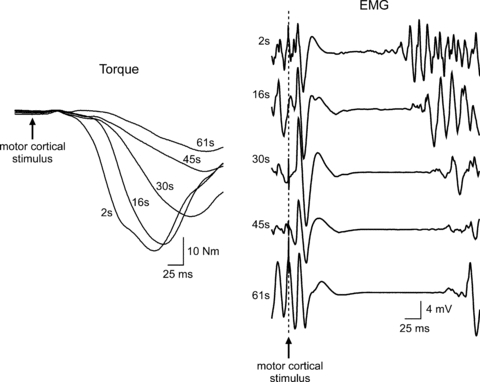
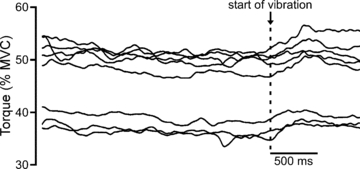
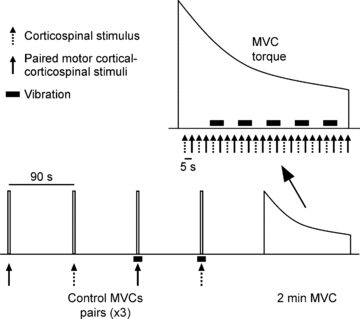
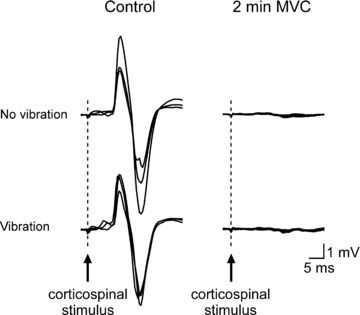
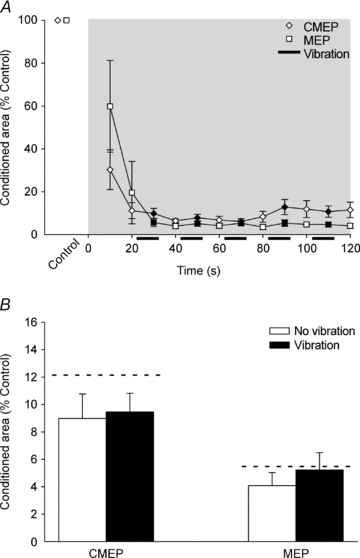
Motoneurone excitability is rapidly and profoundly reduced during a sustained maximal voluntary contraction (MVC) when tested in the transient silent period which follows transcranial magnetic stimulation (TMS) of the motor cortex. One possible cause of this reduction in excitability is a fatigue-induced withdrawal of excitatory input to motoneurones from muscle spindle afferents. We aimed to test if muscle spindle input produced by tendon vibration would ameliorate suppression of the cervicomedullary motor-evoked potential (CMEP) in the silent period during a sustained MVC. Seven subjects performed a 2 min MVC of the elbow flexors. Stimulation of the corticospinal tract at the level of the mastoids was preceded 100 ms earlier by TMS. These stimulus pairs were delivered every 10 s during the 2 min MVC. Stimulus pairs at 30, 50, 70, 90 and 110 s were delivered while vibration (-80 Hz) was applied to the distal tendon of biceps. On a separate day, the protocol was repeated with both stimuli delivered to the motor cortex. The CMEP in the silent period decreased rapidly with fatigue (to -9% of control) and was not affected by tendon vibration (P = 0.766). The motor-evoked potential in the silent period also declined rapidly (to -5% of control) and was similarly unaffected by tendon vibration (P = 0.075). These data suggest motoneurone disfacilitation due to a fatigue-related decrease of muscle spindle discharge does not contribute significantly to the profound suppression of motoneurone excitability during the silent period. Therefore, a change to intrinsic motoneurone properties caused by repetitive discharge is most probably responsible.
Figures
Comment in
-
Tendon vibration does not alter decreased responsiveness of motoneurones in the absence of motor cortical input during fatigue.J Physiol. 2011 Dec 1;589(Pt 23):5559-60. doi: 10.1113/jphysiol.2011.220525. J Physiol. 2011. PMID: 22135409 Free PMC article. No abstract available.
References
Publication types
MeSH terms
LinkOut - more resources
Full Text Sources
