. 2011 Aug 1;589(Pt 15):3731-8.
doi: 10.1113/jphysiol.2011.210252. Epub 2011 Jun 6.

The reduction in human motoneurone responsiveness during muscle fatigue is not prevented by increased muscle spindle discharge

Affiliations

The reduction in human motoneurone responsiveness during muscle fatigue is not prevented by increased muscle spindle discharge

Chris J McNeil et al. J Physiol. .

Abstract

Motoneurone excitability is rapidly and profoundly reduced during a sustained maximal voluntary contraction (MVC) when tested in the transient silent period which follows transcranial magnetic stimulation (TMS) of the motor cortex. One possible cause of this reduction in excitability is a fatigue-induced withdrawal of excitatory input to motoneurones from muscle spindle afferents. We aimed to test if muscle spindle input produced by tendon vibration would ameliorate suppression of the cervicomedullary motor-evoked potential (CMEP) in the silent period during a sustained MVC. Seven subjects performed a 2 min MVC of the elbow flexors. Stimulation of the corticospinal tract at the level of the mastoids was preceded 100 ms earlier by TMS. These stimulus pairs were delivered every 10 s during the 2 min MVC. Stimulus pairs at 30, 50, 70, 90 and 110 s were delivered while vibration (-80 Hz) was applied to the distal tendon of biceps. On a separate day, the protocol was repeated with both stimuli delivered to the motor cortex. The CMEP in the silent period decreased rapidly with fatigue (to -9% of control) and was not affected by tendon vibration (P = 0.766). The motor-evoked potential in the silent period also declined rapidly (to -5% of control) and was similarly unaffected by tendon vibration (P = 0.075). These data suggest motoneurone disfacilitation due to a fatigue-related decrease of muscle spindle discharge does not contribute significantly to the profound suppression of motoneurone excitability during the silent period. Therefore, a change to intrinsic motoneurone properties caused by repetitive discharge is most probably responsible.


Figures
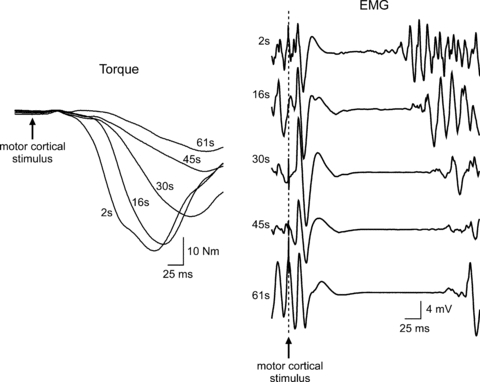
Figure 1
Figure 1. An example of fatigue-related slowing of muscle relaxation rate and lengthening of the silent period recorded from a single subject during a sustained 2 min MVC
Responses were obtained to single transcranial magnetic stimulation during a 2 min sustained maximal effort. Torque responses demonstrate the progressive fatigue-related slowing of muscle relaxation. Normalised to the pre-stimulus torque to account for the loss of maximal torque production, the peak rate of relaxation slowed from −10.5 s−1 to −5.3 s−1 between 2 and 61 s. EMG responses demonstrate the progressive lengthening of the silent period (see Fig. 3 of McNeil et al. 2009 for group data). Traces were collected during the control experiment reported in McNeil et al. (2009).
Figure 2
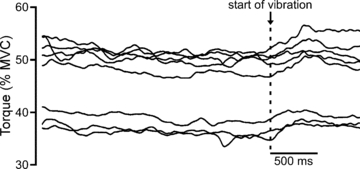
Figure 2. Examples of a vibration-related increase in elbow flexor torque recorded from a single subject during repeated sustained MVCs
Vibration of the distal biceps tendon began when maximal voluntary torque decreased by ∼50–60% and is indicated by the dashed line. During these sustained efforts, torque increased by ∼4% within ∼250 ms of the onset of vibration.
Figure 3
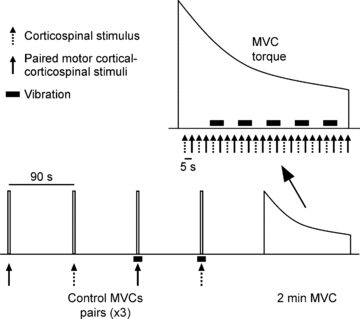
Figure 3. Schematic diagram of protocol A
Twelve brief control MVCs were performed during which paired conditioning–test stimuli or a single test stimulus were delivered. Vibration (∼80 Hz) was applied to the distal biceps tendon on half of these efforts. Single and paired stimuli were delivered alternately at regular intervals whereas vibration was applied periodically during the sustained 2 min MVC. In protocol B, the test stimulus was a motor cortical rather than corticospinal stimulus.
Figure 4
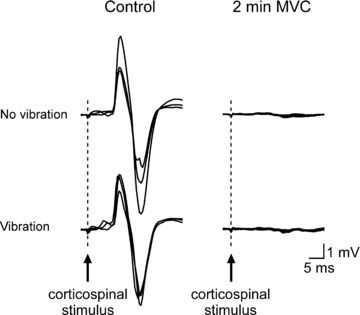
Figure 4. Individual traces of CMEPs in the silent period recorded from a single subject during brief control MVCs and a sustained 2 min MVC
Mean traces of the three conditioned CMEPs with and without vibration are displayed in the left panel. Five responses obtained with (30, 50, 70, 90 and 110 s) and without (40, 60, 80, 100 and 120 s) vibration during the 2 min MVC are overlaid in the right panel. During the sustained effort, conditioned CMEPs were markedly reduced and of similar size both with and without vibration.
Figure 5
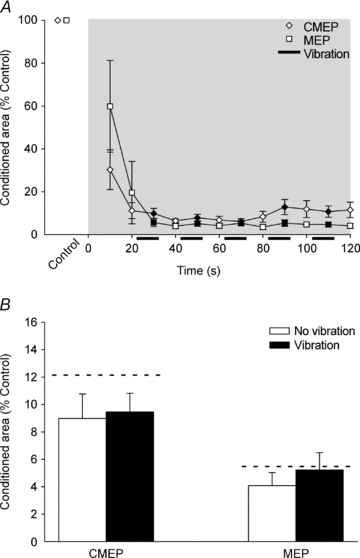
Figure 5. Normalised responses in the silent period during a sustained 2 min MVC
A, data are mean values (± SEM) for conditioned CMEPs and MEPs. The shaded box indicates the sustained MVC and filled symbols indicate data points collected during vibration of the distal biceps tendon. Conditioned area, expressed as a percentage of the control area without vibration, decreased rapidly for both CMEPs and MEPs. B, mean area (± SEM) of conditioned CMEPs and MEPs recorded with (30, 50, 70, 90 and 110 s) and without (40, 60, 80, 100 and 120 s) vibration during the 2 min MVC. Dashed horizontal lines represent the mean value of conditioned potentials recorded at similar time points in our earlier study without vibration (McNeil et al. 2009). Vibration did not significantly increase the size of conditioned CMEPs (P = 0.766) or MEPs (P = 0.075). Conditioned MEPs tended to be smaller than conditioned CMEPs but the difference was not statistically significant (P = 0.080).

Comment in

References

    1. Bigland-Ritchie BR, Dawson NJ, Johansson RS, Lippold OC. Reflex origin for the slowing of motoneurone firing rates in fatigue of human voluntary contractions. J Physiol. 1986;379:451–459. - PMC - PubMed
    1. Bongiovanni LG, Hagbarth KE. Tonic vibration reflexes elicited during fatigue from maximal voluntary contractions in man. J Physiol. 1990;423:1–14. - PMC - PubMed
    1. Butler JE, Taylor JL, Gandevia SC. Responses of human motoneurons to corticospinal stimulation during maximal voluntary contractions and ischemia. J Neurosci. 2003;23:10224–10230. - PMC - PubMed
    1. De Gail P, Lance JW, Neilson PD. Differential effects on tonic and phasic reflex mechanisms produced by vibration of muscles in man. J Neurol Neurosurg Psychiatry. 1966;29:1–11. - PMC - PubMed
    1. Eccles JC, Eccles RM, Lundberg A. The convergence of monosynaptic excitatory afferents on to many different species of alpha motoneurones. J Physiol. 1957;137:22–50. - PMC - PubMed

Publication types

LinkOut - more resources