. 2011 Aug;55(8):3743-51.
doi: 10.1128/AAC.00256-11. Epub 2011 Jun 6.

The pmrCAB operon mediates polymyxin resistance in Acinetobacter baumannii ATCC 17978 and clinical isolates through phosphoethanolamine modification of lipid A

Affiliations

The pmrCAB operon mediates polymyxin resistance in Acinetobacter baumannii ATCC 17978 and clinical isolates through phosphoethanolamine modification of lipid A

Luis A Arroyo et al. Antimicrob Agents Chemother. 2011 Aug.

Abstract

The emergence of multidrug resistance among Acinetobacter baumannii is leading to an increasing dependence on the use of polymyxins as last-hope antibiotics. Here, we utilized genetic and biochemical methods to define the involvement of the pmrCAB operon in polymyxin resistance in this organism. Sequence analysis of 16 polymyxin B-resistant strains, including 6 spontaneous mutants derived from strain ATCC 17978 and 10 clinical isolates from diverse sources, revealed that they had independent mutations in the pmrB gene, encoding a sensor kinase, or in the response regulator PmrA. Knockout of the pmrB gene in two mutants and two clinical isolates led to a decrease in the polymyxin B susceptibility of these strains, which could be restored with the cloned pmrAB genes from the mutants but not from the wild type. Reverse transcription-quantitative PCR (RT-qPCR) analysis also showed a correlation between the expression of pmrC and polymyxin B resistance. Characterization of lipid A species from the mutant strains, by thin-layer chromatography and mass spectrometry, indicated that the addition of phosphoethanolamine to lipid A correlated with resistance. This addition is performed in Salmonella enterica serovar Typhimurium by the product of the pmrC gene, which is a homolog of the pmrC gene from Acinetobacter. Knockout of this gene in the mutant R2 [pmrB(T235I)] reversed resistance as well as phosphoethanolamine modification of lipid A. These results demonstrate that specific alterations in the sequence of the pmrCAB operon are responsible for resistance to polymyxins in A. baumannii.


Figures
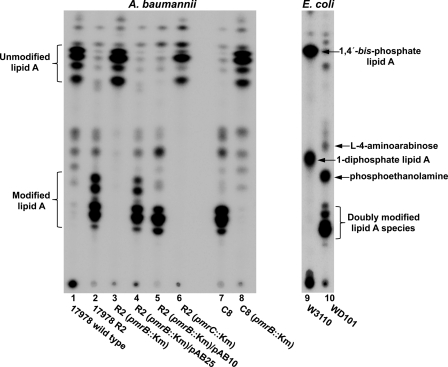
Fig. 1.
Fig. 1.
Analysis of 32P-labeled lipid A species isolated from A. baumannii and E. coli strains. 32P-labeled lipid A species isolated from the indicated bacterial strains were separated by TLC and visualized by phosphorimaging analysis. As shown previously, polymyxin-resistant E. coli (WD101) produced lipid A species modified with l-4-aminoarabinose and phosphoethanolamine, including doubly modified lipid A species (13, 32). Polymyxin B-resistant strains of A. baumannii produced slower migrating, more hydrophilic lipid A species (Rf values of 0.17 to 0.29), compared to the lipid A of polymyxin B-sensitive strains (Rf values of 0.63 to 0.70). The major 32P-labeled lipid A species are indicated with arrows.
Fig. 2.
Fig. 2.
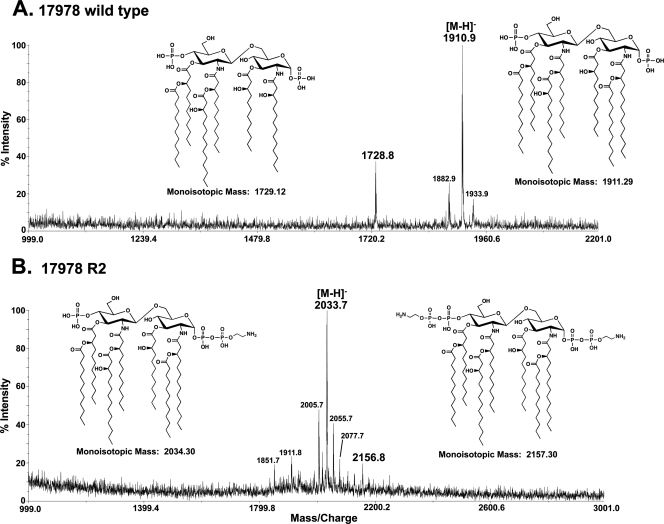
Mass spectrometry of lipid A isolated from wild-type and polymyxin-resistant A. baumannii. Lipid A was isolated from wild-type strain ATCC 17978 and wild-type-derived R2, followed by MALDI-TOF mass spectrometry in the negative-ion mode. (A) Wild-type 17978 produced peaks at m/z values of 1,910.9 and 1,728.8, corresponding to bis-phosphorylated hepta- and hexa-acylated lipid A species, respectively. The minor peak at an m/z of 1,933.9 represents a sodium adduct of the parent ion. The peak at an m/z of 1,882.9 arises from lipid A with an acyl chain reduced by 2 carbons in length compared to that of the major ion. (B) Strain 17978 R2 produced peaks at m/z values of 2,033.7 and 2,156.8, corresponding to bis-phosphorylated hepta-acylated lipid A decorated with one and two phosphoethanolamine groups, respectively. Minor peaks at m/z values of 2,055.7 and 2,077.7 represent sodium adducts of the major parent ion. The minor peak at an m/z of 2,005.7 arises from lipid A with an acyl chain reduced by 2 carbons in length compared to that of the major ion. The peak at an m/z of 1,851.7 is bis-phosphorylated, hexa-acylated lipid A with a single phosphoethanolamine residue.

References

    1. Adams M. D., et al. 2009. Resistance to colistin in Acinetobacter baumannii associated with mutations in the PmrAB two-component system. Antimicrob. Agents Chemother. 53:3628–3634 - PMC - PubMed
    1. Bader M. W., et al. 2005. Recognition of antimicrobial peptides by a bacterial sensor kinase. Cell 122:461–472 - PubMed
    1. Falagas M. E., et al. 2005. Outcome of infections due to pandrug-resistant (PDR) Gram-negative bacteria. BMC Infect. Dis. 5:24. - PMC - PubMed
    1. Fernandez L., et al. 2010. Adaptive resistance to the “last hope” antibiotics polymyxin B and colistin in Pseudomonas aeruginosa is mediated by the novel two-component regulatory system ParR-ParS. Antimicrob. Agents Chemother. 54:3372–3382 - PMC - PubMed
    1. Fishbain J., Peleg A. Y. 2010. Treatment of Acinetobacter infections. Clin. Infect. Dis. 51:79–84 - PubMed

Publication types

MeSH terms