


Assessment of sympathetic index from the Valsalva maneuver
- PMID: 21646629
- PMCID: PMC3269073
- DOI: 10.1212/WNL.0b013e31821e5563
Assessment of sympathetic index from the Valsalva maneuver
Abstract
Objective: Blood pressure (BP) decline and recovery during the Valsalva maneuver (VM) are used to evaluate the degree of sympathetic failure (SF) but a reliable sympathetic index (SI) derived from VM is lacking.
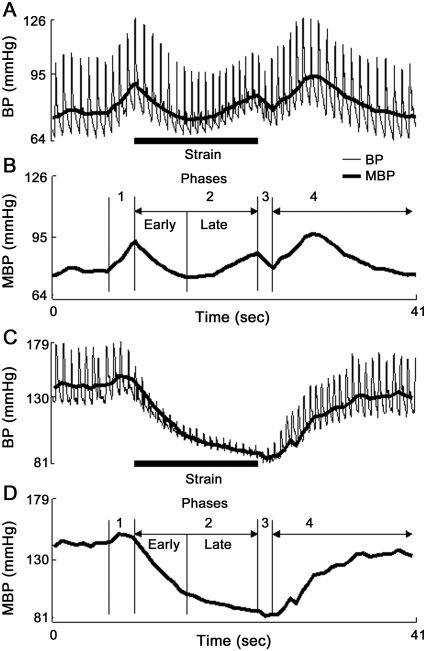
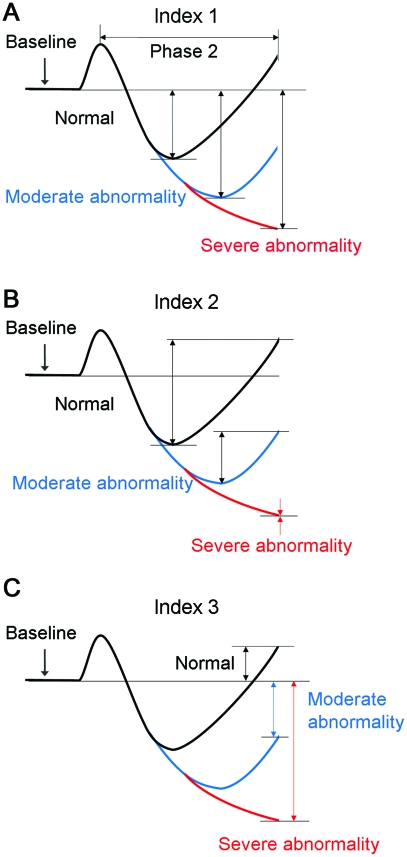
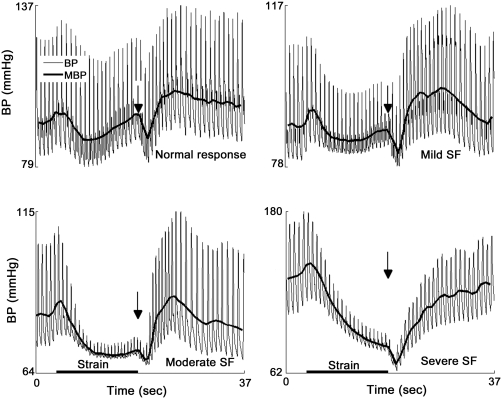
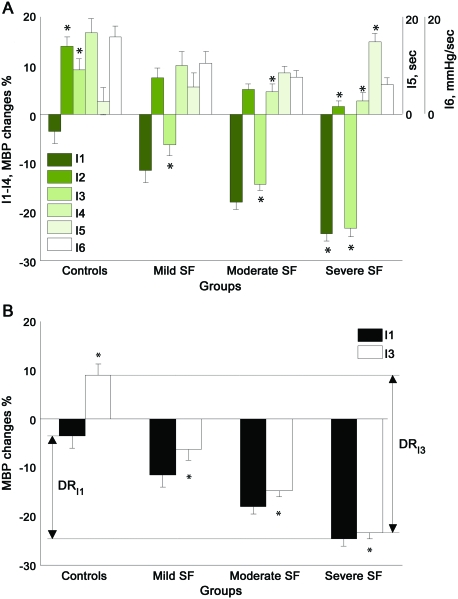
Methods: Patients with mild (n=20), moderate (n=65), and severe (n=60) SF and 23 healthy controls were evaluated using a standardized battery of autonomic tests. SF was defined as mild (associated with reduced sudomotor volumes at distal leg); moderate (associated with a fall in systolic BP ≥10< 30 mm Hg during the tilt test); and severe (associated with a fall in systolic BP ≥30 mm Hg during the tilt test). Six SIs were compared: SI1 (BP fall during phase 2), SI2 (BP recovery during phase 2), SI3 (the difference in BP between baseline and the end of phase 2), SI4 (the magnitude of phase 4), SI5 (BP recovery time), and SI6 (baroreflex sensitivity index).
Results: All indexes showed overall significant differences among tested groups (p<0.05). Only SI3 differentiated all subject groups. Compared to other SIs, SI3 correlated the most with orthostatic hypotension (OH; r=0.62, p < 0.05) during the tilt.
Conclusions: SI3 is the optimal method for calculation of SI since it 1) easily differentiates between healthy controls and those with SF; 2) correlates with the OH, a proxy for a sympathetic failure; 3) tracks the full spectrum of SF (mild-moderate-severe). SI3 expands the utility of quantitative autonomic testing.
Copyright © 2011 by AAN Enterprises, Inc.
Figures
References
-
- Low PA. Composite autonomic scoring scale for laboratory quantification of generalized autonomic failure. Mayo Clin Proc 1993;68:748–752 - PubMed
-
- Korner PI, Tonkin AM, Uther JB. Reflex and mechanical circulatory effects of graded Valsalva maneuvers in normal man. J Appl Physiol 1976;40:434–440 - PubMed
-
- Sandroni P, Benarroch E, Low P. Pharmacological dissection of components of the Valsalva maneuver in adrenergic failure. J Appl Physiol 1991;71:1563–1567 - PubMed
-
- Smith ML, Beightol LA, Fritsch-Yelle JM, et al. Valsalva's maneuver revisited: a quantitative method yielding insights into human autonomic control. Am J Physiol 1996;271:H1240–H1249 - PubMed
-
- Hilz MJ, Dütsch M. Quantitative studies of autonomic function. Muscle Nerve 2006;33:6–20 - PubMed
Publication types
MeSH terms
LinkOut - more resources
Full Text Sources
Medical
