Review
. 2011 Aug;91(8):1122-35.
doi: 10.1038/labinvest.2011.95. Epub 2011 Jun 6.

The mitochondrial paradigm for cardiovascular disease susceptibility and cellular function: a complementary concept to Mendelian genetics

Affiliations
Review

The mitochondrial paradigm for cardiovascular disease susceptibility and cellular function: a complementary concept to Mendelian genetics

David M Krzywanski et al. Lab Invest. 2011 Aug.

Abstract

While there is general agreement that cardiovascular disease (CVD) development is influenced by a combination of genetic, environmental, and behavioral contributors, the actual mechanistic basis of how these factors initiate or promote CVD development in some individuals while others with identical risk profiles do not, is not clearly understood. This review considers the potential role for mitochondrial genetics and function in determining CVD susceptibility from the standpoint that the original features that molded cellular function were based upon mitochondrial-nuclear relationships established millions of years ago and were likely refined during prehistoric environmental selection events that today, are largely absent. Consequently, contemporary risk factors that influence our susceptibility to a variety of age-related diseases, including CVD were probably not part of the dynamics that defined the processes of mitochondrial-nuclear interaction, and thus, cell function. In this regard, the selective conditions that contributed to cellular functionality and evolution should be given more consideration when interpreting and designing experimental data and strategies. Finally, future studies that probe beyond epidemiologic associations are required. These studies will serve as the initial steps for addressing the provocative concept that contemporary human disease susceptibility is the result of selection events for mitochondrial function that increased chances for prehistoric human survival and reproductive success.


Figures
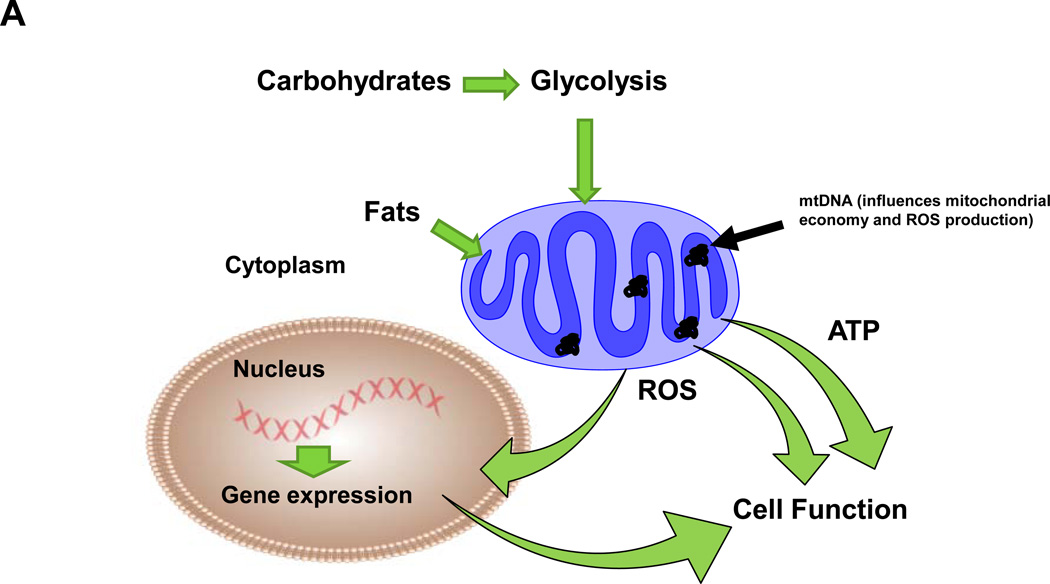
Figure 1
Figure 1
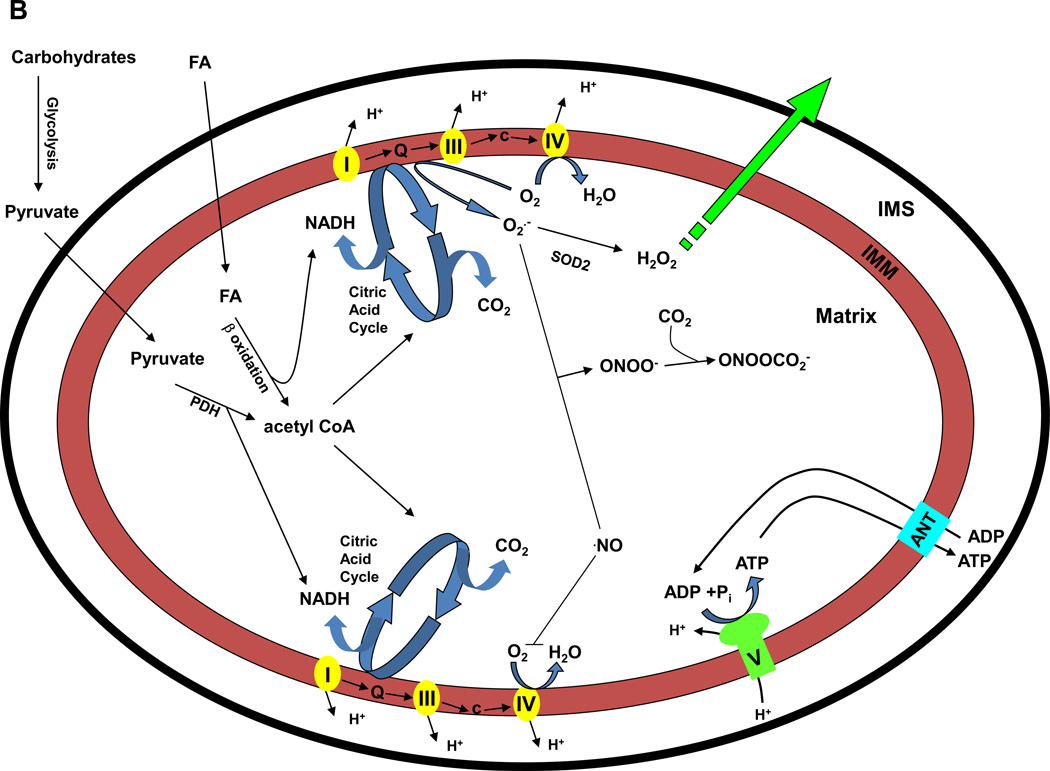
A) Fundamental aspects of mitochondrial function. Caloric energy (carbohydrates and fats) are converted into molecular (ATP) and thermal (heat, energy lost during electron transport) energy and oxidants (reactive oxygen species-ROS). While ATP is utilized for energy requiring cell functions, mitochondrial generated ROS influence redox cell signaling processes, including induction of nuclear gene expression (via redox sensitive transcription factors) which contribute to cell function. Differences in mtDNA sequences are proposed to influence mitochondrial oxygen utilization (economy) and ROS production that impact cell function. The conversion of caloric energy into these respective components is dependent on overall organelle economy (influenced by the mtDNA encoded subunits), degree of positive or negative energy balance and uncoupling proteins. ATP and ROS are utilized for cellular functions (energy requiring processes and redox signaling); mitochondrial ROS also serve as a means for communication to the nuclear compartment and regulation of certain nuclear genes. B) Carbohydrates are metabolized to glucose that is further converted to pyruvate (glycolysis) in the cytoplasm and transported into the mitochondrion. Acetyl CoA is formed from pyruvate via oxidative decarboxylation (pyruvate dehydrogenase), where it enters the citric acid cycle that yields reducing equivalents (NADH and FADH2) for electron transport located within the mitochondrial inner membrane. NADH is oxidized at complex I (NADH:Coenzyme Q oxidoreductase or NADH dehydrogenase) of the transport chain while FADH is oxidized at complex II (Succinate:Coenzyme Q oxidoreductase or Succinate dehydrogenase, part of the citric acid cycle). Electrons are next passed to Coenzyme Q (Q). Complex III (Coenzyme Q:Cytochrome c oxidoreductase or Cytochrome bc1 complex) passes electrons from reduced coenzyme Q (Q) to cytochrome c (c), a peripheral membrane protein that alternately binds cytochrome c1 (of complex III) and to complex IV (Cytochrome c oxidase). Complex IV catalyzes the one electron oxidations of four consecutive reduced cytochrome c molecules and the concomitant four electron reduction of one O2 molecule to yield H2O. During electron transport, protons are pumped across the inner membrane from the matrix into the intermembrane space, creating an electrochemical gradient. The free energy resulting from this gradient is utilized to condense a molecule of inorganic phosphate (Pi) with ADP at complex V (ATP synthase or F1F0 – ATPase) to yield ATP. ATP is subsequently transported out of the matrix by the inner membrane bound adenine nucleotide translocase (ANT) with the exchange of ADP. Fats bypass glycolytic metabolism in the cytoplasm and undergo β-oxidation in the mitochondrion to yield acetyl CoA (plus NADH and FADH2 per cycle of oxidation), which enters the citric acid cycle to generate substrates for electron transport. During electron transport, superoxide (O2˙) is generated when electrons are added to O2; O2˙ is converted to hydrogen peroxide (H2O2) in the mitochondrion by manganese superoxide dismutase (MnSOD or SOD2). H2O2 (which is freely diffusible) can participate in cell signaling processes (H2O2 levels are regulated by a number of antioxidants within the mitochondrion and the cell, not illustrated). Alternatively, O2˙ reacts with nitric oxide (˙NO) to form peroxynitrite (ONOO), an oxidant, which in the presence of carbon dioxide (CO2) forms nitrosoperoxycarbonate (ONOOCO2), a nitrating agent.
Figure 1
Figure 1
A) Fundamental aspects of mitochondrial function. Caloric energy (carbohydrates and fats) are converted into molecular (ATP) and thermal (heat, energy lost during electron transport) energy and oxidants (reactive oxygen species-ROS). While ATP is utilized for energy requiring cell functions, mitochondrial generated ROS influence redox cell signaling processes, including induction of nuclear gene expression (via redox sensitive transcription factors) which contribute to cell function. Differences in mtDNA sequences are proposed to influence mitochondrial oxygen utilization (economy) and ROS production that impact cell function. The conversion of caloric energy into these respective components is dependent on overall organelle economy (influenced by the mtDNA encoded subunits), degree of positive or negative energy balance and uncoupling proteins. ATP and ROS are utilized for cellular functions (energy requiring processes and redox signaling); mitochondrial ROS also serve as a means for communication to the nuclear compartment and regulation of certain nuclear genes. B) Carbohydrates are metabolized to glucose that is further converted to pyruvate (glycolysis) in the cytoplasm and transported into the mitochondrion. Acetyl CoA is formed from pyruvate via oxidative decarboxylation (pyruvate dehydrogenase), where it enters the citric acid cycle that yields reducing equivalents (NADH and FADH2) for electron transport located within the mitochondrial inner membrane. NADH is oxidized at complex I (NADH:Coenzyme Q oxidoreductase or NADH dehydrogenase) of the transport chain while FADH is oxidized at complex II (Succinate:Coenzyme Q oxidoreductase or Succinate dehydrogenase, part of the citric acid cycle). Electrons are next passed to Coenzyme Q (Q). Complex III (Coenzyme Q:Cytochrome c oxidoreductase or Cytochrome bc1 complex) passes electrons from reduced coenzyme Q (Q) to cytochrome c (c), a peripheral membrane protein that alternately binds cytochrome c1 (of complex III) and to complex IV (Cytochrome c oxidase). Complex IV catalyzes the one electron oxidations of four consecutive reduced cytochrome c molecules and the concomitant four electron reduction of one O2 molecule to yield H2O. During electron transport, protons are pumped across the inner membrane from the matrix into the intermembrane space, creating an electrochemical gradient. The free energy resulting from this gradient is utilized to condense a molecule of inorganic phosphate (Pi) with ADP at complex V (ATP synthase or F1F0 – ATPase) to yield ATP. ATP is subsequently transported out of the matrix by the inner membrane bound adenine nucleotide translocase (ANT) with the exchange of ADP. Fats bypass glycolytic metabolism in the cytoplasm and undergo β-oxidation in the mitochondrion to yield acetyl CoA (plus NADH and FADH2 per cycle of oxidation), which enters the citric acid cycle to generate substrates for electron transport. During electron transport, superoxide (O2˙) is generated when electrons are added to O2; O2˙ is converted to hydrogen peroxide (H2O2) in the mitochondrion by manganese superoxide dismutase (MnSOD or SOD2). H2O2 (which is freely diffusible) can participate in cell signaling processes (H2O2 levels are regulated by a number of antioxidants within the mitochondrion and the cell, not illustrated). Alternatively, O2˙ reacts with nitric oxide (˙NO) to form peroxynitrite (ONOO), an oxidant, which in the presence of carbon dioxide (CO2) forms nitrosoperoxycarbonate (ONOOCO2), a nitrating agent.
Figure 2
Figure 2
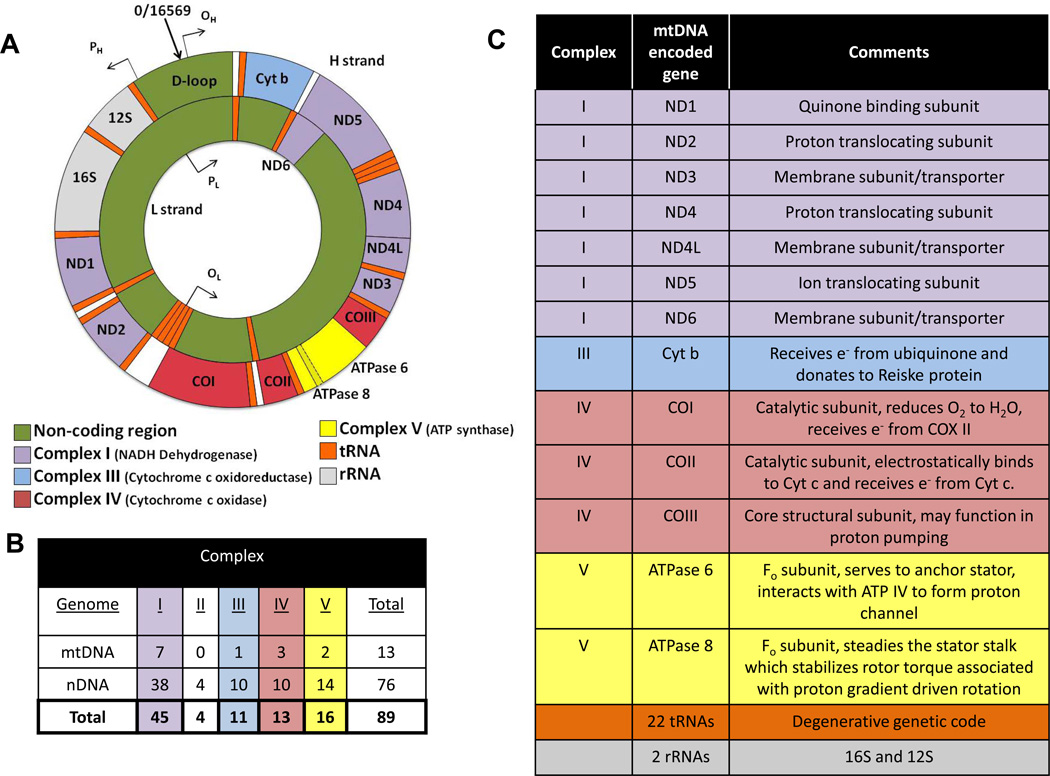
A) Sequence organization of the mammalian mtDNA. Colors indicate mtDNA encoded subunits for respective electron transport complexes, ATP synthase, tRNAs and rRNAs. ATPase 6 and 8 subunits overlap in sequence. The origins of heavy strand (guanosine rich) and light strand DNA synthesis are indicated by OH and OL, respectively. Transcriptional promoters for the heavy and light strands are represented by PH and PL, respectively. The D-loop (displacement loop) is a ~1 kb non-coding region within the mtDNA. The mtDNA genetic code is highly degenerate, so that only 22 are required for protein translation. When uridine is in the wobble position, all four members of a codon family can be read by one mitochondrial tRNA, whereas pairs of codons can be read when guanine or uridine is in the wobble position. Hence, 8 mitochondrial tRNAs recognize four member codon families, while 14 tRNAs recognize codon pairs. B) Table presenting the number of mtDNA and nDNA encoded subunits for each electron transport complex (I–IV) and ATP synthase (V) in the mammalian mtDNA. C) Table summarizing the known (or putative) function of each of the mtDNA encoded genes.
Figure 3
Figure 3
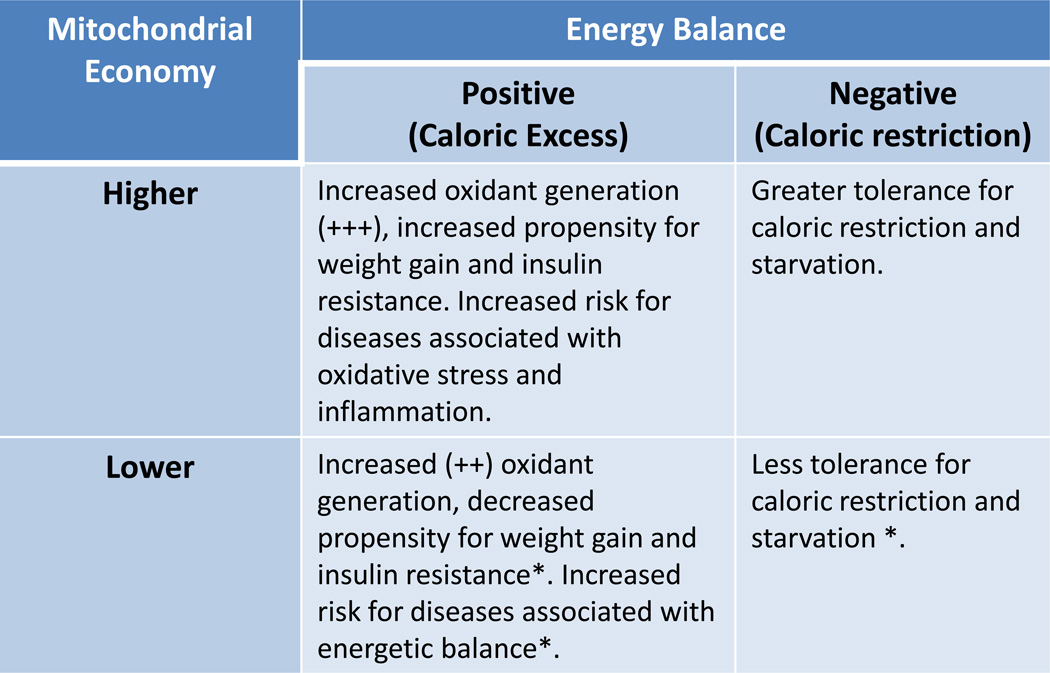
Table summarizing the anticipated characteristics of cells/tissues/individuals harboring mitochondria having higher or lower economy in regard to cellular-tissue oxidant generation and individual propensity for weight gain under positive or negative energy balance. An asterisk (*) indicates relative to higher economy, however under conditions of persistent positive energy balance, even cells/tissues/individuals with decreased (lower) mitochondrial economy will exhibit the same features as those with higher economy due to chronic stress. It is predicted that these features will be related to specific mtDNA sequences, or shared mutations between mtDNA haplotypes (representing mtDNA haplogroups).

References

    1. American Heart Association. Heart Disease and Stroke Statistics - 2006 Update. Circulation. 2006 Feb 14;105:1–67.
    1. Carpenter KL, Taylor SE, van der Veen C, Mitchinson MJ. Evidence of lipid oxidation in pulmonary artery atherosclerosis. Atherosclerosis. 1995;118:169–172. - PubMed
    1. Halliwell B. Free radicals, reactive oxygen species and human disease: a critical evaluation with special reference to atherosclerosis. Br J Exp Pathol. 1989;70:737–757. - PMC - PubMed
    1. Halliwell B. Lipid peroxidation, antioxidants and cardiovascular disease: how should we move forward? Cardiovasc Res. 2000;47(3):410–418. - PubMed
    1. Berliner JA, Heinecke JW. The role of oxidized lipoproteins in atherogenesis. Free Radic Biol Med. 1996;20:707–727. - PubMed

Publication types

Substances