


Disparities in the moral intuitions of criminal offenders: The role of psychopathy
- PMID: 21647247
- PMCID: PMC3107598
- DOI: 10.1016/j.jrp.2011.02.005
Disparities in the moral intuitions of criminal offenders: The role of psychopathy
Abstract
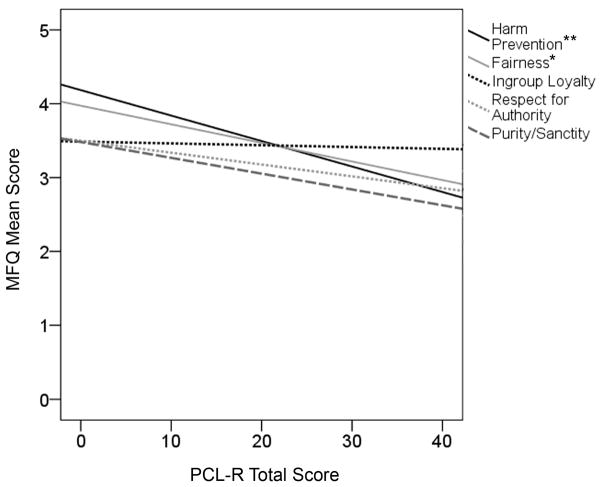
The present study examined whether and in what ways psychopathy is associated with abnormal moral intuitions among criminal offenders. Using Haidt et al.'s Moral Foundations Questionnaire, 222 adult male offenders assessed for clinical psychopathy reported their degree of support for five moral domains: Harm Prevention, Fairness, Respect for Authority, Ingroup Loyalty, and Purity/Sanctity. As predicted, psychopathy total score explained a substantial proportion of the variance in reduced support for Harm Prevention and Fairness, but not the other domains. These results confirm that psychopathy entails a discrete set of moral abnormalities and suggest that these abnormalities could potentially help to explain the characteristic antisocial behavior of individuals with psychopathy.
Figures
References
-
- Aharoni E, Funk C, Sinnott-Armstrong W, Gazzaniga M. Can neurological evidence help courts assess criminal responsibility? Lessons from law and neuroscience. Annals of the New York Academy of Sciences. 2008;1124:145–160. - PubMed
-
- Anderson DA. The aggregate burden of crime. Journal of Law and Economics. 1999;42(2):611–642.
-
- Blair RJ. A cognitive developmental approach to morality: Investigating the psychopath. Cognition. 1995;57:1–29. - PubMed
-
- Blair RJ, Jones L, Clark F, Smith M. The psychopathic individual: a lack of responsiveness to distress cues. Psychophysiology. 1997;34:192–198. - PubMed
-
- Fulero S. Review of the Hare-Psychopathy Checklist-Revised. In: Conoley JC, Impara JC, editors. 12th Mental Measurements Yearbook. Lincoln: Buros Institute; 1996. pp. 453–454.
Grants and funding
LinkOut - more resources
Full Text Sources
Research Materials
Miscellaneous