Review
. 2011 Jan-Feb;2(1):4-9.
doi: 10.4161/nucl.2.1.13723.

Investigating the purpose of prelamin A processing

Affiliations
Review

Investigating the purpose of prelamin A processing

Brandon Sj Davies et al. Nucleus. 2011 Jan-Feb.

Abstract

Lmna yields two major protein products in somatic cells, lamin C and prelamin A. Mature lamin A is produced from prelamin A by four posttranslational processing steps-farnesylation of a carboxyl-terminal cysteine, release of the last three amino acids of the protein, methylation of the farnesylcysteine, and the endoproteolytic release of the carboxyl-terminal 15 amino acids of the protein (including the farnesylcysteine methyl ester). Although the posttranslational processing of prelamin A has been conserved in vertebrate evolution, its physiologic significance remains unclear. Here we review recent studies in which we investigated prelamin A processing with Lmna knock-in mice that produce exclusively prelamin A (Lmna(PLAO)), mature lamin A (Lmna(LAO)) or nonfarnesylated prelamin A (Lmna(nPLAO)). We found that the synthesis of lamin C is dispensable in laboratory mice, that the direct production of mature lamin A (completely bypassing all prelamin A processing) causes no discernable pathology in mice, and that exclusive production of nonfarnesylated prelamin A leads to cardiomyopathy.

Keywords: cardiomyopathy; prelamin A; progeria; protein farnesylation; restrictive dermopathy.


Figures
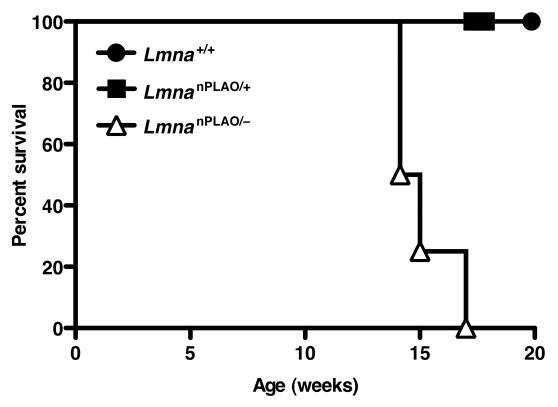
Figure 1
Figure 1
Survival curves for Lmna+/+, LmnanPLAO/+ and LmnanPLAO/− mice. The survival time for male LmnanPLAO/− mice was shorter than for Lmna+/+ or LmnanPLAO/+ mice (n = 4 for each group) (p = 0.002). Previous studies showed that male LmnanPLAO/nPLAO mice had an average survival time of 38.5 weeks (a milder phenotype than LmnanPLAO/− mice), suggesting that nonfarnesylated prelamin A is a poorly functioning lamin.
Figure 2
Figure 2
The effects of disrupting A-type lamin synthesis and processing in laboratory mice. (A) Wild-type mice produce both lamin C and prelamin A. Prelamin A then undergoes four sequential posttranslational processing steps to generate mature lamin A. (B) Lmna−/− mice produce neither lamin A nor lamin C. These mice have muscular dystrophy and die at 5–6 weeks of age. (C) LmnaLCO/LCO mice produce only lamin C. These mice appear to be phenotypically normal. (D) LmnaPLAO/PLAO mice do not produce lamin C. The prelamin A produced by these mice is efficiently converted to mature lamin A. These mice also appear to be normal. (E) LmnaLAO/LAO mice produce mature lamin A directly, bypassing prelamin A synthesis and processing. These mice make no lamin C. Like LmnaLCO/LCO and LmnaPLAO/PLAO mice, LmnaLAO/LAO mice appear to be normal. (F) LmnanPLAO/nPLAO produce exclusively nonfarnesylated prelamin A. Because of a cysteine-to-serine substitution in prelamin A's CaaX motif, the prelamin A cannot be farnesylated. These mice develop dilated cardiomyopathy and have reduced survival. (G) Zmpste24-deficient mice produce both lamin C and prelamin A, but the final endoproteolytic step does not occur, resulting in the accumulation of farnesylated prelamin A. These mice display multiple progeria-like disease phenotypes., (H) In addition to making normal lamin C and prelamin A from one allele, LmnaHG/+ mice make a prelamin A with a 50-amino acid internal deletion (from the LmnaHG allele). This deletion prevents the final, ZMPSTE24-mediated, endoproteolytic step from occurring and leads to the accumulation of a farnesylated and truncated form of prelamin A called progerin. Despite the presence of normal forms of lamin A and lamin C, these mice develop progeria-like disease phenotypes., (I) LmnanHG/+ mice are identical to LmnaHG/+ mice except that the truncated prelamin A generated from the LmnanHG allele cannot be farnesylated (due to a cysteine-to-serine substitution in the CaaX motif), leading to the accumulation of nonfarnesylated progerin. These mice also have progeria, though it is somewhat less severe than that found in LmnaHG/+ mice.

References

    1. Muchir A, Worman HJ. The nuclear envelope and human disease. Physiology (Bethesda) 2004;19:309–314. - PubMed
    1. Lin F, Worman HJ. Structural organization of the human gene encoding nuclear lamin A and nuclear lamin C. J Biol Chem. 1993;268:16321–16326. - PubMed
    1. Hutchison CJ, Worman HJ. A-type lamins: guardians of the soma? Nat Cell Biol. 2004;6:1062–1067. - PubMed
    1. Wilson KL. The nuclear envelope, muscular dystrophy and gene expression. Trends Cell Biol. 2000;10:125–129. - PubMed
    1. Sullivan T, Escalante-Alcalde D, Bhatt H, Anver M, Bhat N, Nagashima K, et al. Loss of A-type lamin expression compromises nuclear envelope integrity leading to muscular dystrophy. J Cell Biol. 1999;147:913–920. - PMC - PubMed

Publication types

LinkOut - more resources
