


The narrowing of the CD8 T cell repertoire in old age
- PMID: 21652194
- PMCID: PMC3163762
- DOI: 10.1016/j.coi.2011.05.005
The narrowing of the CD8 T cell repertoire in old age
Abstract
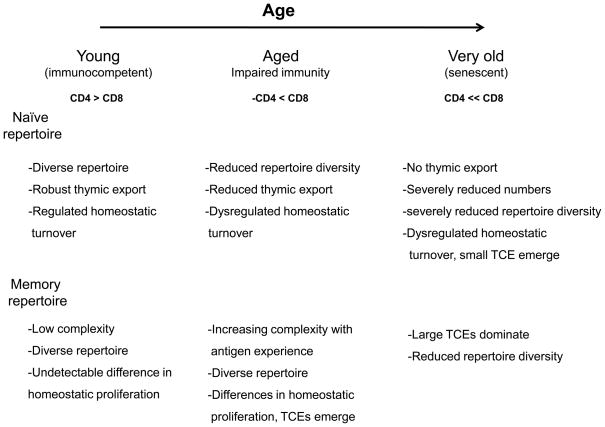
Immune function declines progressively with age, resulting in increased susceptibility of the elderly to infection and impaired responses to vaccines. A diverse repertoire of T cells is essential for a vigorous immune response, and an important manifestation of immune aging is the progressive loss of repertoire diversity, predominantly among CD8 T cells in both mice and humans. Importantly, perturbations in the peripheral T cell repertoire, including reduction of the CD4:CD8 ratio and cytomegalovirus-driven T cell clonal expansions, make a major contribution to the 'immune risk phenotype' defined for humans, which predicts two-year mortality in very old individuals.
Copyright © 2011 Elsevier Ltd. All rights reserved.
Figures
References
-
- Messaoudi I, Guevara Patino JA, Dyall R, LeMaoult J, Nikolich-Zugich J. Direct link between mMHCpolymorphism, T cell avidity, and diversity in immune defense. Science. 2002;298:1797–1800. - PubMed
-
- Nikolich-Zugich J, Fremont DH, Miley MJ, Messaoudi I. The role of MHC polymorphism in antimicrobial resistance. Microbes Infect. 2004;6:501–512. - PubMed
-
- Nikolich-Zugich J, Slifka MK, Messaoudi I. The many important facets of T-cell repertoire diversity. Nat Rev Immunol. 2004;4:123–132. - PubMed
-
- Casrouge A, Beaudoing E, Dalle S, Pannetier C, Kanellopoulos J, Kourilsky P. Size estimate of the alpha beta TCR repertoire of naive mouse splenocytes. J Immunol. 2000;164:5782–5787. - PubMed
-
- Arstila TP, Casrouge A, Baron V, Even J, Kanellopoulos J, Kourilsky P. A direct estimate of the human alphabeta T cell receptor diversity. Science. 1999;286:958–961. - PubMed
Publication types
MeSH terms
Grants and funding
LinkOut - more resources
Full Text Sources
Other Literature Sources
Medical
Research Materials
