


Early death rate in acute promyelocytic leukemia remains high despite all-trans retinoic acid
- PMID: 21653939
- PMCID: PMC3790946
- DOI: 10.1182/blood-2011-04-346437
Early death rate in acute promyelocytic leukemia remains high despite all-trans retinoic acid
Abstract
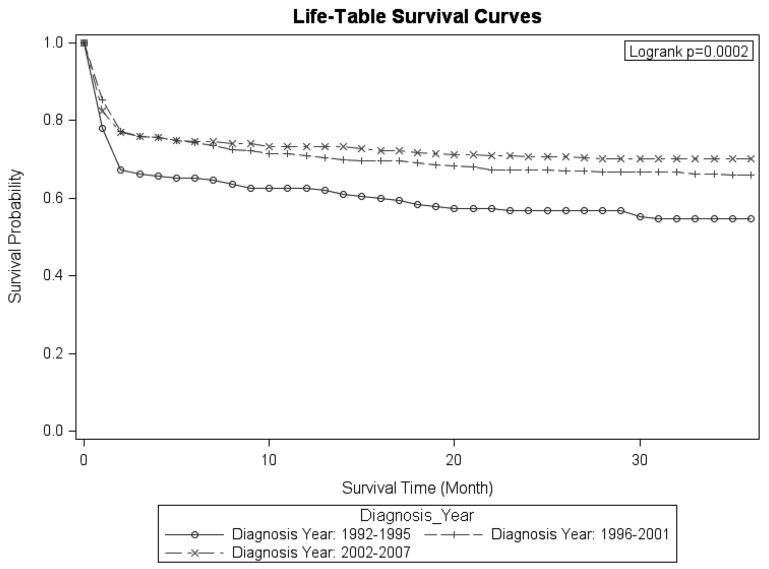
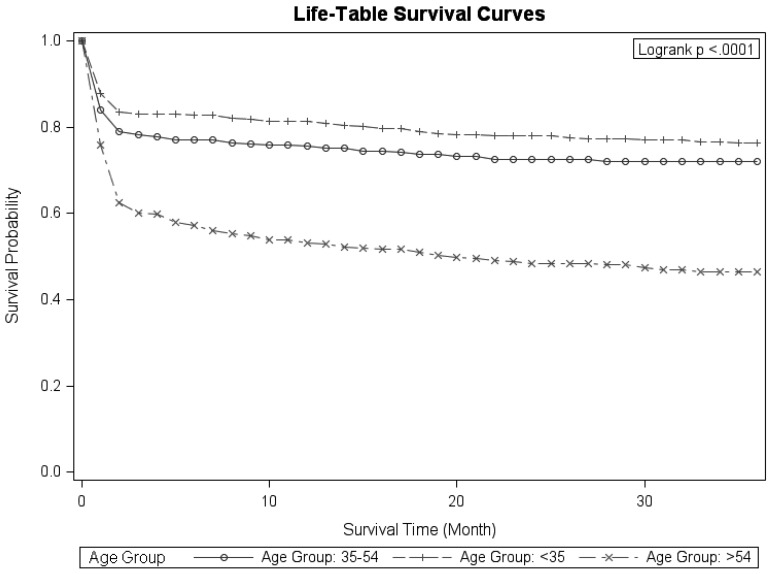
The incidence of early death in a large population of unselected patients with acute promyelocytic leukemia (APL) remains unknown because of the paucity of outcome data available for patients treated outside of clinical trials. We undertook an epidemiologic study to estimate the true rate of early death with data from the Surveillance, Epidemiology, and End Results (SEER) program. A total of 1400 patients with a diagnosis of APL between 1992 and 2007 were identified. The overall early death rate was 17.3%, and only a modest change in early death rate was observed over time. The early death rate was significantly higher in patients aged ≥ 55 years (24.2%; P < .0001). The 3-year survival improved from 54.6% to 70.1% over the study period but was significantly lower in patients aged ≥ 55 years (46.4%; P < .0001). This study shows that the early death rate remains high despite the wide availability of all-trans retinoic acid and appears significantly higher than commonly reported in multicenter clinical trials. These data highlight a need to educate health care providers across a wide range of medical fields, who may be the first to evaluate patients with APL, to have a major effect on early death and the cure rate of APL.
Figures
Comment in
-
ED in APL: tip of the iceberg?Blood. 2011 Aug 4;118(5):1188-9. doi: 10.1182/blood-2011-06-361238. Blood. 2011. PMID: 21816836 No abstract available.
References
-
- Bennett JM, Catovsky D, Daniel MT, et al. A variant form of hypergranular promyelocytic leukaemia (M3). Br J Haematol. 1980;44(1):169–170. - PubMed
-
- Bennett JM, Catovsky D, Daniel MT, et al. Proposals for the classification of the acute leukaemias. French-American-British (FAB) co-operative group. Br J Haematol. 1976;33(4):451–458. - PubMed
-
- Tallman MS, Kwaan HC. Reassessing the hemostatic disorder associated with acute promyelocytic leukemia. Blood. 1992;79(3):543–553. - PubMed
-
- Rowley JD, Golomb HM, Dougherty C. 15/17 translocation, a consistent chromosomal change in acute promyelocytic leukaemia. Lancet. 1977;1(8010):549–550. - PubMed
-
- Grignani F, Ferrucci PF, Testa U, et al. The acute promyelocytic leukemia-specific PML-RAR alpha fusion protein inhibits differentiation and promotes survival of myeloid precursor cells. Cell. 1993;74(3):423–431. - PubMed
Publication types
MeSH terms
Substances
LinkOut - more resources
Full Text Sources
Medical
