PREDICT: a method for inferring novel drug indications with application to personalized medicine
- PMID: 21654673
- PMCID: PMC3159979
- DOI: 10.1038/msb.2011.26
PREDICT: a method for inferring novel drug indications with application to personalized medicine
Abstract
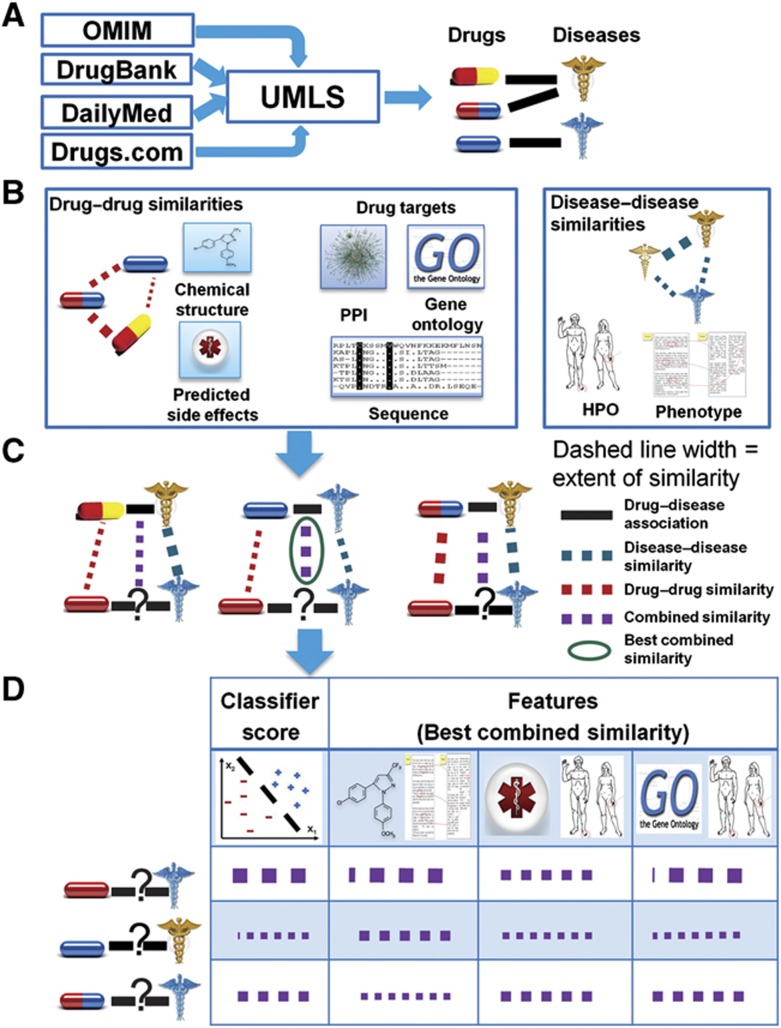
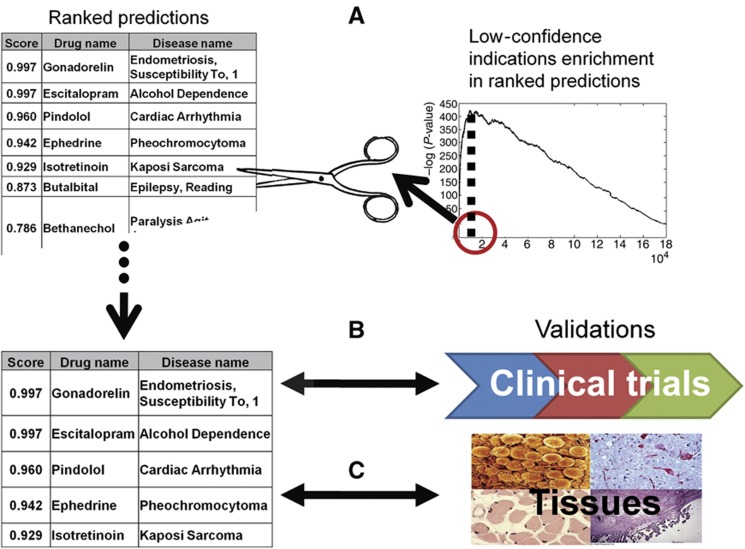
Inferring potential drug indications, for either novel or approved drugs, is a key step in drug development. Previous computational methods in this domain have focused on either drug repositioning or matching drug and disease gene expression profiles. Here, we present a novel method for the large-scale prediction of drug indications (PREDICT) that can handle both approved drugs and novel molecules. Our method is based on the observation that similar drugs are indicated for similar diseases, and utilizes multiple drug-drug and disease-disease similarity measures for the prediction task. On cross-validation, it obtains high specificity and sensitivity (AUC=0.9) in predicting drug indications, surpassing existing methods. We validate our predictions by their overlap with drug indications that are currently under clinical trials, and by their agreement with tissue-specific expression information on the drug targets. We further show that disease-specific genetic signatures can be used to accurately predict drug indications for new diseases (AUC=0.92). This lays the computational foundation for future personalized drug treatments, where gene expression signatures from individual patients would replace the disease-specific signatures.
Conflict of interest statement
The authors declare that they have no conflict of interest.
Figures
References
-
- Ashburner M, Ball CA, Blake JA, Botstein D, Butler H, Cherry JM, Davis AP, Dolinski K, Dwight SS, Eppig JT, Harris MA, Hill DP, Issel-Tarver L, Kasarskis A, Lewis S, Matese JC, Richardson JE, Ringwald M, Rubin GM, Sherlock G (2000) Gene ontology: tool for the unification of biology. The Gene Ontology Consortium. Nat Genet 25: 25–29 - PMC - PubMed
-
- Atias N, Sharan R (2011) An algorithmic framework for predicting side-effects of drugs. J Comput Biol 18: 207–218 - PubMed
Publication types
MeSH terms
Substances
LinkOut - more resources
Full Text Sources
Other Literature Sources