. 2011 Nov;19(11):1173-80.
doi: 10.1038/ejhg.2011.96. Epub 2011 Jun 8.

An atlas of tissue-specific conserved coexpression for functional annotation and disease gene prediction

Affiliations

An atlas of tissue-specific conserved coexpression for functional annotation and disease gene prediction

Rosario Michael Piro et al. Eur J Hum Genet. 2011 Nov.

Abstract

Gene coexpression relationships that are phylogenetically conserved between human and mouse have been shown to provide important clues about gene function that can be efficiently used to identify promising candidate genes for human hereditary disorders. In the past, such approaches have considered mostly generic gene expression profiles that cover multiple tissues and organs. The individual genes of multicellular organisms, however, can participate in different transcriptional programs, operating at scales as different as single-cell types, tissues, organs, body regions or the entire organism. Therefore, systematic analysis of tissue-specific coexpression could be, in principle, a very powerful strategy to dissect those functional relationships among genes that emerge only in particular tissues or organs. In this report, we show that, in fact, conserved coexpression as determined from tissue-specific and condition-specific data sets can predict many functional relationships that are not detected by analyzing heterogeneous microarray data sets. More importantly, we find that, when combined with disease networks, the simultaneous use of both generic (multi-tissue) and tissue-specific conserved coexpression allows a more efficient prediction of human disease genes than the use of generic conserved coexpression alone. Using this strategy, we were able to identify high-probability candidates for 238 orphan disease loci. We provide proof of concept that this combined use of generic and tissue-specific conserved coexpression can be very useful to prioritize the mutational candidates obtained from deep-sequencing projects, even in the case of genetic disorders as heterogeneous as XLMR.


Figures
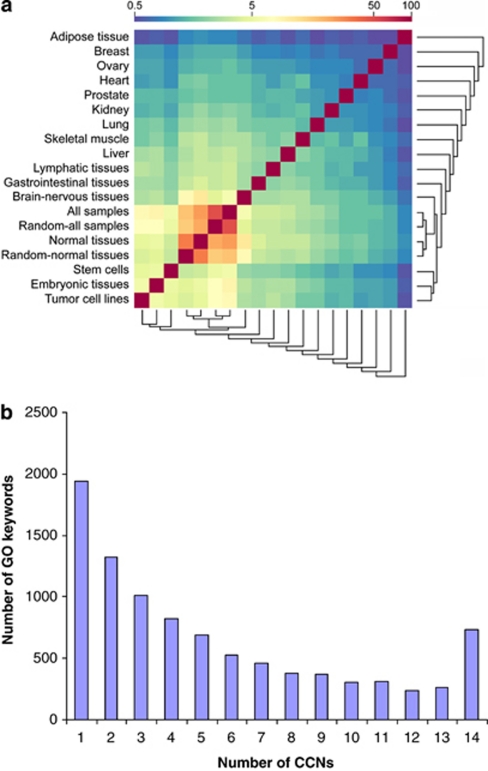
Figure 1
Figure 1
(a) A heatmap representing the fraction of common edges between different CCNs. The two random cases are representative examples of networks obtained from 10% of the experiments that compose the indicated data set, chosen at random. The scale bar represents the percentage of common links (intersection/union). (b) The number of GO keywords significantly enriched in the indicated number of CCNs.
Figure 2
Figure 2
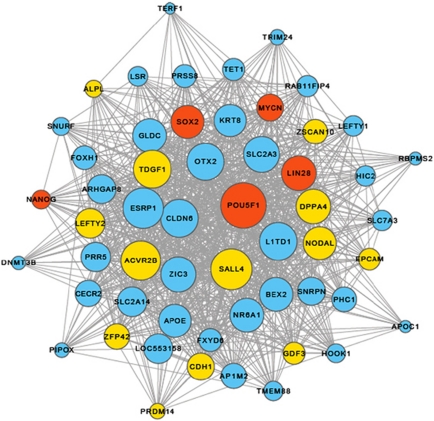
The neighborhood of the POU5F1 gene in the CCN obtained from stem cell microarray experiments. The size of the nodes and their distance from the center are a function of their connectivity. The genes shown in orange have been used successfully to reprogram differentiated cells to iPS cells. The genes shown in yellow have been linked experimentally to the pluripotent state or are considered as pluripotency markers.
Figure 3
Figure 3
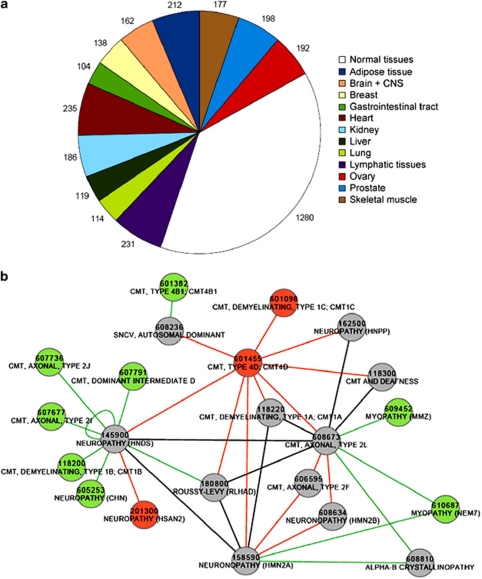
(a) The number of OMIM–OMIM links unique to each of the PCNs. (b) Charcot–Marie–Tooth disease type-4D (CMT4D; OMIM 601455) and its first- and second-level neighbors in the CNS and NT PCNs. Gray nodes and black edges were found in both PCNs. Red and green nodes/edges were specifically found in the CNS or in the NT PCNs, respectively. Legend: CMT, Charcot–Marie–Tooth disease; MMZ, myopathy, myofibrillar, ZASP-related; NEM, nemaline myopathy; HMN, neuronopathy, distal hereditary, motor; SNCV, slowed nerve conduction velocity; CHN, neuropathy, congenital, hypo-myelinating; HSAN, neuropathy, hereditary, sensory and autonomic; RLHAD, Roussy–Levy hereditary areflexic dystasia; HNPP, neuropathy, hereditary, with liability to pressure palsies; HNDS, hypertrophic neuropathy of Dejerine–Sottas.
Figure 4
Figure 4
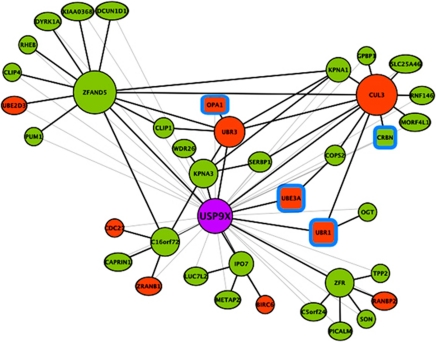
A representation of a subset of the USP9X gene's neighborhood in the three CCNs from which it was predicted as a candidate XLMR gene (normal tissues, CNS and skeletal muscle) by means of related phenotypes. It includes all the nodes that were connected to USP9X in at least one network. The thick edges represent links found in all three networks. The genes shown in orange are functionally involved in the ubiquitin cycle, whereas those with a cyan border are involved in diseases related to XLMR (MimMiner score ≥0.4).

References

    1. Yang JY, Yang MQ, Zhu MM, Arabnia HR, Deng Y. Promoting synergistic research and education in genomics and bioinformatics. BMC Genomics. 2008;9 (Suppl 1:I1. - PMC - PubMed
    1. Barabasi AL, Oltvai ZN. Network biology: understanding the cell's functional organization. Nat Rev Genet. 2004;5:101–113. - PubMed
    1. Oti M, Brunner HG. The modular nature of genetic diseases. Clin Genet. 2007;71:1–11. - PubMed
    1. Wang X, Dalkic E, Wu M, Chan C. Gene module level analysis: identification to networks and dynamics. Curr Opin Biotechnol. 2008;19:482–491. - PMC - PubMed
    1. Turner FS, Clutterbuck DR, Semple CA. POCUS: mining genomic sequence annotation to predict disease genes. Genome Biol. 2003;4:R75. - PMC - PubMed

Publication types