. 2011 Jun 9;2(6):e171.
doi: 10.1038/cddis.2011.55.

Role of TRAIL and the pro-apoptotic Bcl-2 homolog Bim in acetaminophen-induced liver damage

Affiliations

Role of TRAIL and the pro-apoptotic Bcl-2 homolog Bim in acetaminophen-induced liver damage

A Badmann et al. Cell Death Dis. .

Abstract

Acetaminophen (N-acetyl-para-aminophenol (APAP), paracetamol) is a commonly used analgesic and antipyretic agent. Although considered safe at therapeutic doses, accidental or intentional overdose causes acute liver failure characterized by centrilobular hepatic necrosis with high morbidity and mortality. Although many molecular aspects of APAP-induced cell death have been described, no conclusive mechanism has been proposed. We recently identified TNF-related apoptosis-inducing ligand (TRAIL) and c-Jun kinase (JNK)-dependent activation of the pro-apoptotic Bcl-2 homolog Bim as an important apoptosis amplification pathway in hepatocytes. In this study, we, thus, investigated the role of TRAIL, c-JNK and Bim in APAP-induced liver damage. Our results demonstrate that TRAIL strongly synergizes with APAP in inducing cell death in hepatocyte-like cells lines and primary hepatocyte. Furthermore, we found that APAP strongly induces the expression of Bim in a c-JNK-dependent manner. Consequently, TRAIL- or Bim-deficient mice were substantially protected from APAP-induced liver damage. This study identifies the TRAIL-JNK-Bim axis as a novel target in the treatment of APAP-induced liver damage and substantiates its general role in hepatocyte death.


Figures
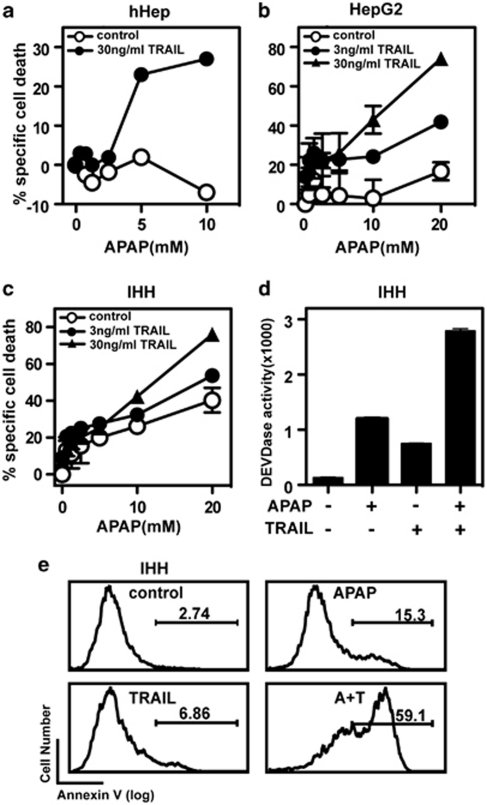
Figure 1
Figure 1
TRAIL synergizes with APAP in inducing cell death. Human hepatocytes (hHep) (a), the hepatoma cell line HepG2 (b) or immortalized human hepatocytes (IHH) (c) were preincubated with buffer control or increasing concentrations of TRAIL, prior stimulation with different doses of APAP. Cell death was assessed by MTT assay (ac) in primary hepatocytes, HepG2 and IHH cells, by DEVD cleavage assay (d) or Annexin V staining (e) in control IHH cells or IHH cells treated with 10 mM APAP, 30 ng TRAIL or the combination thereof, respectively. Mean values±S.D. of triplicates are shown for MTT and DEVDase assays, which were repeated three times, yielding similar results. A typical experiment out of two is shown for Annexin V staining
Figure 2
Figure 2
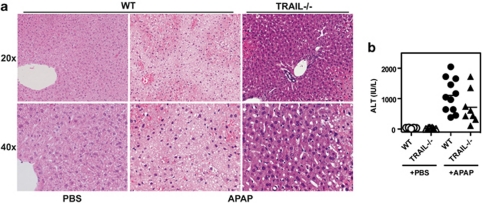
TRAIL is required for efficient APAP-induced liver damage in vivo. Wild type (WT) or TRAIL-deficient mice (TRAIL−/−) were treated with PBS as control or APAP (400 mg/kg body weight), and liver damage was analyzed by histology (a) and transaminase levels (AST) in serum (b) after 5 h. Pooled experimental data from 8 to 12 mice per group are shown
Figure 3
Figure 3
APAP induces Bim protein expression. Human hepatocytes (a), HepG2 (b) or IHH (c) cells were treated with APAP, TRAIL or both for 6 h, and Bim protein expression was analyzed by western blot. (d) Liver samples of PBS- or APAP-treated wild-type mice were analyzed for the expression of Bim by western blot. JNK or tubulin was used to normalize protein loadings
Figure 4
Figure 4
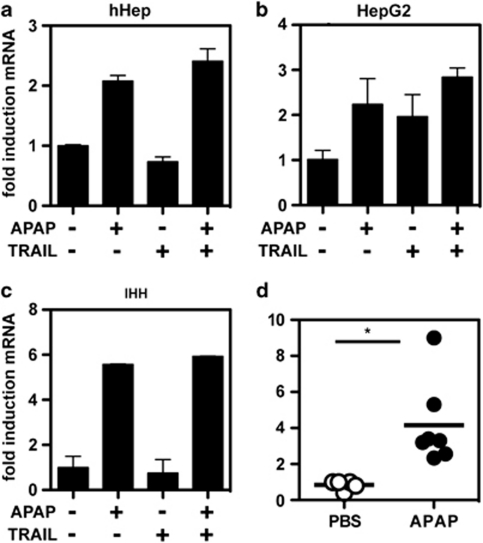
APAP induces Bim transcription. Human hepatocytes (a), HepG2 (b) or IHH (c) cells were treated with with 10 mM APAP, 30 ng TRAIL or the combination thereof for 6 h, and Bim expression was analyzed by quantitative RT-PCR. (d) Wild-type mice were treated with PBS or APAP, and Bim expression was analyzed in liver samples by quantitative RT-PCR after 5 h. GAPDH was used to normalize Bim expression levels. Mean values±S.D. of triplicates are shown for fold induction of mRNA levels. Pooled data from 6 to 7 mice per group are shown. *P=0.011 (unpaired Student's t-test)
Figure 5
Figure 5
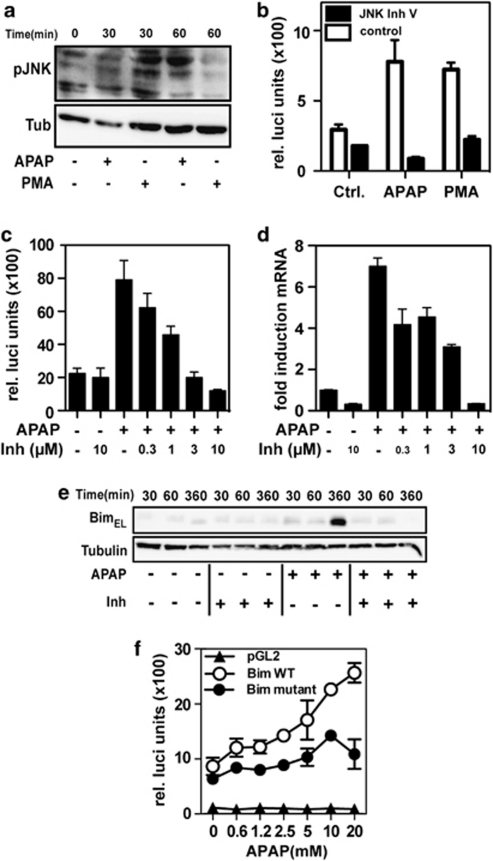
APAP-induced Bim transcription is JNK- and Foxo3a-dependent. (a) IHH cells were stimulated with APAP (10 mM) or, as positive control, phorbol 12-myristate 13-acetate (30 ng/ml) and phospo-JNK and tubulin protein levels were analyzed at different time points by western blot. (b) IHH cells were transfected with the wild-type (WT) Bim reporter construct, pre-treated with JNK V inhibitor (10 μM) and stimulated with APAP (10 mM) or phorbol 12-myristate 13-acetate (30 ng/ml). (c) Similarly, IHH cells were transfected with the WT Bim reporter construct, pretreated with different concentrations of the JNK inhibitor V and stimulated with APAP (10 mM). Luciferase activity was measured and normalized to β-galactosidase. (d) IHH were pretreated with JNK inhibitor V and stimulated with APAP (10 mM). Bim mRNA expression was measured by quantitative RT-PCR (6 h). (e) IHH cells were treated as described above and Bim were analyzed at different time points by western blot. (f) IHH cells were transfected with empty vector (pGL2), the wild-type (Bim WT) or the Foxo3a mutant Bim reporter constructs (Bim Foxo3a), and stimulated with APAP (10 mM) for 6 h. Luciferase activity was measured and normalized to β-galactosidase activity. Mean values±S.D. of triplicates are shown for relative luciferase units and fold induction of mRNA levels. The experiments have been repeated three times, yielding similar results
Figure 6
Figure 6
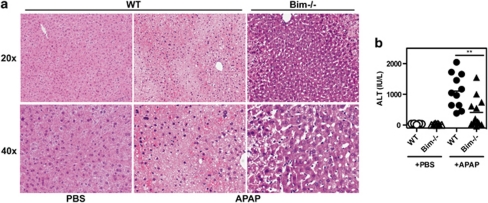
Bim is required for efficient APAP-induced liver damage in vivo. Wild-type (WT) or Bim-deficient mice (Bim−/−) were treated with PBS as control or 400 mg/kg body weight APAP, and liver damage was analyzed by histology (a) and transaminase levels (AST) in serum (b). Pooled data from 10 to 12 mice per group are shown. **P=0.0047 (unpaired Student's t-test)

References

    1. Rumack BH. Acetaminophen misconceptions. Hepatology. 2004;40:10–15. - PubMed
    1. Lee WM. Acetaminophen and the U.S. Acute Liver Failure Study Group: lowering the risks of hepatic failure. Hepatology. 2004;40:6–9. - PubMed
    1. Masubuchi Y, Suda C, Horie T. Involvement of mitochondrial permeability transition in acetaminophen-induced liver injury in mice. J Hepatol. 2005;42:110–116. - PubMed
    1. Burcham PC, Harman AW. Acetaminophen toxicity results in site-specific mitochondrial damage in isolated mouse hepatocytes. J Biol Chem. 1991;266:5049–5054. - PubMed
    1. Cover C, Mansouri A, Knight TR, Bajt ML, Lemasters JJ, Pessayre D, et al. Peroxynitrite-induced mitochondrial and endonuclease-mediated nuclear DNA damage in acetaminophen hepatotoxicity. J Pharmacol Exp Ther. 2005;315:879–887. - PubMed

Publication types

MeSH terms