. 2011 Dec;12(8):615-25.
doi: 10.1038/gene.2011.34. Epub 2011 Jun 9.

Genome-wide association study of severity in multiple sclerosis

Collaborators

Genome-wide association study of severity in multiple sclerosis

International Multiple Sclerosis Genetics Consortium. Genes Immun. 2011 Dec.

Abstract

Multiple sclerosis (MS) is a chronic inflammatory disorder of the central nervous system with a strong genetic component. Several lines of evidence support a strong role for genetic factors influencing both disease susceptibility and clinical outcome in MS. Identification of genetic variants that distinguish particular disease subgroups and/or predict a severe clinical outcome is critical to further our understanding of disease mechanisms and guide development of effective therapeutic approaches. We studied 1470 MS cases and performed a genome-wide association study of more than 2.5 million single-nucleotide polymorphisms to identify loci influencing disease severity, measured using the MS severity score (MSSS), a measure of clinical disability. Of note, no single result achieved genome-wide significance. Furthermore, variants within previously confirmed MS susceptibility loci do not appear to influence severity. Although bioinformatic analyses highlight certain pathways that are over-represented in our results, we conclude that the genetic architecture of disease severity is likely polygenic and comprised of modest effects, similar to what has been described for MS susceptibility, to date. However, a role for major effects of rare variants cannot be excluded. Importantly, our results also show the MSSS, when considered as a binary or continuous phenotype variable is by comparison a stable outcome.


Figures
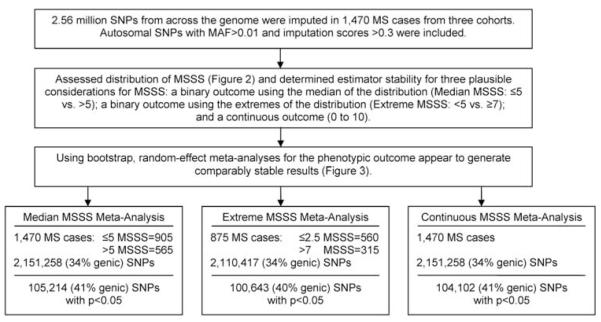
Figure 1
Figure 1
Schematic overview of analysis.
Figure 2
Figure 2
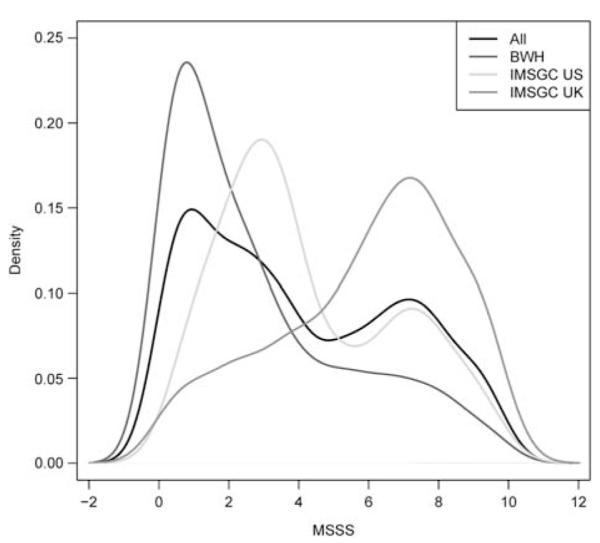
Density plot of the MSSS distribution by cohort of origin. A full colour version of this figure is available at the Genes and Immunity journal online.
Figure 3
Figure 3
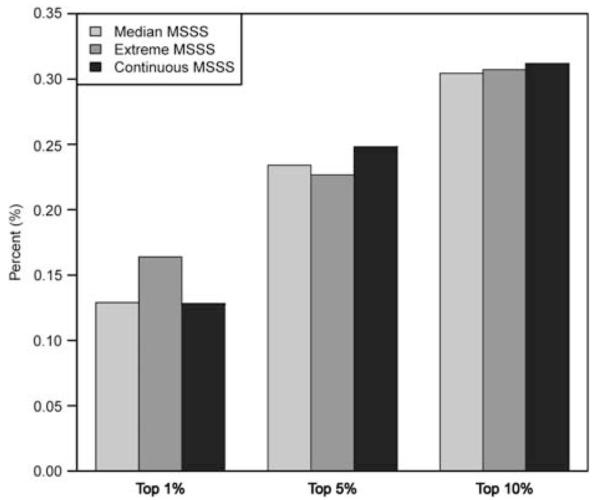
Estimator stability for each MSSS meta-analysis: percent concordance of top-ranking SNPs in the testing data set and across the 100 bootstrapped data sets. To determine which meta-analysis of the phenotypic outcome was most appropriate given the distribution of MSSS (see Figure 2), the stability of the estimator was evaluated using bootstrap. An augmented data set of 1000 randomly selected SNPs from among the union of SNPs (N=196 771 SNPs) that showed a significant association (P<0.05) in any of the three meta-analyses. One hundred bootstrap replicates were generated and the meta-analyses were performed (logistic and linear regression as appropriate) for each SNP in each of the 100 bootstrapped data sets. The ranking of each SNP in the original augmented data set was compared with its ranking in each of the 100 bootstrapped data sets. The aim was to determine if a specific phenotype showed greater stability among its top 1% (10), 5% (50) and 10% (100) SNPs. The application of a random-effect meta-analysis proved to be consistently stable across the phenotypic outcomes; therefore, all three meta-analytical results were considered equally. A full colour version of this figure is available at the Genes and Immunity journal online.
Figure 4
Figure 4
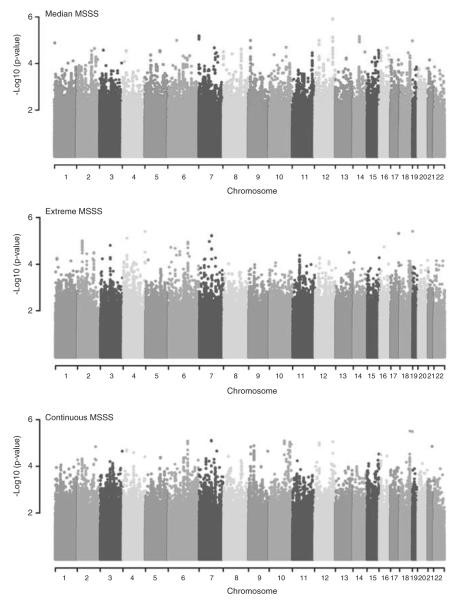
Manhattan plots for the random-effects meta-analyses adjusted for cohort and gender. A full colour version of this figure is available at the Genes and Immunity journal online.

References

    1. Oksenberg JR, Barcellos LF. Multiple sclerosis genetics: leaving no stone unturned. Genes Immun. 2005;6:375–387. - PubMed
    1. Zuvich RL, McCauley JL, Pericak-Vance MA, Haines JL. Genetics and pathogenesis of multiple sclerosis. Semin Immunol. 2009;21:328–333. - PMC - PubMed
    1. De Jager PL, Jia X, Wang J, de Bakker PI, Ottoboni L, Aggarwal NT, et al. Meta-analysis of genome scans and replication identify CD6, IRF8 and TNFRSF1A as new multiple sclerosis susceptibility loci. Nat Genet. 2009;41:776–782. - PMC - PubMed
    1. International Multiple Sclerosis Genetics Consortium (IMSGC) Comprehensive follow-up of the first genome-wide association study of multiple sclerosis identifies KIF21B and TMEM39A as susceptibility loci. Hum Mol Genet. 2010;19:953–962. - PMC - PubMed
    1. Oksenberg JR, Baranzini SE. Multiple sclerosis genetics—is the glass half full, or half empty? Nat Rev Neurol. 2010;6:429–437. - PubMed

Publication types