. 2011 Mar;2(1):27-38.
doi: 10.1007/s13167-011-0063-4. Epub 2011 Mar 10.

Lipoprotein associated phospholipase A(2): role in atherosclerosis and utility as a biomarker for cardiovascular risk

Lipoprotein associated phospholipase A(2): role in atherosclerosis and utility as a biomarker for cardiovascular risk

Kenneth J Colley et al. EPMA J. 2011 Mar.

Abstract

Atherosclerosis and its clinical manifestations are widely prevalent throughout the world. Atherogenesis is highly complex and modulated by numerous genetic and environmental risk factors. A large body of basic scientific and clinical research supports the conclusion that inflammation plays a significant role in atherogenesis along the entire continuum of its progression. Inflammation adversely impacts intravascular lipid handling and metabolism, resulting in the development of macrophage foam cell, fatty streak, and atheromatous plaque formation. Given the enormous human and economic cost of myocardial infarction, ischemic stroke, peripheral arterial disease and amputation, and premature death and disability, considerable effort is being committed to refining our ability to correctly identify patients at heightened risk for atherosclerotic vascular disease and acute cardiovascular events so that they can be treated earlier and more aggressively. Serum markers of inflammation have emerged as an important component of risk factor burden. Lipoprotein-associated phospholipase A2 (Lp-PLA(2)) potentiates intravascular inflammation and atherosclerosis. A variety of epidemiologic studies support the utility of Lp-PLA(2) measurements for estimating and further refining cardiovascular disease risk. Drug therapies to inhibit Lp-PLA(2) are in development and show considerable promise, including darapladib, a specific molecular inhibitor of the enzyme. In addition to substantially inhibiting Lp-PLA(2) activity, darapladib reduces progression of the necrotic core volume of human coronary artery atheromatous plaque. The growing body of evidence points to an important role and utility for Lp-PLA(2) testing in preventive and personalized clinical medicine.


Figures
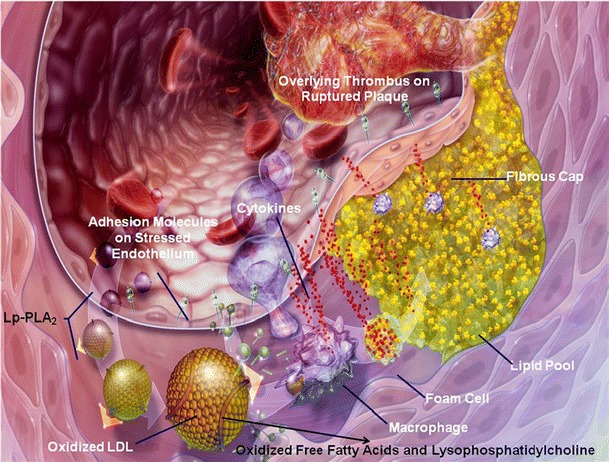
Fig. 1
Fig. 1
Lipoprotein-associated phospholipase A2 and atherogenesis. Dysfunctional endothelial cells express a variety of adhesion molecules that promote the binding, rolling, and stable arrest of inflammatory white blood cells, such as T-cells, monocytes, and mast cells. These inflammatory white cells express a large number of interleukins and cytokines which help to create an inflammatory nidus within the vessel wall. Monocytes alter their three-dimensional actin cytoskeleton and follow a gradient of monocyte chemoattractant protein-1 down into the subendothelial space by diapadesing between endothelial cells. Monocytes can transform into resident tissue macrophages. Low-density lipoprotein particles carry both lipid and Lp-PLA2 into the arterial wall. Macrophages also produce Lp-PLA2 in situ within plaque. The lipid in LDL particles undergoes oxidation mediated by myeloperoxidase, 5′-lipoxygenase, and other agents. Oxidized LDL stimulates increased expression of scavenging receptors on the surface of macrophages. As lipid is taken up into macrophages, they are converted into foam cells which can coalesce to form fatty streaks, which then evolve into atherosclerotic plaques. Lp-PLA2 specifically hydrolyzes phosphatidylcholine into oxidized free fatty acid and lysophosphatidylcholine. These lipids potentiate inflammation and plaque progression. The cap region of a plaque can become architecturally weakened as matrix metalloproteinases are produced within plaque. The plaque can rupture with overlying thrombus formation, resulting in acute myocardial ischemia and an acute coronary syndrome
Fig. 2
Fig. 2
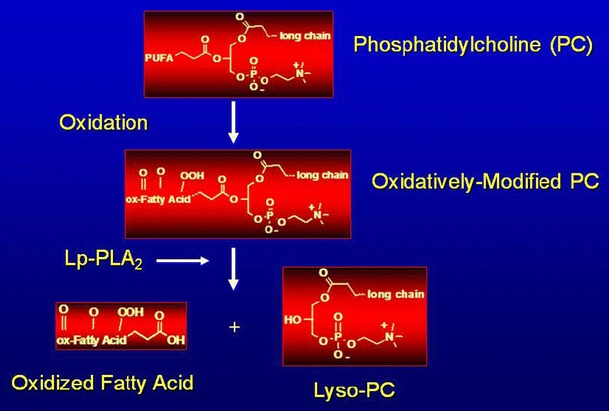
Lp-PLA2 hydrolyzes oxidized LDL to release proinflammatory lipids. Oxidative enzymes can oxidize phospholipids in LDL particles. Oxidized phosphatidylcholine is hydrolyzed by Lp-PLA2 to release oxidized fatty acid and lysophosphatidylcholine
Fig. 3
Fig. 3
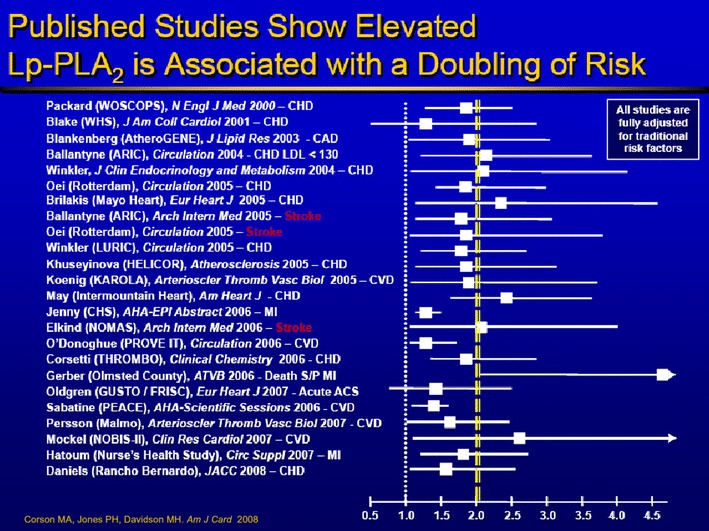
Epidemiologic evidence demonstrates the clinical utility of Lp-PLA2. More than two dozen clinical studies demonstrate the utility of Lp-PLA2 and are peer-reviewed and published [16]
Fig. 4
Fig. 4
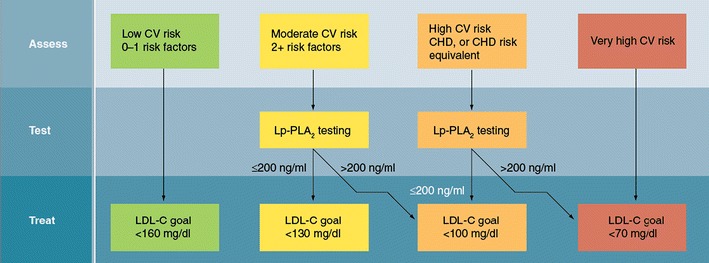
Algorithm for Lp-PLA2 screening and utility for refining cardiovascular risk estimation. It is not recommended that Lp-PLA2 be measured in patients at low risk for cardiovascular disease (one or fewer risk factors). Patients with two or more risk factors (10 year Framingham risk score of 10–20%) are optimal candidates for Lp-PLA2 screening. If the serum level of this enzyme is <200 ng/mL, then their level of risk requires no further adjustment. However, if the serum level of Lp-PLA2 is >200 ng/mL, then the patient is reassigned to high risk status and the LDL-C and non-HDL-C targets are adjusted to <100 mg/dL and <130 mg/dL, respectively. Among patients who are high risk (established CHD, diabetes mellitus, abdominal aortic aneurysm, peripheral vascular disease, symptomatic carotid artery disease, or a 10 year Framingham risk score >20%), consideration can be given to further refining risk estimation with an Lp-PLA2 measurement. If the patient’s serum Lp-PLA2 measurement >200 ng/ml, then the patient can be reclassified as very high risk, and the LDL-C and non-HDL-C targets should be <70 mg/dL and <100 mg/dL, respectively. Reproduced with permission from [34]

References

    1. Toth PP. Making a case for quantitative assessment of cardiovascular risk. J Clin Lipidol. 2007;1:234–241. doi: 10.1016/j.jacl.2007.07.002. - DOI - PubMed
    1. Ridker PM. Clinical application of C-reactive protein for cardiovascular disease detection and prevention. Circulation. 2003;107:363–369. doi: 10.1161/01.CIR.0000053730.47739.3C. - DOI - PubMed
    1. Blake GJ, Dada N, Fox JC, Manson JE, Ridker PM. A prospective evaluation of lipoproteinassociated phospholipase A(2) levels and the risk of future cardiovascular events in women. J Am Coll Cardiol. 2001;38:1302–1306. doi: 10.1016/S0735-1097(01)01554-6. - DOI - PubMed
    1. Nicholls SJ, Hazen SL. Myeloperoxidase and cardiovascular disease. Arterioscler Thromb Vasc Biol. 2005;25:1102–1111. doi: 10.1161/01.ATV.0000163262.83456.6d. - DOI - PubMed
    1. Libby P. What have we learned about the biology of atherosclerosis? The role of inflammation. Am J Cardiol. 2001;88:3J–6J. - PubMed