Seroepidemiology of hepatitis A in Korea: changes over the past 30 years
- PMID: 21655066
- PMCID: PMC3102874
- DOI: 10.3346/jkms.2011.26.6.791
Seroepidemiology of hepatitis A in Korea: changes over the past 30 years
Abstract
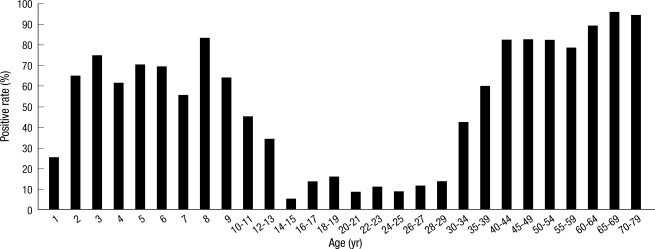
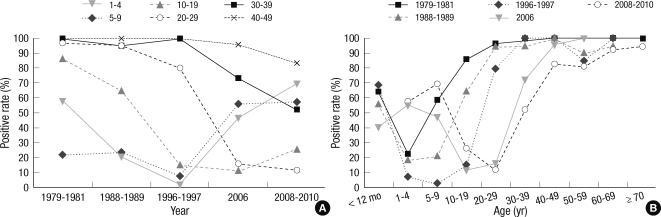
This study aimed to assess the immune status of the Korean population against hepatitis A virus (HAV). Residual serum samples from 2008 to 2010 were collected from diagnostic laboratories and a total of 1,872 samples were analyzed. Anti-HAV seroprevalence was 57.3% in subjects aged 1-4 yr, 69.8% at 5-9 yr and decreased to 38.8% at 10-14 yr, 13.0% at 15-19 yr, and 11.7% at 20-29 yr. Seroprevalence increased with increasing age: 52.2% at 30-39 yr, 83.2% at 40-49 yr, 81.4% at 50-59 yr, 93.2% at 60-69 yr, and 95.1% at 70-79 yr. The most susceptible age group consisted of subjects aged 10-29 yr, especially those aged 20-29 yr. This pattern is markedly different from that in the past 3 decades, where the most susceptible group had consisted of children aged less than 10 yr and almost all subjects aged more than 20 yr had developed anti-HAV antibodies. Because of improvements in hygiene and introduction of hepatitis A vaccine, the age demographic of the susceptible population has shifted. These data are important for creating new prevention measures, including vaccination policies, to prevent and control outbreaks of hepatitis A in Korea.
Keywords: Hepatitis A; Seroepidemiologic Studies.
Figures
References
-
- Bell BP, Feinstone SM. Hepatitis A Vaccine. In: Plotkin SA, Oreinstein WA, editors. Vaccines. 4th ed. Philadelphia, PA: Saunders; 2004. pp. 269–297.
-
- Kim JH. Recent epidemiological status and vaccination of hepatitis A in Korea. J Korean Med Assoc. 2008;51:110–118.
-
- Center for Disease Control and Prevention (CDC) Prevention of hepatitis A through active or passive immunization: Recommendations of the Advisory Committee on Immunization Practices (ACIP) MMWR Recomm Rep. 1999;48:1–37. - PubMed
-
- Lee BC, Lee DB. Clinical observation of type A hepatitis in children. J Korean Pediatr Soc. 1979;22:213–222.
-
- Kim NJ, Sung JK, Lee SW, Lee KT, Lee SM, Kim SH, Lee BS, Kim JH, Yu JH, Lee HY. An outbreak of hepatitis A in Taejeon city. Korean J Gastroenterol. 1999;34:205–212.
MeSH terms
Substances
LinkOut - more resources
Full Text Sources
Medical
Miscellaneous