


Evolution of glycosaminoglycans: Comparative biochemical study
- PMID: 21655428
- PMCID: PMC3104567
- DOI: 10.4161/cib.4.2.14547
Evolution of glycosaminoglycans: Comparative biochemical study
Abstract
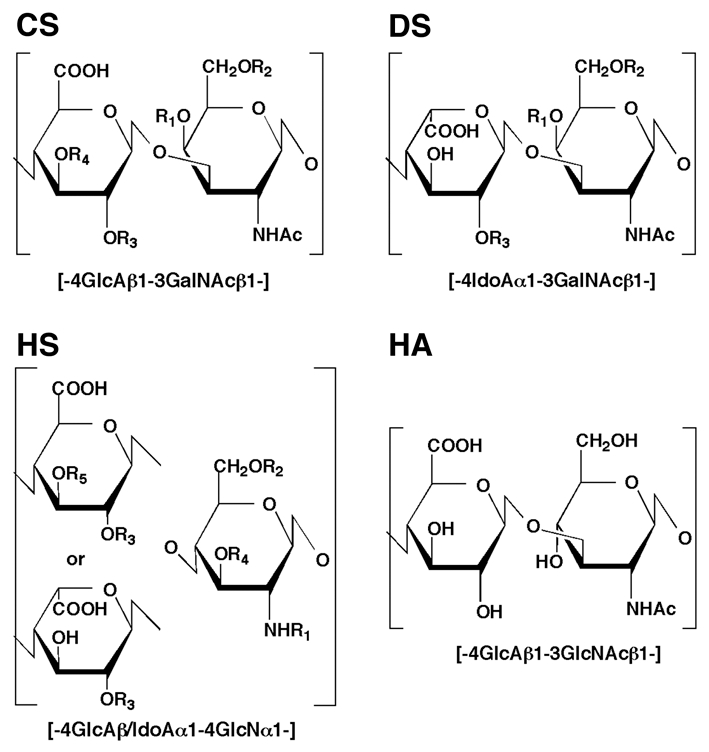
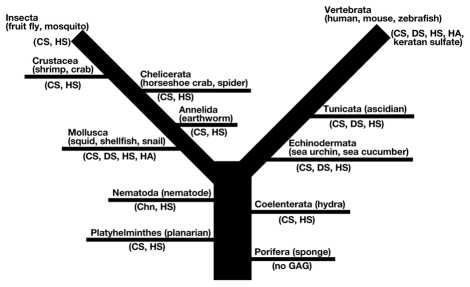
Glycosaminoglycans, a major component of the extracellular matrix molecules in animal tissues, play important roles in various physiological events. Glycosaminoglycans are found in not only vertebrates but also many invertebrates, implying a conserved function in the animal kingdom. Here, we discuss the analysis of glycosaminoglycans in 11 invertebrate phyla focusing on structure as well as physiological functions elucidated in model organisms. Various sulfated structures of heparan sulfate are widely distributed from very primitive organisms to humans, indicating an involvement in fundamental biological processes. By contrast, chondroitin/dermatan sulfate from lower organisms is limited in its structural complexity and often associated with a particular function. The presence of hyaluronic acid outside of vertebrates has been reported only in a mollusk.
Keywords: chondroitin sulfate; dermatan sulfate; evolution; glycosaminoglycan; heparan sulfate; hyaluronic acid; invertebrate.
Figures
References
-
- Sugahara K, Kitagawa H. Recent advances in the study of the biosynthesis and functions of sulfated glycosaminoglycans. Curr Opin Struct Biol. 2000;10:518–527. - PubMed
-
- Esko JD, Selleck SB. Order out of chaos: assembly of ligand binding sites in heparan sulfate. Annu Rev Biochem. 2001;71:435–471. - PubMed
-
- Sugahara K, Mikami T, Uyama T, Mizuguchi S, Nomura K, Kitagawa H. Recent advances in the structural biology of chondroitin sulfate and dermatan sulfate. Curr Opin Struct Biol. 2003;13:612–620. - PubMed
-
- Rauch U, Kappler J. Chondroitin/dermatan sulfates in the central nervous system: their structures and functions in health and disease. Adv Pharmacol. 2006;53:337–356. - PubMed
-
- Yamada S, Sugahara K. Potential therapeutic application of chondroitin sulfate/dermatan sulfate. Curr Drug Discov Technol. 2008;5:289–301. - PubMed
LinkOut - more resources
Full Text Sources
Other Literature Sources
