. 2011 Oct;192(1):87-98.
doi: 10.1111/j.1469-8137.2011.03789.x. Epub 2011 Jun 10.

Phloem transport of arsenic species from flag leaf to grain during grain filling

Affiliations

Phloem transport of arsenic species from flag leaf to grain during grain filling

Anne-Marie Carey et al. New Phytol. 2011 Oct.

Abstract

• Strategies to reduce arsenic (As) in rice grain, below concentrations that represent a serious human health concern, require that the mechanisms of As accumulation within grain be established. Therefore, retranslocation of As species from flag leaves into filling rice grain was investigated. • Arsenic species were delivered through cut flag leaves during grain fill. Spatial unloading within grains was investigated using synchrotron X-ray fluorescence (SXRF) microtomography. Additionally, the effect of germanic acid (a silicic acid analog) on grain As accumulation in arsenite-treated panicles was examined. • Dimethylarsinic acid (DMA) and monomethylarsonic acid (MMA) were extremely efficiently retranslocated from flag leaves to rice grain; arsenate was poorly retranslocated, and was rapidly reduced to arsenite within flag leaves; arsenite displayed no retranslocation. Within grains, DMA rapidly dispersed while MMA and inorganic As remained close to the entry point. Germanic acid addition did not affect grain As in arsenite-treated panicles. Three-dimensional SXRF microtomography gave further information on arsenite localization in the ovular vascular trace (OVT) of rice grains. • These results demonstrate that inorganic As is poorly remobilized, while organic species are readily remobilized, from leaves to grain. Stem translocation of inorganic As may not rely solely on silicic acid transporters.


Figures

Fig. 1
Fig. 1
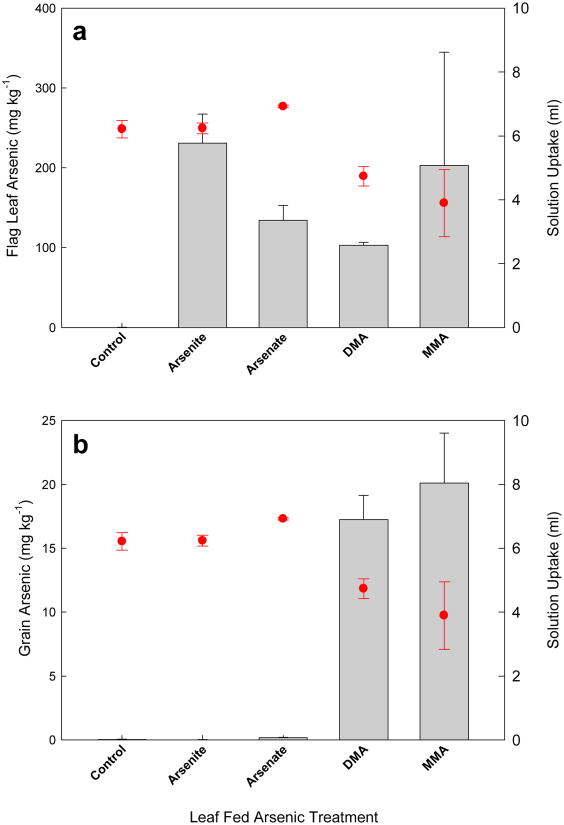
Mean total arsenic (As) concentrations (bars) in (a) flag leaf and (b) grain, for rice panicles exposed to 333 μM of 1 of 5 arsenic treatments together with 1 mM rubidium and strontium. Treatments were delivered through the cut flag leaf on intact plants for 7 d, with a fresh vial applied every 24 h. Total solution uptake is also shown for each treatment (circles). Error bars represent ± SE of three replicates.
Fig. 2
Fig. 2
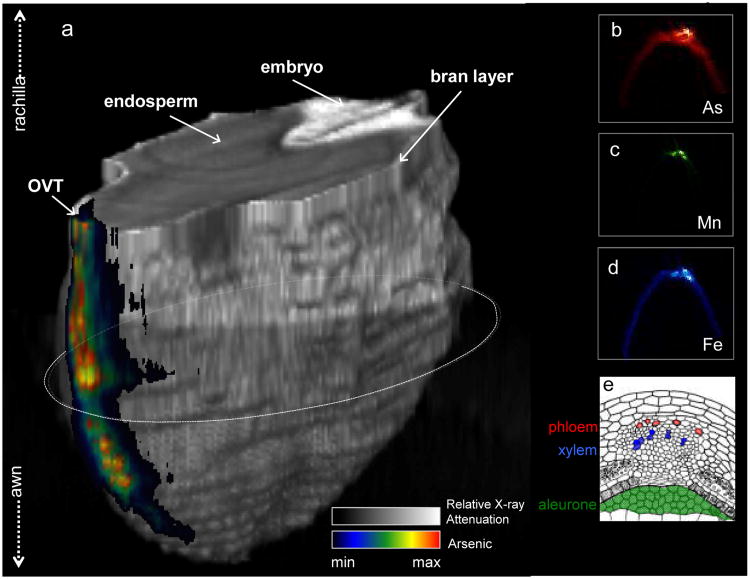
(a) Three dimensional rendering of total x-ray absorption (greyscale colourbar) and arsenic (As) (rainbow colourbar) fluorescence of an immature rice grain pulsed with 133 μM arsenite. (b-d) Individual tomograms of As, manganese (Mn) and iron (Fe) in the ovular vascular trace. (e) Transverse section of ventral side of immature rice grain at rapid grain filling stage (c. 10 DAF) showing the vasculature of the ovular vascular trace, re-printed, with the kind permission of the authors, from Krishnan and Dayanandan (2003).
Fig. 3
Fig. 3
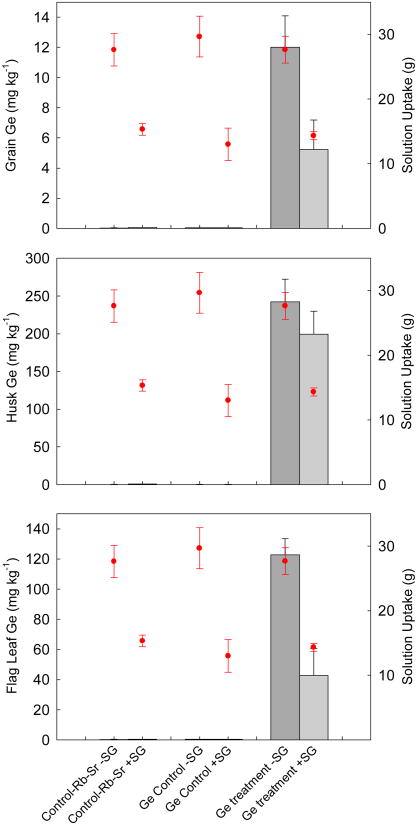
Mean total concentrations of germanium (Ge) in grain (a), husk (b) and flag leaf (c) for excised rice panicles subjected to a ± stem girdling treatment and hydroponically fed, over a 48 h period, nutrient solution amended with 133 μM germanic acid and 1 mM rubidium (Rb) and strontium (Sr); 1mM Rb and Sr only (germanic acid controls) or, for zero exposure controls, no amendment. Total solution uptake is also shown for each treatment (circles). Error bars represent the ± SE of three replicates.
Fig. 4
Fig. 4
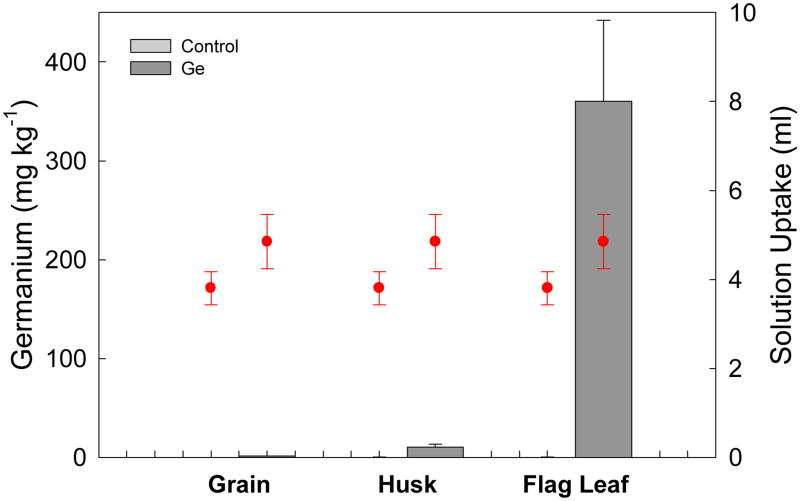
Mean total germanium (Ge) concentrations in flag leaf, grain and husk, for rice panicles exposed to 333 μM germanic acid, and 1 mM rubidium (Rb) and strontium (Sr), through the cut flag leaf on intact plants for 7 d, with a fresh vial applied every 24 h. Total solution uptake is also shown for each treatment (circles). Error bars represent ± SE of three replicates. [Author, please note that the key will be deleted according to our journal style. As it is not possible to distinguish the colour of (supposedly?) pale grey bars, the key was not included in the legend. Please alter the legend if necessary.]
Fig. 5
Fig. 5
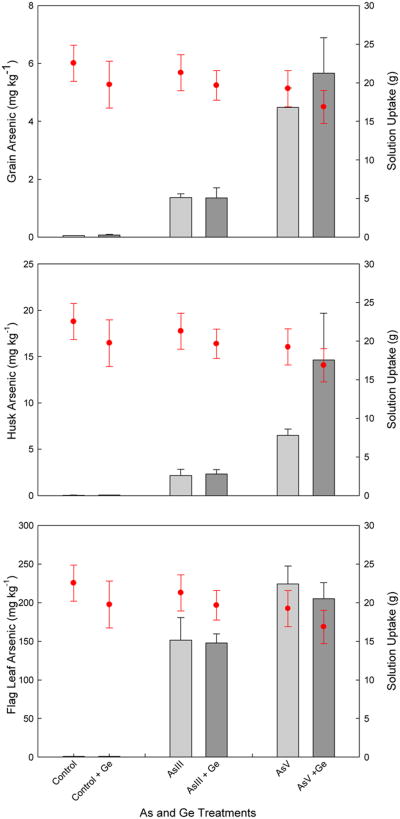
Mean total arsenic (As) concentrations rice grain (top), husk (middle) and flag leaf (bottom) for excised rice panicles hydroponically fed, over a 48 h period, nutrient solution amended with either 133 μM arsenite (AsIII) or arsenate (AsV) together with 1.33 mM germanic acid. Total solution uptake is shown for each treatment (circles). Error bars represent ± SE of three replicates.

References

    1. Abedin J, Cresser MS, Meharg AA, Feldmann J, Cotter-Howells J. Arsenic accumulation and metabolism in rice (Oryza sativa L.) Environmental Science and Technology. 2002a;36:962–968. - PubMed
    1. Abedin MJ, Feldmann J, Meharg AA. Uptake kinetics of arsenic species in rice plants. Plant Physiology. 2002b;128:1120–1128. - PMC - PubMed
    1. Adomako EE, Solaiman ARM, Williams PN, Deacon C, Rahman GKMM, Meharg AA. Enhanced transfer of arsenic to grain for Bangladesh grown rice compared to US and EU. Environment international. 2009;35:476–479. - PubMed
    1. Bleeker PM, Hakvoort HWJ, Bliek M, Souer E, Schat H. Enhanced arsenate reduction by a CDC25-like tyrosine phosphatase explains increased phytochelatin accumulation in arsenate-tolerant Holcus lanatus. Plant Journal. 2006;45:917–929. - PubMed
    1. Carey AM, Scheckel KG, Lombi E, Newville M, Choi Y, Norton GJ, Charnock JM, Feldmann J, Price AH, Meharg AA. Grain unloading of arsenic species in rice (Oryza sativa L.) Plant Physiology. 2010;152:309–319. - PMC - PubMed

Publication types